Introduction to the American Political System Midterm Review Sheet
 Call Kai
 Learn
 Practice Test
 Spaced Repetition
 Match
 Flashcards
 Knowt Play
1/86

There's no tags or description
Looks like no tags are added yet.
Name | Mastery | Learn | Test | Matching | Spaced | Call with Kai | Chat |
|---|
No analytics yet
Send a link to your students to track their progress
87 Terms
Congress
the legislative branch of the federal government. Its primary responsibility is to make federal laws.
Congress is ___, meaning it has two chambers.
bicameral
House of Representatives
Lower chamber.
435 voting representatives.
Representation is based on state population.
Members serve two-year terms.
Revenue bills must originate here.
Senate
Upper chamber.
100 senators.
Every state has two senators, regardless of population.
Senators serve six-year terms.
Elections are staggered so that only some seats are up every two years.
Why have two chambers?
Proportional representation: larger states receive more representatives in the House.
Equal state representation: every state receives two senators.
Voting members of the House
435
Number of Senators
100
Total voting members of Congress
535
Total presidential electors
538
House term
2 years
Senate term
6 years
Length of a Congress
2 years
Critical distinction
535 is the total number of voting members of Congress. The 538 figure is the total number of presidential electors, including three for Washington, D.C.
Washington, D.C., has a ___ delegate in the House and no senators. Its three electoral votes come from the 23rd Amendment, not from having three voting representatives.
nonvoting
Midterm elections
Occur halfway through a president's four-year term. These elections determine congressional seats and can change which party controls one or both chambers.
How a bill enters Congress
A bill is a proposal for legislation.
A bill introduced in the House is labeled H.R.
A bill introduced in the Senate is labeled S.
Only a member of the respective chamber may formally introduce a bill there.
The president, an ordinary citizen, or a governor does not formally introduce a bill in Congress, although they can advocate for proposed legislation.
Basic legislative process

Standing committee
Permanent committee that continues from one Congress to the next.
Select or special committee
Created for a particular issue or purpose; may be temporary.
Joint committee
Involves members from both the House and Senate.
What can committees do?
can hold hearings, investigate problems, review legislation, and decide whether bills advance. A bill may advance, stall, or die in committee.
Speaker of the House
A major leadership position that influences House proceedings and whether legislation reaches the floor.
House Rules Committee
Helps establish the terms for debate on legislation.
Lobbying
Advocacy directed at lawmakers to influence public policy. It is not automatically bribery, although particular gifts or payments may be illegal.
Constituents
People represented by an elected official.
Veto
The president's rejection of a bill.
Congress can override a presidential veto with a___ vote in both chamber
two-thirds
House: 290 of 435, assuming all members are present and voting.
Senate: 67 of 100, assuming all senators are present and voting.
Impeachment
A formal constitutional process for accusing a federal official of misconduct.
The House impeaches; the Senate conducts the trial and votes on conviction.
War powers
The constitutional distinction between saying the country is “at war” and formally declaring war.
Congress has the constitutional power to declare war.
The president is commander in chief of the armed forces.
The president does not possess the constitutional power to formally declare war.
Remember that military action and a formal declaration of war are not the same thing.
Constitutional requirements to become president
Be a natural-born citizen of the United States.
Be at least 35 years old.
Have been a U.S. resident for at least 14 years.
The phrase natural-born citizen does not necessarily mean someone must have been born on U.S. soil; citizenship at birth can depend on circumstances such as a U.S.-citizen parent.
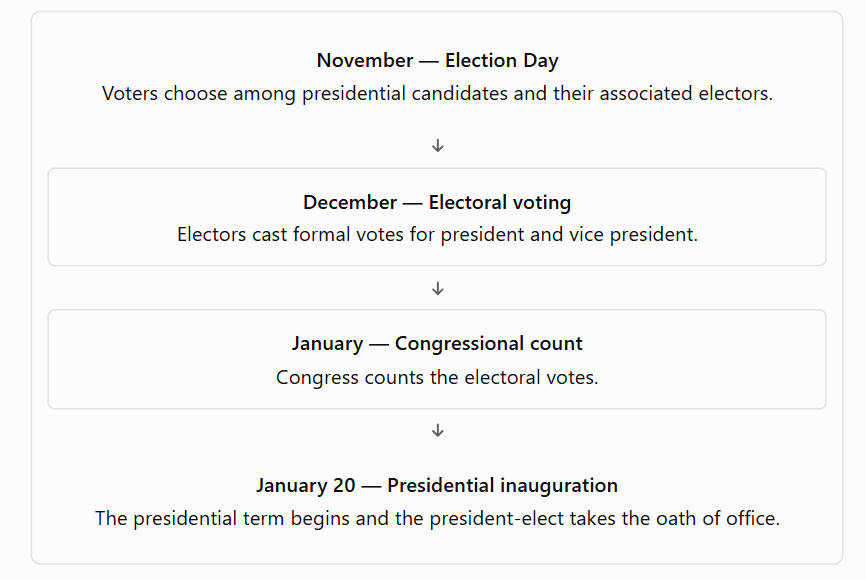
How the Electoral College works (November, December, January, January 20)
Electoral College numbers
Total electoral votes: 538
Majority needed to win: 270
435 electoral votes correspond to House seats apportioned among the states.
100 correspond to the two senators from each state.
3 belong to Washington, D.C.
Winner-take-all rules
In 48 states and Washington, D.C., the candidate who wins the state's popular vote generally receives all of its electoral votes. Maine and Nebraska are exceptions because they can divide electoral votes.
Electoral-vote totals can change after the census because House representation is reapportioned according to population.
Popular vote
The votes cast by individual voters.
Electoral vote
The formal votes cast by electors.
Electoral majority
More than half of all electoral votes; currently 270.
What happens if no candidate wins 270 votes?
This is called a contingent election
For the House to choose the president, a candidate needs votes from a majority of the states—not a majority of all individual representatives.
This means a small state and a large state each have one state delegation vote in the contingent election.
Your notes identify the election of 1824 as a historical example: Andrew Jackson received the most popular and electoral votes, but no electoral majority; the House selected John Quincy Adams.

Presidential succession
President of the United States
Vice president
Speaker of the House
President pro tempore of the Senate
Cabinet members, in statutory order
The vice president is the president of the Senate and can cast a tie-breaking vote there.
The president pro tempore is a separate Senate position, generally held by a senior senator.
The vice president may become president if the president dies, resigns, or otherwise cannot continue in office. The succession framework is governed by the Constitution and federal law, including the Presidential Succession Act of 1947.
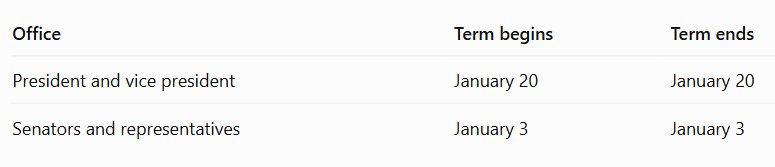
The 20th Amendment establishes
the relevant start and end dates for federal terms.
The Office Term beginning and end
The times specified in the amendment are noon.
Air Force One
The call sign used when the president is aboard an Air Force aircraft. It is not simply the permanent name of one particular plane.
Marine One
The call sign used when the president is aboard a Marine Corps aircraft.
Federal Reserve
The U.S. central banking system, established by the Federal Reserve Act of 1913. The dollar is fiat currency rather than currency redeemable for a fixed quantity of gold.
Federalism
the division and sharing of governmental power between the national government and state governments.
Delegated powers
Powers granted to the federal government by the Constitution.
Example: Declaring war and raising armed forces.
Reserved powers
Powers left to the states or the people.
Examples: Powers not delegated to the federal government or prohibited to states.
Concurrent powers
Powers exercised by both federal and state governments.
Example: Taxation is a common example.
Why federalism matters
Federalism determines which level of government can act on a particular issue. Disagreements can arise when federal and state policies conflict.
Example: state policies allowing medical marijuana while federal drug law prohibits it. The key lesson is that state permission does not automatically prevent federal enforcement of federal law.
Constitutional powers
Congress's power to declare war: Article I, Section 8, Clause 11.
Congress's powers relating to raising and supporting armed forces: Article I, Section 8, Clauses 12–14.
Federalism and the courts
When different federal appeals courts reach conflicting interpretations of federal law, the Supreme Court may review a case and resolve the disagreement.
Circuit split
A disagreement between federal appellate courts about a legal issue. Resolving such conflicts helps promote consistent federal law across the country.
three main levels of federal courts
U.S. Supreme Court (SCOTUS)
U.S. Courts of Appeals
U.S. District Courts

U.S. Supreme Court (SCOTUS)
The highest federal court and the highest federal appellate court.
U.S. Courts of Appeals
Also called circuit courts; review lower-court decisions.
U.S. District Courts
Trial courts — generally where federal cases begin
Federal judges
The president nominates federal judges, including Supreme Court justices. The Senate must approve nominations through its advice-and-consent role.
Federal judges generally serve during good behavior rather than fixed terms. They can leave office through retirement or death and can be removed through impeachment and conviction.
Judicial review
The power of courts to determine whether laws or government actions are consistent with the Constitution.
It is associated with Marbury v. Madison (1803).
If a law or government action is found unconstitutional, it cannot be enforced to the extent of the constitutional conflict.
Major Supreme Court cases

How the Supreme Court selects cases
A party generally asks the Supreme Court to review a case by filing a petition for a writ of certiorari.
Certiorari granted: The Court agrees to hear the case.
Certiorari denied: The Court declines to hear it.
Rule of Four: At least four of the nine justices must vote to hear a case.
A denial of certiorari does not mean the Supreme Court has endorsed the lower court's reasoning as nationwide precedent. The lower-court ruling remains in effect for that case.
The Court often considers nationally important questions, conflicts between appellate courts, and cases involving major questions of federal law.
Certiorari granted
The Court agrees to hear the case.
Certiorari denied
The Court declines to hear it.
Rule of Four
At least four of the nine justices must vote to hear a case.
Jurisdiction
A court's authority to hear a case; the lecture also emphasizes location.
Appeal
A request for a higher court to review a lower-court decision.
Appellant
The party seeking appellate review.
Petitioner
A party asking a court to take action, including review by certiorari.
Respondent
The opposing party in a proceeding.
Precedent
An earlier judicial decision used as authority in later cases.
Circuit split
A disagreement among federal appellate courts about the law.
Civil versus criminal cases

Civil case
A legal dispute between people or organizations, usually involving money, property, or rights. Example: Someone sues another person for damages after a car accident.
Criminal case
A case where the government prosecutes someone for breaking the law. Example: Someone is charged with theft and may face fines or jail time.
Violation
A relatively minor offense. Your lecture uses a traffic or speeding ticket as an example.
Misdemeanor
A criminal offense generally less serious than a felony, but potentially punishable by jail time.
Felony:
A serious criminal offense. Examples from class include murder, arson, robbery, and rape.
Grand jury
Your notes describe a grand jury of 23 people.
Reviews the prosecution's evidence.
Determines whether there is sufficient probable cause to indict.
Proceedings are secret.
Does not decide guilt or innocence.
Trial jury (petit jury)
Hears evidence at trial.
Evaluates the case.
Determines the verdict of guilty or not guilty in a criminal trial.
Probable cause
A sufficient factual basis to believe that a crime may have been committed or that a legal threshold for action has been met.
Indictment
A formal accusation that someone committed a crime.
True bill
The grand jury votes to indict.
No true bill
The grand jury declines to indict on that presentation.
Voir dire
Questioning prospective jurors to assess their suitability and impartiality.
Subpoena
A legal order requiring someone to provide testimony or documents.
Fourth Amendment
Protection against unreasonable searches and seizures; warrants require probable cause.
Fifth Amendment
Right against compelled self-incrimination, including the right to remain silent.
Sixth Amendment
Right to counsel in criminal prosecutions, among other trial protections.
Constitutional religion provisions