Latent Prints Week 1
 Call Kai
 Learn
Learn Practice Test
 Spaced Repetition
 Match
Match Flashcards
 Knowt Play
1/117

Earn XP
Description and Tags
FRSC 350 - Lisa Gilbert
118 Terms
What can fingerprintings be used for?
In both criminal cases (for suspect connection to crimes) and non-criminal cases (identification).
Revisit: What is Locard’s Triangle/Principle?
The idea that everything leaves a trace. Connects the victim, suspect, crime scene.

What is Locard’s principle in relation to fingerprints?
Fingers come into contact with an item there could be a transfer of fingerprint residue in the form of that person’s friction ridge skin.
What were fingerprints used/found in ancient times?
As artwork signatures, in Chinese Babylonian times, by megalithic builders in Western Europe like the tombs in Brittney.
Why is knowing fingerprint history important?
Knowing it gives insight on how it was discovered and integrated into criminal justice.
Who is Sir William Herschel?
The second son of a well respected English family who was the first person to practice fingerprinting.
What sparked Sir William Herschel’s idea of fingerprinting in criminal use?
He attended a funeral ritual where the spouse would leave a red handprint on the wall near the cremation area before jumping into the fire themselves. The print was chiseld out of the wall and became a sign of immortality.
When and where did Sir William Herschel begin his fingerprinting?
In the Hooghly district of India in 1853.
What was Sir William Herschel’s first fingerprinting usage? When? Why?
Since he would have trouble with felons showing up for their trials, he would take a fingerprint before they would leave like a contract and also a means for them to be found incase they did not show up.
Why was Sir William Herschel’s prevention tactic with fingerprints a fail?
The idea was there, but what would stop them from not showing up and how he was going to find them became the issue.
Who was Dr. Henry Faulds?
A religious medical doctor that experiemented with permanence and convictions with fingerprints.
What was Dr. Henry Faulds’ fingerprint permanence experiment?
He asked his trainee’s to rub their skin off to see if the prints would grow back the same way as they used to be.
What were two of Dr. Henry Faulds’ fingerprint convictions?
A greasy fingerprint on a liquor bottle
A print left on a white wall of wet paint
Who and when did Dr. Henry Faulds write to? Why?
A letter to Nature Magazine in 1880 proposing the usage of fingerprinting criminal cases.
Who was Alphonse Bertillon?
A clerk at the national police office who delt with repeat offenders aroudn the time where branding inmates was being considered.
What was Alphonse Bertillon’s theory?
His anthropometric system theory where no two people’s measurements are exactly alike and unchanged at a certain point which can be used for identification.
What case disproved Alphonse Bertillons antropometric measurement system?
The Will/William West Case where a set of identical twins did infact share identical measurements.
Who was Charles Darwin?
An English biologist known for his evolution theory.
Who (list all) inquired Charles Darwin about fingerprints? Did he go through with it?
The Royal Academy of Science and Dr. Faulds both asked him to conduct research comparing fingerprinting to anthropomentrics.
Who did Charles Darwin recomend after denying the research inquiry?
Sir Francis Galton.
Who is Sir Francis Galton?
A geneticist who is credited for fingerprint reserach even though he was not the pioneer.
What was Sir Francis Galton’s original theory on fingerprint uniqueness?
He originally throught there would be minimal difference between prints from person to person, which he later retracted.
What was Sir Francis Galton’s most famous theory?
The theory of uniqueness and permanence of fingerprints.
What did Sir Francis Galton originally name minutia?
Galton’s Details.
What were Sir Francis Galton’s years of fingerprinting activity.
1882-1892.
What were the overarching ideas of Sir Francis Galton’s book?
Suggested that anthropometrics was unworkable and suggested the ALW (arch, loop, whorl) system of classification while demonstrating that all prints were different (1:64 billion).
Who’s work/research did Sir Francis Galton use as starting points?
Marcello Malpighi - 1685
J.C.A. A Maher 1788
Johannes E. Purkinji - 1823
Dr Henry Faulds - though he was never given credit
Who was Juan Vucetich?
An Argentinian clerk in the Bertillon unit.
What did Juan Vucetich develop?
A handmade classification and identification system - similar to AFIS - in 1891-’92 deemed as the first, and largest of it’s kind.
What case did Juan Vucetich’s work help most famously? Where and when did it take place?
Francisca Rojas case in 1892 for the muder of her children in LaPlata.
Who was Sir Edward Henry?
An English man sent to study in the Bengal district of India.
What was Sir Edward Henry’s conrtibution to fingerprinting? When did it come about?
Developed a classification system from 1895-’99, which he later published in 1901.
Where did Sir Edward Henry share his findings?
In the 1904 World Fair presented in St. Louis.
Why was Sir Edward Henry’s first request to go to the world fair denied originally?
It intervened with the current belief of anthropometrics.
Who was John Kenneth Ferrier?
A seargent in Scotland Yard Fingerprint Bureau in change of setting crown jewels in the World Fair 1904.
What did John Kenneth Ferrier do professionally?
He was mainly a lecturer, he was set to ensure that any fingerprint infomration was shared correctly - he had 9 core students but lectured all around.
What case turned police speculation on fingerprints far around?
The “lord” Barrington case.
Who/how many were John Kenneth Ferrier’s main students?
Mary Holland
Emmet Evans
Edward Evans
Who was Mary Holland?
The co-publisher of the Detective Magazine who was a trained navy seal, and became a professor in fingerprints after getting knowleddge from John Kenneth Ferrier.
Who were Emmet and Edward Evans?
The sons of the 8×8 card inventor, Micheal Evans, who started using this identification system in 1905.
What was the Jennings trail in 1910?
A home invasion and murder where a man was caught by leaving his prints on a newly painted railing. This case was based on fingerprint identification and expert testimony and was later appealed in 1911.
What is the larget organ in the body?
The skin.
What are the two layers of the skin? At what rates do the develop?
The epidermis and the dermis, both of which develop simultaneously during the first trimester of a pregnancy.
What are some of what the skin is for?
Protection from pathogens, excretions of waste, sensation, fluid and nutrient balance, and temperature maintaining.
What parts of the body are not covered in hair?
The palms, soles of the feet, and lips.
Who named the five layers of the epidermis?
Marcello Malpighi.
What kind of injury to the skin leaves a scar?
One that penetrates through all 5 layers of the epidermis and reaches the dermis.
What is friction ridge skin?
Skin that covers the hands and feet in a series of peaks and valleys - the raised areas are the valleys and the lower areas are the land.
What are characteristics of friction ridge skin?
It has no hair follicles or oil glands, large number of sweat pores, and a high concentration of sensory nerves.
What is ridge flow? What is it’s downside?
The determination of patterns in prints, however this determination by itself cannot be used as identifiable.
What can be used to identify fingeprints?
Minutia characteristics of a print that ma minutia like thier size, shape, and spatial relationship.
What are volar pads?
Swellings in the mesenchymal tissue where fingerprints develop in gestation.
What are the weeks for fingerprint creation during gestation?
Elevations on fingerprints start to form at around 6.5 weeks
Primary volar pads and friction ridges start to from around 10.5 week point
Fingerprints are fully determined by 16/17 weeks in
Friction ridges become distinct at 26 weeks
How do friction ridges form?
Sweat glands begin to form in the fetus and that is when skin cells fuse around the pore to create ridge units, which later turn into the actual ridges.
What are ridge units?
Small sections of preformed ridge that form an outline for where the ridges will form.
What is differential growth?
The term for development of fingerprint uniqueness in vitro.
How does differential growth occur?
Pretty randomly, can be caused by both hereditary influences like volar placement, and external influences like the mother’s diet or physical stress.
What kind of volar pad height coresponds to what kind of ridge flow one has?
High pads - end in whorls
Medium pads with steep radial sides - loops
Low pads - arches
Where can volar pads be found in the hands?
Fingertips
Interdigital region - under the fingers
Thenar region - under the thumb
Hypothenar region - on the lateral-most side
Where can volar pads be found in the feet?
Toe tips
Interdigital region - under the fingers
What are the functions of friction ridge skin?
Protection, moisture retainment, allows for gripping friction.
What kind of system is friction ridge skin?
A papillary system where a double row of papillae provide support to each ridge.
What is the anatomy of a ridge?
An outline around sweat pores with a non-uniform edge.
What are the main ridge characteristics?
Bifurcations
Ridge endings
Dots
About how many ridge characteristics can be found per fingerprint?
About 75-150.
How many sweat pores are in each sq. inch of friction ridge skin?
About 2700.
What is tthe function of sweat pores in friction ridge skin?
In the process of gripping by keeping the skin moist by consistenly perspirating.
What can an expert do in terms of ridge length?
Determine the amount of ridge units per ridge.
What is the study of ridge edges called?
Edgeoscopy.
What is the study of sweat pores called?
Poreoscopy.
What percentage of fingerprints are loops?
65%.
What percentage of fingerprints are whorls?
30%.
What percentage of fingerprints are aches?
5%.
What is the composition of palmer sweat?
99-99.5% of it is water and the remainder are dissolved solids.
What are the dissolved solids from palmer sweat?
A 50/50 mixture of inorganic (chlorides like K and Na) and organic (amino acid and B complex vitamis) materials.
What is the purpose of palmer sweat?
Removes waste from the body and protects the skin.
What are some enviornmental factors that could affect fingerprints?
Sun damage or line of work (construction, sewing, etc.)
What is a trauma factor that could affect fingerprints?
Cuts.
Which trauma factors on fingerprints could become permanent?
The cuts that go past the epidermal layer of skin could lead to scarring.
What are the three categories of print patterns? Are these the only ones?
Loops
Arches
Whorls
They are technically not the only ones as they each have sub-categories.
Where are patterns in fingerprints found?
On the tips or bases of fingers and the lower palm.
What is the purpose of pattern recognition in fingerprints?
To eliminate rather than identify, decreases suspect pool by cutting out the prints that do not match the overall pattern before minutia searching.
What do fingerprint classification systems allow for?
The filing and retrieval of fingerprint cards (now digitally) by developing rules of organization for their patterns.
What was the first classifcaition system called? What is used now?
The Henry System, we now use a more modern version of it and the original version is pretty much extinct.
What is the common classification system that is mostly used in South America?
The Vucetich System.
Which fingerprint classification system is known to be more practical?
Vucetich System
What is the finger numbering order?
1 is the right thumb, follow the right hand and then start at 6 on the left thumb, ending with the left little finger.
What is ridge count?
The total number of ridges in the imaginary line from the core to the delta of a loop pattern.
What is the core of a fingerprint pattern?
The innermost recurving ridge of a loop or a whorl patterned print.
What is a type line in a fingerprint?
The two innermost ridges that essentially outline the pattern area on a print.
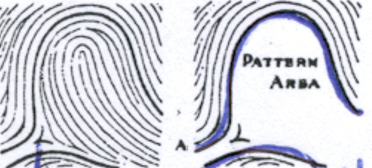
What is a delta?
The point in divergence of the type lines.
What kind of print does not have any deltas or type lines?
Arches.
How do prints change overtime?
Ridges become less pronounced and creases get deeper with age.
What are pattern types on palms?
Palms may have similar AWL strcutures on the interdigital area, thenar, and hypothenar areas since those places used to be volar pads as well.
What is an anchor?
An eye-catching area on a print that draws the analyzer to look in that area first.
How do loops on the palm differ from that of the fingers?
They are different strtcutres and much less go around each other, they are characterized by a ridge coming in and going out in the same place but could just be one.
What is a delta?
An area in which ridges are going in 3 directions.
What is unique about pinky and index fingers in palmar prints?
Ridges under them are straighter than normal
Have martini glass looking curves in the ridges
Can be differentiated from left to right from the ridges around this print the best
What is a flexion crease?
The creases that make up the main part of the body.
What is the NCIC?
The National Crime Information Center.