Chemistry- Topic 7 (Sc18/19) > Rates of Reaction and Energy Changes (Y10 autumn)
 Call Kai
 Learn
Learn Practice Test
 Spaced Repetition
 Match
Match Flashcards
 Knowt Play
1/24

There's no tags or description
Looks like no tags are added yet.
Name | Mastery | Learn | Test | Matching | Spaced | Call with Kai | Chat |
|---|
No analytics yet
Send a link to your students to track their progress
25 Terms
In order for reactions to occur…
the reactant particles must collide together with enough energy for a successful collision
the more successful collisions…
the higher the reaction rate
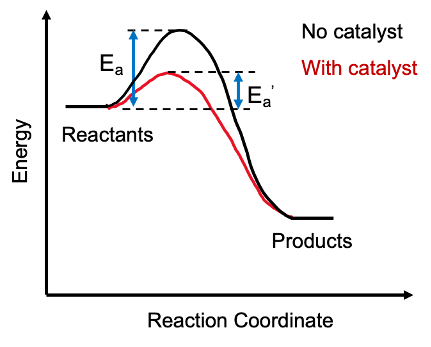
activation energy
minimum amount of energy required for reactant particles to react
Factors affecting rate of reaction
TEMPERATURE > particles move faster and have enough energy
SURFACE AREA > particles have more area to collide with
CONCENTRATION > more reactant particles in the same volume
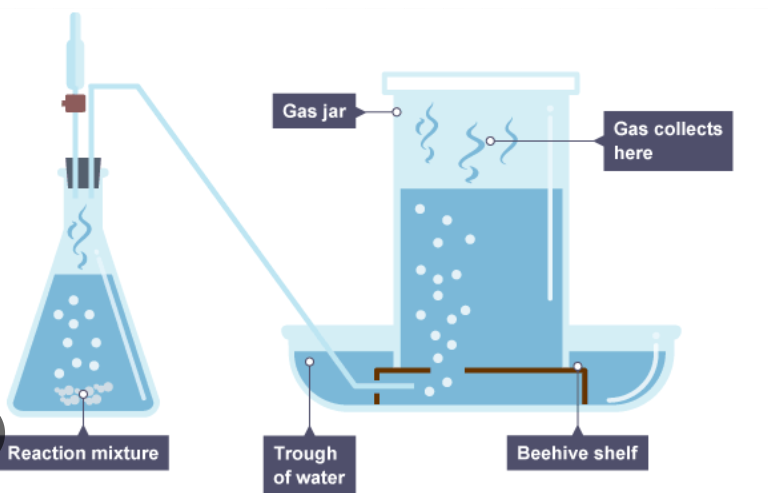
Methods for finding rate of reaction for GASES
measure time and decrease of mass as Gas escapes using a balance
measure time and collect gas in an upturned measuring cylinder in a trough of water
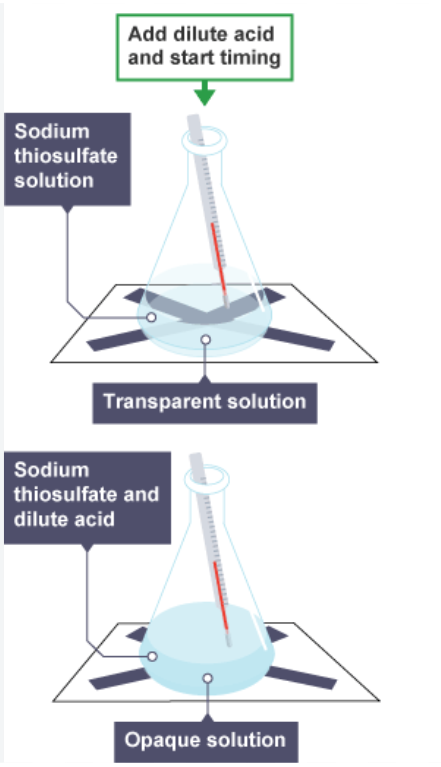
Method for finding rate of reaction for PRECIPITATE
Place reactant mixture over a black cross and time how long it takes for the mixture to go opaque and the cross is no longer visible
CORE PRACTICAL: Affect of SA on reaction rate: Equation
Calcium Carbonate(marble chips) + Hydrochloric acid > Calcium Chloride+ Water + Carbon Dioxide
CORE PRACTICAL: Affect of SA on reaction rate: Simple method
- Add reactants to flask and place bung back quickly
- Record volume of gas collected at regular time intervals until reaction has finished
- Repeat for small/large marble chips
CORE PRACTICAL: effect of Temperature on reaction rate: Equation
Sodium Thiosulfate + Hydrochloric acid > sodium chloride + water + sulphur dioxide + Sulphur
CORE PRACTICAL: effect of Temp on reaction rate: Simple Method
Add reactants and start stopwatch
Stop when the cross is no longer visible
This is because Sulphur forms a precipitate making the solution opaque
How can you calculate Rate of Reaction from a graph
rate of reaction = gradient
draw tangents for specific times
catalyst
a substance that speeds up a reaction without getting used up in the process
what do catalysts do?
Catalysts LOWER activation energy of a reaction, so less energy is needed for particles to react when they collide
Exothermic Reactions
A reaction that RELEASES heat energy into the surroundings
increase in temperature of surroundings
Endothermic Reactions
A reaction the ABSORBS heat energy from the surroundings
decrease in temperature of surroundings
Exothermic Reaction profile
Energy of Reactants is higher than energy of Product because heat is RELEASED

Endothermic Reaction Profile
Energy of Reactants is lower than the products because heat is ABSORBED

How can you measure TEMP CHANGE in heat reactions
By using a polystyrene cup surrounded by cotton wool since they are INSULATORS so heat doesn’t dissipate and a Lid so heat can’t escape
Record the initial and final temp to find temperature change

Types of reaction with heat energy
Salts dissolving in water> endo/exo
Neutralisation> exo
Displacement> exo
Precipitation> exo
what happens to bonds in reactants
they BREAK, which requires energy
what happens to bonds in products
they FORM new bonds, which releases energy
what happens to Bonds in EXOthermic reactions
energy RELEASED by forming bonds is greater than energy required to break bonds
what happens to bonds in ENDOthermic reactions
energy REQUIRED to break bonds is greater than energy released by forming bonds
what does it mean if the Overall energy change is NEGATIVE
the reaction is EXOTHERMIC
Overall Energy Change
Energy REQUIRED - Energy RELEASED