Lesson 77: Liver Functions
 Call Kai
 Learn
 Practice Test
 Spaced Repetition
 Match
 Flashcards
 Knowt Play
1/87

There's no tags or description
Looks like no tags are added yet.
88 Terms
The liver is the largest internal gland and one of the most metabolically active organs in the body. It occupies a central position in the regulation of:
energy metabolism, nutrient processing, synthesis of plasma proteins, lipid and cholesterol and AA and bilirubin metabolism
nitrogen disposal
vitamin and mineral homeostasis, and biotransformation of endogenous and exogenous compounds
Major functions of the liver: carb metabolism
Glycogenesis, Glycogenolysis, Gluconeogenesis, Glycolysis
Regulation of blood glucose
Major functions of the liver: lipid metabolism
Fatty acid oxidation
Fatty acid, TG, cholesterol, lipoprotein synthesis
Cholesterol elimination
Ketogenesis
Major functions of the liver: protein and AA metabolism
Amino acid uptake
Transamination, Deamination
Urea and Plasma protein synthesis
Acute-phase protein production
Major functions of the liver: bilirubin metabolism
Uptake, Conjugation, Excretion
Major functions of the liver: vitamin metabolism
Storage, Activation, Metabolism, Transport
Major functions of the liver: mineral metabolism
Iron, Copper, Zinc
Major functions of the liver: biotransformation
Phase I reactions
Phase II reactions
Phase III transport/excretion
Major function of the liver: Endocrine and hormonal metabolism
Metabolizes hormones
Produces hormone-binding proteins
Participates in IGF-1 production
Converts or regulates several biologically active compounds
Functional organization of the liver: functional unit is the Hepatic lobule
Blood enters it from branches of the portal vein and hepatic artery and flows through sinusoids toward the central vein
bile flows in the opposite direction through bile canaliculi toward the portal triads
Liver blood supply: Hepatic portal vein(Supplies approximately 70–75% of hepatic bloodflow)
carries glucose, amino acids, fatty acids, nutrients, gut-derived metabolites, microbial products, some toxins, and drugs absorbed from the GIT
Liver blood supply: Hepatic artery provides approximately
25–30% of blood flow but contributes a substantial proportion of the liver's oxygen supply
Hepatocytes perform most of the metabolic functions: They contain abundant
Mitochondria, smooth ER, rough ER, peroxisomes, lysosomes, and Golgi apparatus
This organelle-rich structure reflects the extensive metabolic work performed by the hepatocytes

Zone 1 – Periportal
Closest to the portal triad
Receives relatively oxygen-rich blood
What is zone 1 important for?
Oxidative metabolism
Gluconeogenesis
Fatty-acid oxidation
Urea synthesis
Zone 2
Intermediate metabolic characteristics
Zone 3 – Centrilobular/pericentral
Closest to the central vein. Receives relatively less oxygen
vulnerable to hypoxia
What is zone 3s function?
Glycolysis
Lipogenesis
Ketogenesis
CYP450-mediated drug metabolism
Diagram of the zones

Liver absorptive phase: timeframe
Lasts roughly 4 hours after eating a meal, while nutrients pass through the gastrointestinal tract and enter the blood
Liver absorptive phase: primary hormone
Insulin spikes in response to rising blood glucose and AA levels, driving anabolism (building up stores) and nutrient uptake
Function of the absorptive phase:
Carbohydrate, Lipid, Protein Metabolism
Liver postabsorptive phase: timeframe
Begins roughly 4 hours after a meal(when gut absorption is complete) and lasts until
the next meal
Liver postabsorptive phase: primary hormone
Glucagon (along with a drop in insulin and a rise in counter-regulatory hormones like epinephrine and cortisol) signals the release of stored energy
Function of the postabsorptive phase of the liver
Carbohydrate & Glucose Pathways
Gluconeogenesis
Lipid Metabolism (Glucose-Sparing)
Glycogenesis
biological process of creating glycogen from excess glucose molecules for energy storage
occurs primarily in the liver and skeletal muscles when blood glucose is relatively high, such as after feeding
Purpose of glycogenesis
key enzyme is glycogen synthase
Keeps blood sugar stable and stores energy for future use
Glycogenesis trigger
Stimulated by the hormone insulin when blood sugar levels are high, such as after a meal
Insulin Promotes:
Glucose uptake/use, Glycogenesis, Lipogenesis
Insulin inhibits
Glycogenolysis
Gluconeogenesis
Glycogenolysis
Breakdown of glycogen into glucose-1-phosphate and glucose to provide immediate energy and maintain blood sugar levels
liver is particularly important because it can release free glucose into the circulation
A key distinction between the liver and skeletal muscle is that?
hepatocytes have glucose-6-phosphatase, which converts glucose-6-phosphate
to glucose, allowing it to enter the bloodstream
Skeletal muscle lacks sufficient glucose-6-phosphatase for this purpose and primarily uses its glycogen for its own energy needs
Hormonal regulation of glycogenolysis: Glucagon
Released by the pancreas during fasting or low blood sugar; stimulates glycogenolysis specifically in the liver to raise blood glucose
Hormonal regulation of glycogenolysis: Epinephrine (Adrenaline)
Released by the adrenal glands during stress or exercise; stimulates glycogenolysis in the liver and skeletal muscle
Hormonal regulation of glycogenolysis: Insulin
Released after a meal when blood sugar is high; it inhibits glycogenolysis and promotes glycogen storage (glycogenesis)
Liver creates new glucose from non-carbohydrate sources to keep blood sugar stable: It is particularly important during
Fasting, Prolonged exercise, Starvation, Increased metabolic demand
Major gluconeogenic substrates include:
Lactate, Glycerol, Glucogenic amino acids
Propionate in ruminants
Propionate is the major glucogenic volatile fatty acid
converted in the liver to: Propionate → Succinyl-CoA → Oxaloacetate → Glucose
Hepatic gluconeogenesis is essential for?
maintaining glucose homeostasis in ruminants
Fed state: Insulin dominates
The liver promotes: Glycogenesis, Glycolysis, Lipogenesis, Protein synthesis
Fasting state: Glucagon and other counter-regulatory hormones dominate
liver promotes: Glycogenolysis, Gluconeogenesis, Fatty-acid oxidation, Ketogenesis
Lipid metabolism: fatty acid uptake
Process by which hepatocytes absorb circulating non-esterified free fatty acids to regulate energy balance, lipid storage, and lipoprotein secretion
Fatty acids reach the liver from:
Dietary lipids, Adipose tissue, Lipoproteins, De novo synthesis
During fasting, adipose tissue releases non-esterified fatty acids into the circulation. The liver takes them up and decides whether to:
Oxidize them
Convert them into triglycerides
Incorporate them into phospholipids
Produce ketone bodies
Beta-oxidation is the mitochondrial metabolic pathway that breaks down?
fatty acid molecules two carbons at a time to generate acetyl-CoA, NADH, and FADH₂.
Each cycle removes a two-carbon unit as: Acetyl-CoA
while producing: NADH, FADH₂
NADH, FADH₂
These reducing equivalents generate ATP through oxidative phosphorylation
Fatty acid synthesis
building of fatty acids from acetyl-CoA and malonyl-CoA using NADPH to store energy and form cell membranes
Location and transport of fatty acid synthesis: Cytosol
De novo synthesis happens in the cell cytoplasm, mainly in the liver and fat tissue
Location and transport of fatty acid synthesis: Citrate Shuttle
Acetyl-CoA is made inside mitochondria but cannot cross the membrane directly
It leaves the mitochondria as citrate (bound with oxaloacetate)
Location and transport of fatty acid synthesis: Cytoplasmic Release
In the cytosol, ATP citrate lyase breaks citrate back down into acetyl-CoA and oxaloacetate
Fatty acid synthesis is primarily regulated at the rate-limiting carboxylation step catalyzed by the enzyme acetyl-CoA carboxylase (ACC)
Insulin: Stimulates lipogenesis
Glucagon: Inhibits lipogenesis and promotes mobilization/oxidation of stored energy.
An important regulatory molecule is: Malonyl-CoA
Triglyceride synthesis (lipogenesis) is
the metabolic pathway that builds triglycerides from a glycerol backbone and three activated fatty acids for energy storage.
The liver can esterify fatty acids with glycerol-derived substrates to form triglycerides.
Main Classes of Lipoproteins: Chylomicrons
The largest and least dense particles; they carry fats from the intestines into the
bloodstream or lymphatic system
Main classes of lipoproteins: VLDL (Very-Low-Density Lipoproteins)
Made by the liver to carry newly made fats to tissues
Main classes of lipoproteins: IDL (Intermediate-Density Lipoproteins)
Formed when VLDL loses some of its fat
Main classes of lipoproteins: LDL (Low-Density Lipoproteins)
Rich in cholesterol; they deliver cholesterol to cells (often called "bad" cholesterol).
Main classes of lipoproteins: HDL (High-Density Lipoproteins)
The densest particles; they bring extra cholesterol back to the liver (often called "good" cholesterol)
Lipoprotein metabolism is divided into?
Exogenous Pathway (processing dietary fats from the gut)
Endogenous Pathway(processing lipids synthesized inside the body, mainly by the liver)
Cholesterol synthesis is a multi-step biochemical pathway that builds?
a 27-carbon sterol molecule from acetyl-CoA in the cytosol and endoplasmic reticulum of mammalian cells
The rate-limiting enzyme is: HMG-CoA reductase
Bile acid synthesis: The primary pathway for the catabolism and excretion of cholesterol
Converts cholesterol into water-soluble primary bile acids(cholic acid and chenodeoxycholic acid)
essential for lipid digestion, cholesterol excretion, and systemic metabolic signaling
Enterohepatic Circulation
The recycling pathway where bile acids, bilirubin, and certain drugs travel from the liver into the bile and small intestine, get reabsorbed into the portal vein, and return to the liver
Enterohepatic circulation: Bile Acid Conservation
Bile acids are reabsorbed in the terminal ileum and returned to the liver via the portal vein
Enterohepatic circulation: Fat and Vitamin Digestion
Recycling ensures a steady, high concentration of bile salts in the duodenum to emulsify dietary fats and support the absorption of fat-soluble vitamins (A, D, E, and K)
Enterohepatic circulation: Cholesterol Homeostasis
bile acids are synthesized from cholesterol, the small fraction lost daily in feces represents the primary pathway for excreting excess cholesterol
Enterohepatic circulation: Energy Conservation
Reusing bile salts saves significant metabolic energy and synthetic resources that the hepatocytes spend on continuous de novo production
Ketogenesis
Production of ketone bodies from acetyl-CoA in the mitochondria of liver cells as an alternative fuel for the brain, skeletal muscle, and cardiac muscle during prolonged fasting
Beta-hydroxybutyrate:
The most abundant ketone body circulating in the blood
Acetoacetate
The primary ketone body formed early in the pathway
Acetone
A volatile byproduct formed by the spontaneous or enzymatic decarboxylation of acetoacetate; it is exhaled through the lungs
Physiological Triggers & Regulation of ketogenesis
Low blood glucose, fasting, starvation, prolonged exercise, or a low-carbohydrate ketogenic diet
Hormonal control of ketogenesis
Upregulated by a low insulin-to-glucagon ratio, elevated cAMP, and glucagon signaling; inhibited by insulin
Ketogenesis: liver limitations
The liver cannot utilize ketones for fuel; instead, it exports them to the brain, heart, and skeletal muscle.
Ketosis (hyperketonemia)
metabolic disorder in vet med, most frequently diagnosed in high-producing dairy cows during early lactation, as well as in pregnant sheep and goats (pregnancy toxemia)
Process of ketosis
extreme negative energy balance → animal's dietary carbohydrate intake cannot keep pace with the massive glucose demands of milk production
deficit triggers the intense mobilization of body fat reserves, inundating the liver and resulting in the excess production of toxic ketone bodies like beta-hydroxybutyrate (BHB), acetoacetate, and acetone
Protein and AA digestion and absorption
Proteins break down in the stomach via hydrochloric acid and pepsin, then in the small intestine via pancreatic enzymes and peptidases into free amino acids
Protein and AA metabolism: The Amino Acid Pool
Free amino acids come from diet, tissue protein turnover, and de novo synthesis. The body cannot store excess amino acids; they are used for synthesis, converted to glucose or fatty acids, or catabolized
Transamination:
Transfer of an amino group from an amino acid to an α-keto acid (α-ketoglutarate) via aminotransferases (ALT, AST)
form new nonessential amino acids or keto acids
Deamination
Removal of the amino group (yielding free ammonia/ammonium) in the liver via glutamate dehydrogenase
The Urea Cycle
Toxic ammonia is converted into non-toxic urea in the liver through the five-step urea cycle and excreted by the kidneys in urine
Protein and AA metabolism: Glucogenic Amino Acids
Converted to pyruvate or citric acid cycle intermediates(like oxaloacetate) to fuel gluconeogenesis
Protein and AA metabolism: Ketogenic Amino Acids
Converted to acetyl-CoA or acetoacetyl-CoA (such as leucine and lysine) to produce ketone bodies or fatty acids
Liver specific functions: protein synthesis
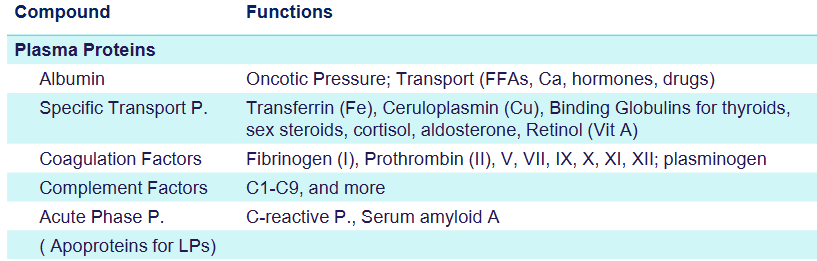
Liver specific functions: Hormones

Liver specific functions: carb synthesis

Liver specific functions: Lipid synthesis
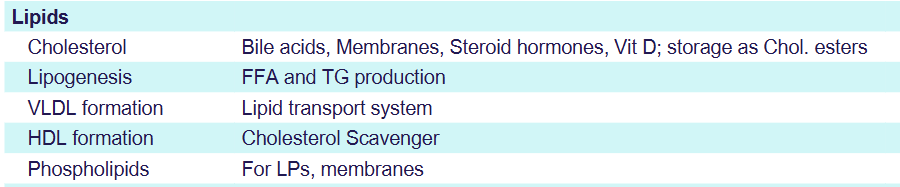
Liver specific functions: biotransformation and detoxification

Liver specific functions: storage
