"All righty" Maths
 Call Kai
 Learn
 Practice Test
 Spaced Repetition
 Match
 Flashcards
 Knowt Play
1/28

There's no tags or description
Looks like no tags are added yet.
29 Terms
What are the 3 equations for straight lines and what are their use cases?
y - y1 = m(x-x1) —> use THIS formula to calculate equation of a line
y = mx+c —> necessary to plot linear graphs (it tells us the gradient and y-intercept, which is why it is called the “slope intercept form“)
ax+by+c = 0 —> (“general form”) doesn’t require a set gradient (so can be used to represent straight lines) and useful for vector form (a - left, b - up).
What is the general form for a coordinate on a line with a known equation, ie the point A lies on the line y=2x-1
(x,2x-1)
This general form is useful because there is only 1 unknown. This can then be applied (given a known distance between 2 points, say 2 sqrt13 ) in the equation (with the point -2,3)
sqrt((x+2)²+(2x+1 - 3)²) = 2 sqrt13
this can then be expanded to find the 2 points on the line which are exactly 2 sqrt13 away from the point (-2,3)
NOTE: it is possible to ignore this general form, and then sub in 2x-1 for y² and 2y when using the normal distance equation (x,y) BUT this is harder to do since you need to keep track and substitute in for multiple values.
What are the ONLY 2 pieces of information you need to find the equation of a straight line
1) one point on the line AND its gradient
eg: m = 5 , (3,4)
—> y-4 = 5(x-3)
2) 2 points on the line
eg: (3,4) , (5,6)
m = (4-6)/(3-5) = 1
—> y-4 = x-3
How do you find the equation of a line parallel or perpendicular to a given line through a given point?
Find the gradient of the given line.
Parallel → same gradient.
Perpendicular → negative reciprocal.
Use y − y₁ = m(x − x₁) with the given point.
The root of f(x) is -1. What is the new root at f(2x+3)
f(ax+b) —> ax+b = original x coordinate
ie: 2x+3=-1 —> x=-2
how do you calculate the gradient?
m = (y - y1) / (x-x1)
OR
m = Δy / Δx
how do you know if 2 lines are parallel or perpendicular? How do we state this at the end of proof?
parallel lines have the same gradient “m”
m1 = m2 —> they are “collinear“ ONLY if gradient is the same, AND lines share a point (three or more points on 1 line)
NOTE: could have potential application to geometry eg: trapeziums have parallel lines
perpendicular lines have the negative inverse gradient “ - 1 / m”
y = (-1/m)x + c
Therefore m1 x m2 = -1

How do you find the intersection point of a pair of straight lines?
you equate variables ie: isolate y and substitute that into the other equation.
NOTE: once you figure out x, ALWAYS remember to find y as well!
Find the intersection of the lines 3y+4x-30 = 0 and 4y-3x-15 = 0. (what are the stages starting from rearranging —> final coordinates )
Rearrange:
4x + 3y = 30 (1)
−3x + 4y = 15 (2)
Multiply (1) by 4 and (2) by 3:
16x + 12y = 120
−9x + 12y = 45
Subtract the second equation from the first:
25x = 75
x = 3
Substitute x = 3 into (1):
4(3) + 3y = 30
12 + 3y = 30
3y = 18
y = 6
Hence, the lines intersect at (3, 6).
How do you find the gradient from ax + by + c = 0?
Rearrange into y = mx + c:
ax + by + c = 0
by = −ax − c
y = −(a/b)x − c/b
Therefore:
m = −a/b
For b = 0, the line is vertical.
what does it mean for 2 quantities/variables to be in “(direct) proportion“
2 quantities that increase at the same rate. This “rate“ is represented by the constant k, in the equation y = kx
NOTE: Direct Proportion is ONLY when c = 0 and the line passes through the origin
Direct proportion and proportional ARE THE SAME
when y = mx + c where c ≠ 0 , this is a “Linear Relationship“
what is the formula for the distance between 2 points? How is it derived? What are the applications?
d = √ [(x₂ − x₁)² + (y₂ − y₁)²]
Derivation by Pythagoras' theorem, the horizontal and vertical displacements form perpendicular sides of a right-angled triangle.
Horizontal displacement = x₂ − x₁
Vertical displacement = y₂ − y₁
Hence, it can be written as: d = √ [ (Δy)2 + (Δx)2 ]
applications:
finding the area of graphical shapes (must find the vertical displacement AND horizontal displacement - a triangle in a rectangle, touching 3 sides is always half the area - to find them you simply need the coordinates of the 3 points)
finding the radius of a circle given its origin and a point on its circumference (easy)
finding a missing coordinate given a known distance (just substitute into the formula)
why do we use linear models? When is a linear model appropriate for plotted points? What is process is necessary when turning real-life problems into linear models? (hint: abstractions)
Linear models show the straight line relationship between 2 variables which are related to an equation in the form y = ax+c
Linear models are appropriate when plotted lines are close to the “line drawn through” (they ONLY need to be close) —> if points are not close to the line, then it is LESS appropriate
We must make assumptions and simplifications to real-life to make linear models. A bad example is population growth mapped using linear increase, makes the assumption that population increase by the same rate each year (it is exponential).
a better assumption would be the depth of water as we drain a water silo against time.

How do we interpret the meaning of m (gradient) and c (y-intercept)? Use the example of Fahrenheit and Celcius.
gradient: the temperature increases by 1.8 degrees F, for every 1 degree C
NOTE: this is actually a conversion factor not a gradient (how much a quantity changes over a given time or direction)
better example: “The temperature goes down by 0.2F for each 1m increase in altitude“
—> F against m
y-intercept: The intial value —> “when the temperature is 0 C, it is 32 F“
or
“the temperature when the altitude is 0m“
Why is finding the temperature at 2000m altitude not accurate from a linear model on which altitude data has only been measured upto 1800m? Why might this model not be useful for calculating the temperature at low altitudes
You should try not to extrapolate beyond the range of data, as we have no proof this trend carries on. In practice and in a case like this, it isn’t too bad though.
the relationship may not be linear at lower altitudes (the temperature is roughly the same lower down). The y-intercept could be negative (like for example with carbon emissions from tonnes of fuel extracted - which is impossible)
NOTE: the origin potential issues stems from looking at data beyond the range of calculated data (in this case beyond the smallest point)
OR exposes how a linear relationship isn’t actually appropriate (for example temperature decreases exponentially as altitude increases)
What are the equations and gradients of horizontal and vertical lines?
Horizontal line:
y = a
gradient = 0
Vertical line:
x = a
gradient = undefined

What form must the divisor and dividend be in?
ax²+bx+c, ie: a full polynomial including all x terms
eg: 3x²+0x+1 / 3x³+0x²+3x+16
What are the basic to remember when doing fractions?
adding fractions require the same denominator
Dividing fractions requires a sign flip, and flipping the divisor
a/b x b/c = a/c (factors on both the denominator and numerator cancel)
make sure to put everything in brackets (particularly negative signs should always be multiplied)
(a/b)/c = a/bc (since we are reducing the numerator it is equivalent to increasing the denominator)
a/(b/c) = ac/b (since we are reducing the denominator it is equivalent to increasing the numerator)
what is the method to solving algebraic fractions (including surds)?
Q: Simplify (x² − 9)/(x² + 5x + 6) ?
1) factorise the numerator and denominator
2) cancel any repeated factors
SURDS ONLY 3) rationalize the denominator by using difference of squares
NOTE: ALWAYS state restrictions such that we done divide by 0
Step 1: Factorise the numerator and denominator.
= [(x − 3)(x + 3)] / [(x + 2)(x + 3)]
Step 2: Cancel the common factor (x + 3).
= (x − 3)/(x + 2)
Step 3: State restrictions: x ≠ −3, −2.
What counts as a polynomial? Give examples and non-examples.
A polynomial is a FINITE expression with Positive, Whole number indices (0, 1, 2, 3, …), with constant coefficients.
Examples:
3x² + 2x − 5
x⁴ − 7x + 1
6x³
5 (a constant polynomial)
√2x² + πx − 4
Non-examples:
x⁻¹ + 2 (negative power)
√x + 3 (fractional power)
2ˣ + 1 (variable in the exponent - exponential)
1/(x² + 1) (variable in the denominator - equivalent to a negative power)
sin(x) + x² (trigonometric function)
Divide 2x³ − 5x + 6 by x² − 2.
Step 0: Add in your 0xn terms
2x³ + 0x² − 5x + 6 by x² + 0x − 2.
Step 1: Divide the leading terms: 2x³ ÷ x² = 2x.
Step 2: Multiply: 2x(x²) and 2x(− 2) = 2x³ and − 4x.
Step 3: Subtract: (2x³ + 0x² − 5x + 6) − (2x³ + 0x − 4x) = −x + 6.
Step 4: The remainder −x + 6 has degree less than the divisor, which has degree 2, so stop.
Ans: 2x + (−x + 6)/(x² − 2) —> Q(x) + remainder/divisor
_2x ____________ (Quotient)
x² + 0x - 2 | 2x³ + 0x² - 5x + 6
-(2x³ + 0x² - 4x)
- 1x + 6 (Remainder)
how are we asked to apply the factor theorem (hint: zero the function)
f(a) = 0 <=> (x - a) is a factor of f(x)
Show that (x-3) is a factor of x³+x²-4x-4
sub. in “a“ for x in the polynomial and show it equals 0
Find a factor of x³+2x²+x+3
try values form -3 —> 3 and see which gives a value of 0
Given (x+1) is a factor of 4x4 - 3x³ + 3x - a, find the value of a
Substitute -1 into the formula and set equal to 0.
All of this comes to the application of “solve this cubic“ where you use the factor theorem to
a. find a factor by trial and error
b. Check any factors you find
NOTE: always use the calculator to check you are correct !
How are partial fractions formed?
If the denominator is the product of linear terms (ax+b), it can be split into “partial fractions“, where the denominator is a single linear term.
NOTE: partial fractions are only valid when the fraction is proper (ie: the degree of the top polynomial is greater than the numerator). Improper fractions must first isolate the quotients.
EVEN the same degree is improper!
What is the form we want to get partial fractions to (regardless of method)
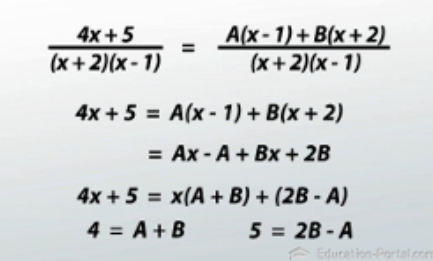
multiply by denominator (you will find the linear denominators cancel leaving a sum of factorised polynomials)
ie: 6x-2 = A(x+1) + B(x-3)
What are use cases for the 2 methods for solving partial fractions
Substitution: Finding the values for x which make parts of the sum = 0
eg: A(x+2)(x-3)+B(x+2) —> x=3: B(x+2)
Pros: good when limited terms in the series (simple equations). Also the best option if the fraction is very unfamiliar.
Equating coefficients: expand the fractions and create simultaneous equations using each coefficient. Solve using calculator.
Pros: good for all methods, simple and quick.
NOTE: this method of expansion is good practice for all identity questions
What do you do if you have repeated roots? (You can’t use substitution ONLY in this case)
Turn it into the form A/(x-1) + B/(x-1)² and solve as normal
Eg: If (x − 2)² is a repeated linear factor, include a term for each power.
1/[(x + 1)(x − 2)²] = A/(x + 1) + B/(x − 2) + C/(x − 2)²
NOTE: you cannot use ONLY substitution as it is impossible to isolate the single power

How do we determine the form of an “improper” algebraic fraction dividend.
An improper fraction is one which has a numerator with degree equal to or greater than denominator.
Numerator degree - denominator degree = Quotient degree
Number of partial fractions = denominator degree
The form could be Ax²+Bx+C+ D/(x+1) + E/(x-3)
NOTE: the multiples are ADDED not in brackets (until multipled out by the denominator)
NOTE: only turn into partial fractions if asked
Fact: the numerator is always an integer UNLESS the denominator is an indivisible quadratic like x²+4, where the numerator could be linear.

Resolve (x² + 3x + 5)/(x + 1) into partial fractions (using algebraic division)
Step 1: It is an improper fraction because the degree of the numerator (2) is greater than the degree of the denominator (1). Use algebraic division first.
Step 2: Divide the leading terms: x² ÷ x = x.
Step 3: Multiply: x(x + 1) = x² + x.
Step 4: Subtract: (x² + 3x + 5) − (x² + x) = 2x + 5.
Step 5: Divide: 2x ÷ x = 2.
Step 6: Multiply: 2(x + 1) = 2x + 2.
Step 7: Subtract: (2x + 5) − (2x + 2) = 3.
Step 8: Write the result as quotient + remainder/divisor.
(x² + 3x + 5)/(x + 1) = x + 2 + 3/(x + 1)
Final answer: x + 2 + 3/(x + 1)
Resolve (2x² + 5x + 7)/(x² + 2x − 3) into partial fractions (By comparing coefficients)
Step 1: Divide the polynomials.
(2x² + 5x + 7)/(x² + 2x − 3) = 2 + (x + 13)/(x² + 2x − 3)
Step 2: Factorise the denominator.
x² + 2x − 3 = (x + 3)(x − 1)
Step 3: Set up the partial fractions.
(x + 13)/[(x + 3)(x − 1)] = A/(x + 3) + B/(x − 1)
Step 4: Multiply through by (x + 3)(x − 1) and expand.
x + 13 = A(x − 1) + B(x + 3)
x + 13 = (A + B)x − A + 3B
Step 5: Compare coefficients.
A + B = 1
−A + 3B = 13
Step 6: Solve simultaneously using a calculator.
A = −5/2, B = 7/2
Step 7: Write the final answer.
2 − 5/[2(x + 3)] + 7/[2(x − 1)]