midterm 380 lec 3
 Call Kai
 Learn
Learn Practice Test
 Spaced Repetition
 Match
Match Flashcards
 Knowt Play
1/37

There's no tags or description
Looks like no tags are added yet.
Name | Mastery | Learn | Test | Matching | Spaced | Call with Kai | Chat |
|---|
No analytics yet
Send a link to your students to track their progress
38 Terms
Corrosion
metal degradation by reactions with
the environment (carbon steel car corrodes)
Global cost
3.4% of GDP (2013 estimate, 2016
NACE study
Electroplating
deposition by reducing metal ions
Three questions to ask about corrosion
which reactions occur, are they favourable, how fast do they proceed
voltmeter in series
current doesn’t pass
measuring thermodynamic pus
Reference Cells
• Potentials are relative to the standard hydrogen electrode (SHE)
• Platinum provides an inert reaction surface
• Standard metal half-cell: pure metal in a 1 mol/L solution of its ions
• Values shown: 25 °C, standard conditions, zero curren
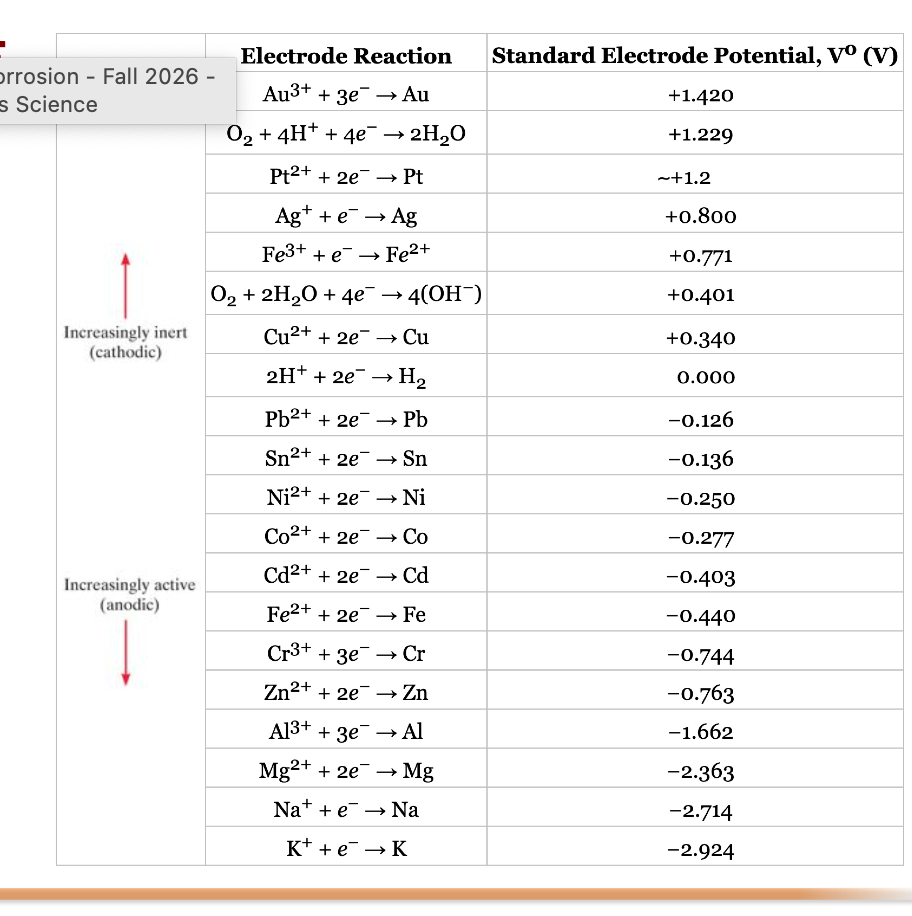
Standard EMF Series
• All entries are reduction potentials
• More positive values favour reduction
• Values refer to specified standards conditions
more at the bottom , more likely to oxides (sign flip)
delta v don’t get multiplied by stoich
nerst
• Equilibrium cell potential at the specified temperature and composition
• Use standard potentials at the same temperature
• Ion concentrations in mol/L (ideal, dilute solutions)
Metal-Ion Concentration Cells
•Lower metal-ion concentration gives a lower reduction potential (Nernst)
•The electrode in the dilute solution is the anode: it dissolves and its ion concentration rises
•This argument is for a metal-ion concentration cell; oxygen concentration cells use a different cathodic reaction
Corrosion Current and Metal Loss
• Cell potential predicts the favourable reaction direction
• Kinetics and mass transport determine the corrosion current
• A corroding surface has zero net external current, yet metal dissolves locally
Exchange Current Density
• A single metal in a solution of its own ions, at equilibrium
• Dissolution and deposition continue, at equal rates
• No net current and no net metal loss
• i0 (exchange current density): magnitude of each opposing
partial current density
i0 is a property of one redox couple at equilibrium
It is not a corrosion rate: corrosion couples two different
reactions
• Polarization:
electrode-potential shift caused by current flow
Overpotential
η = Vw − VE is positive
Oxide Growth Kinetics
•Parabolic: increasing diffusion distance slows growth through an adherent film
•Approximately linear: porous or spalling films repeatedly expose fresh
metal
•Logarithmic: very thin films (<100 nm), often near room temperature
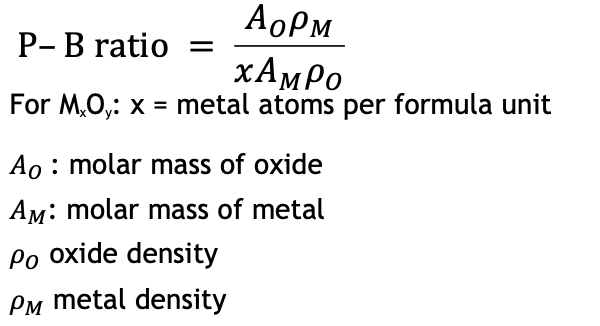
Oxide Volume and Film Integrit/ Pilling–Bedworth Ratio
oxide volume /metal volume consumed
P–B < 1: insufficient oxide volume for full coverage (discontinuous oxide layer can never be protective)
P–B = 1: equal oxide and consumed-metal volumes
P–B > 1: excess oxide volume can generate compression and buckling
The ratio alone does not establish protectio
electrochemical rxn
mediated by electrons
only need a conductor
oxidation(anode) : loss electrons , reduction(cathode) : gain electrons (Leo ger)
half rxn happen at seperate electrically connected sites
require electronic and ionic path
2 possible run (potential must be positive)
Protective oxide
complete coverage without
excessive tensile or compressive stres
Geometric criterion Pilling–Bedworth Ratio
adhesion, transport and stress also govern protectio
Dry Corrosion: Oxidation in Gases
• Metal is oxidized and O2 is reduced at a solid–gas interface: still a redox process
• The oxide scale is both electrolyte (ion transport) and circuit (electron transport)
• A continuous, adherent scale slows transport and protects the meta

Cathodic Protection
• Supply electrons to the structure so it becomes the cathode: its own
oxidation is suppressed
• Sacrificial anode: a more active metal (Zn, Mg) is connected and
corrodes instead
• Impressed current: a DC rectifier drives electrons into the structure
IMAGE: RECTIFIER : APPLY VOLTAGHE TO A PIECE OF METAL DIRECTLY
Examples of cathodic protection

Corrosion prevention
Material selection Match alloy and cost to the service
environment
Environmental control Lower temperature, velocity or concentration;
remove dissolved O2
Inhibitors Adsorb on the surface to slow the anodic or cathodic reaction
Coatings Barrier (paint, polymer or metal layer) between metal and environment
Cathodic protection Make the structure the cathode: sacrificial anode or impressed curren
form of corrosion
•Uniform
•Galvanic
•Crevice
•Pitting
•Intergranular
•Selective leaching
•Erosion-corrosion
•Stress corrosion
Hydrogen embrittlement is a related degradation mechanism

Uniform Corrosion
Metal loss spread roughly evenly over the whole exposed surface
The most common form but the least dangerous: predictable, and measured as an average thickness loss (mm/yr)
corton steel

Galvanic Corrosion
Two dissimilar metals electrically connected in
the same electrolyte
• The less noble (more active) metal becomes
the anode and corrodes faster
• Area effect: a small anode feeding a large
cathode corrodes very fast
Prevention
•Choose metals close together in the galvanic
series
•Avoid a small anode coupled to a large
cathode
•Insulate the joint to break the electronic
path
•Connect a third, more active metal as a
sacrificial anode

Crevice Corrosion
• Stagnant solution in a crevice cannot
exchange with the bulk
• O2 inside is consumed and not
replenished: O2 reduction moves
outside
• The O2-poor crevice becomes the
anode; acidification and Cl− build-up
accelerate attack
Control: weld instead of bolting, avoid
sharp corners, drain fully, use non-
absorbent gaskets
An oxygen concentration cell, not a
metal-ion cel

Pitting
• Local breakdown of the passive film
(often by Cl−) initiates a pit
• The tiny anodic pit is fed by the large
passive cathodic surface: very high local
current density
• Pits grow downward and can perforate a
wall with negligible overall mass loss
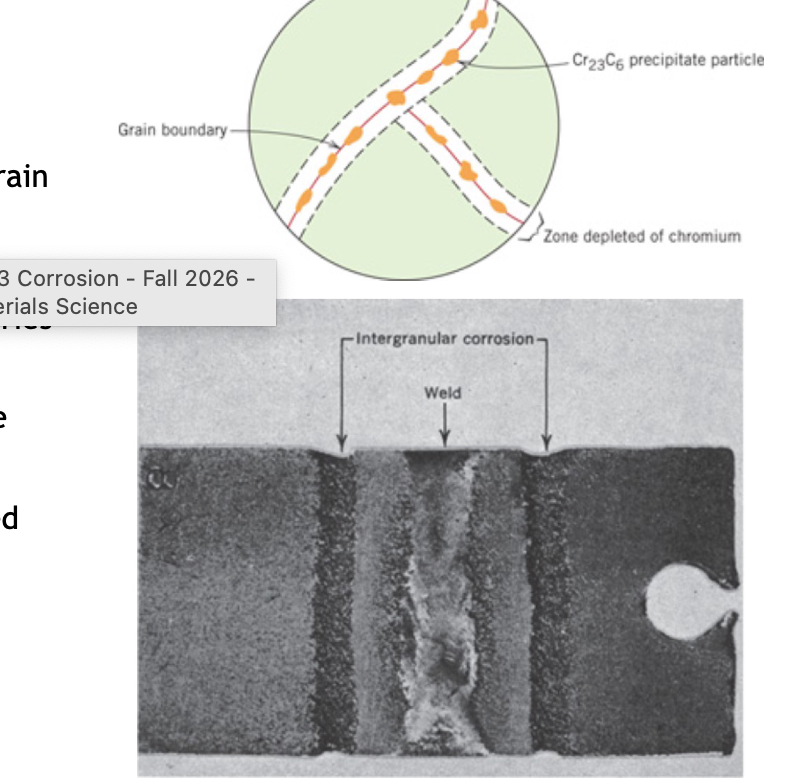
Intergranular
Corrosion
• Attack follows susceptible grain
boundaries
• Sensitized stainless steel: Cr23C6
precipitates at grain boundaries
(500–800 °C)
• The Cr-depleted zone beside
them loses its passivity
• Common in the heat-affected
zone of welds (weld decay

Selective Leaching and Erosion-Corrosion
Selective leaching
• One element of a solid-solution alloy is
preferentially dissolved
• Dezincification of brass: Zn dissolves, leaving
a porous, weak Cu-rich sponge
Erosion-corrosion
• Chemical attack plus mechanical wear by a
fast-flowing fluid, often carrying particles or
bubbles
• Severe when flow strips the passive film:
bends, elbows, pumps, impeller

Stress-Corrosion Cracking
•Tensile stress + a specific environment
(e.g., brass in ammonia, stainless steel
in chlorides)
•Cracks grow roughly perpendicular to
the stress, even in a mildly corrosive
medium
•Residual stress (welding, cold work) is
enough: no applied load is needed
Required combination: susceptible material,
tensile stress and environment
Remove any one of the three and cracking
stops: the basis for contro

Hydrogen
Embrittlement
•Atomic H diffuses into the lattice;
high-strength steels are most
susceptible
•Ductility and fracture toughness
drop sharply
•Sources: pickling, plating, H2S,
over-protective cathodic
protection
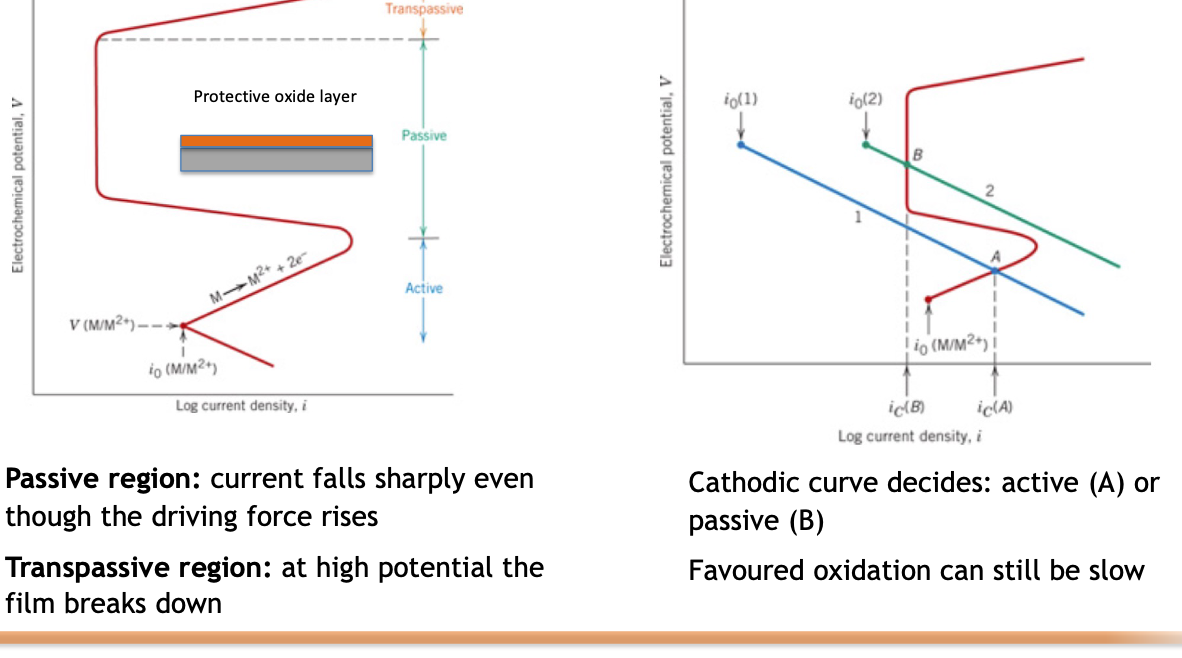
Passivity
• Passivity: a thin, adherent oxide film sharply lowers the dissolution rate
• Common in Cr, Fe, Ni, Ti, Al and their alloys
• Stainless steel (≥ 11 wt% Cr): protection comes from a Cr2O3-rich film
Combining Polarization Effects
•Start with the Nernst potential at bulk composition
•Add the activation and concentration overvoltages of that half-reaction
In the depletion term i is a positive magnitude, 0 ≤ i < iL; as i approaches iL, ηc grows without bound
concentration polarization
• Reactant supply limits the current
• Low current: diffusion keeps up
• High current: a depletion layer forms
• Here it limits the cathodic reaction (H+ or O2)
The curves meet before reactant supply limits the reduction current/The curves meet before the transport limit: mainly activation contr
Concentration polarization moves the intersection to a lower current
Less reactant supply gives a lower corrosion current

Corrosion Potential and Current
A common electrode potential couples metal
dissolution and H2 evolution
• At Vc, total anodic and cathodic currents are
equal and opposite
• The anodic dissolution current remains nonzero
Vc: corrosion potential
ic: corrosion current density
Zinc polarization
Overpotential, η = 0.000 V Equal dissolution and deposition rates. Net current = 0
Overpotential, η = +0.100 More oxidation current means faster zinc dissolution
Overpotential, η = +0.200 V More positive potential increases the oxidation rate
Tafel Relation


Activation Polarization
Interfacial reaction steps require activation
energy
• The slowest interfacial step limits the
activation-controlled rate
Hydrogen evolution on platinum
1. H+ reaches and adsorbs on Pt
2. Electrons reach the interface
3. Electron transfer forms adsorbed H
4. H atoms combine into H2
5. H2 molecules form bubbles
Activation overvoltage changes the relative forward and reverse rates
At equilibrium, the two rates are equal and the net current is zer