Animal Behaviour 2721 Hormones and Behaviour
 Call Kai
 Learn
 Practice Test
 Spaced Repetition
 Match
 Flashcards
 Knowt Play
1/29

There's no tags or description
Looks like no tags are added yet.
30 Terms
Hormones
Chemical substances secreted in one part of the body that are conveyed by the bloodstream to other parts of the body where they exert their effects
Ø secreted into blood stream by Endocrine System 1. endocrine glands 2. neurons
Ø products reach virtually all cells of the body
Ø affect growth, metabolism, water balance, reproduction
• General mechanism–indirect: hormones bind to receptors on target cells and initiate a response
• Scope–broad: reach all tissues in body
• Onset–slow (hours – weeks) • Duration–very long (days – lifetime)
1. Endocrine glands
• ductless glands that deposit hormones into spaces between cells
• hormone then diffuses directly into the bloodstream
androgens, estrogens, corticosteroids

androgens
testes
development and maintenance of male reproductive tract, and male secondary sexual characteristics
estrogens
ovaries
development and maintenance of female reproductive tract and female secondary sexual characteristics
corticosteroids
adrenal cortex
regulation of stress and immune response
2. Neurons (i.e., neurosecretory cells)
• produce ‘neurohormones’ or ‘neurosecretions’
• produced in cell body, travel down axon, and are released at axon tip, where they diffuse into bloodstream
• e.g., oxytocin, vasopressin, dopamine
2 major types of hormones
Peptide hormones – water-soluble amino acid chains that affect target cells by binding to receptors on their surface. They often affect cell membrane properties and protein function.
Steroid hormones – secreted primarily (but not exclusively) by gonads and adrenal glands. They are derived from cholesterol, are fat-soluble, and are thus capable of crossing cell membranes to bind to intracellular receptors, which may then enter the nucleus and affect gene expression.–
4 major classes of steroid hormones
progestogens, androgens, estrogens, and corticosteroids
Modes of action

Chemical control of behaviour
Confusion can arise because the same substance can act as a neurotransmitter, neuromodulator, and hormone in different contexts (e.g., serotonin)
Defined unambiguously by:
• mechanism of action • scope • onset • duration
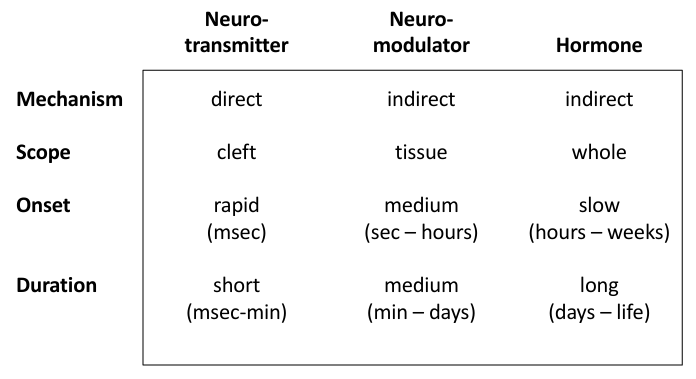
Action of hormones divided for convenience into:
1. Organizational effects 2. Activational effects
1. Organizational effects
• act on the formation of neural pathways responsible for certain behaviours
• occur early in life
• tend to be permanent
–permanence implies structural changes in the brain or other long-term cellular changes » may alter subsequent responsiveness to hormones
2. Activational effects
• stimulate existing neural systems responsible for mediating specific patterns of behaviour
• occur during adulthood
• are transient in nature
– last only as long as hormone present at high level
– impermanence suggests effect exerted via subtle changes in existing pathways
e.g., changes in neurotransmitter production or release
Influence of steroid hormones on the sexual behaviour of the Norway Rat (Rattus norvegicus)
Male Sexual Behaviour in Norway rats: •Mounting •Intromission • Ejaculation
Female Sexual Behaviour: • Solicitation– ear wiggling– hop-dart gait •Lordosis
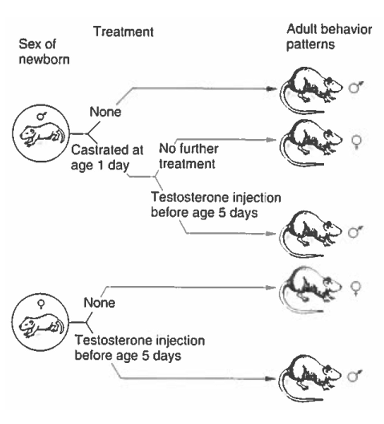
Sex differences in behaviour are due to differences in the organization of neurons in the brains of males and females → those differences are induced by irreversible actions of testosterone and estradiol during late fetal and early neonatal life (i.e., perinatal life)
Hormonal influence on rat embryonic development
• early in embryonic development, all rats have the potential to develop male or female typical neural control mechanisms
• totipotency disappears over the 24-day gestation period– from 14 days post-conception to 5 days after birth, secretion of testosterone by male’s testes exerts masculinizing effects on male brains
Patterns of sexual differentiation
Masculinized females:
• reduced activity
• increased scent marking
• increased mounting
• increased aggression
• less attractive to males
Why aren’t females masculinized in rats?
Inside neurons in the brain, testosterone is converted to estradiol
– binds cytoplasmic receptor and conveyed to nucleus
– complexes with DNA, altering gene expression
• developing females have low levels of both testosterone and estradiol
• during critical period of brain development alpha fetoprotein is produced by liver
– binds circulating estradiol preventing it from reaching target neurons in brain
– prevents masculinization
• alpha-fetoprotein does not bind circulating testosterone in developing males
– testosterone reaches cells of brain and crosses into cells
» converted to estradiol
» exerts masculinizing effect
Intrauterine position effect - vom Saal
•rats and mice have bicornate uterus
– developing fetuses arranged sequentially in uterine horns
– each in own amniotic sac with own placental connection
• secretions of fetal endocrine glands alter the morphology, physiology and behaviour of neighbours
if you're surrounded by 2 males, the testosterone will
•3 types of females– 0M, 1M, 2M
• by 17 d gestation, males have 3x the testosterone of females
• female fetuses are “contaminated” by testosterone from male neighbours– 2M > 1M > 0M
• hormones pass via uterine blood vessels to neighbouring fetuses
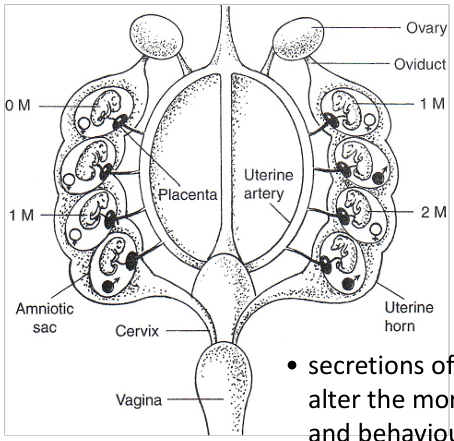
Degree of female fetus masculinization determined by number of male neighbours
1. Morphology • ano-genital distance
• M > 2M females > 1M females > 0M females
2. Physiology
• masculinized females have longer and more irregular estrous cycles
• reproductive senescence at earlier age
• 2M females > 1M females > 0M females
3. Behaviour
2M females > 1M females > 0M females
– reduced activity level
– higher frequency of marking a novel environment
– increased mounting of others
– increased aggression
– less attractive to males than control female
Mongolian Gerbils
• show aspects of biparental care
• alloparental males help females at nest by huddling and grooming young
• considerable variation among males in their tendency to help
• Clark and Galef hypothesized that variation in male helping was attributable to intrauterine position
• contrasted mating and parental behaviour of 2F males versus 2M males
• in adult gerbils, 2F males have half the circulating testosterone level of 2M males
• of 18 2F males tested:– 10 failed to impregnate receptive female– 4 of those 10 did not attempt to mate (asexuals)
• tested 2F males with new female and litter– parental behaviour negatively correlated with male’s prior interest in mating– parental behaviour of all 2F males greater than 2M males
Øreveals hormonal basis for helping behaviour
_ can also explain differences in territoriality
Hormones
tree lizard dewlap polymorphisms
Lizard 1 → territorial / aggressive / site faithful
Lizard 2 →non-territorial / less aggressive
• colour, territoriality, and aggression are developmentally fixed
• similar hormone profiles in adulthood
Ø suggests organizational, as opposed to activational, effects

Hormones can also explain differences among individuals

Hormones can also explain differences within individuals
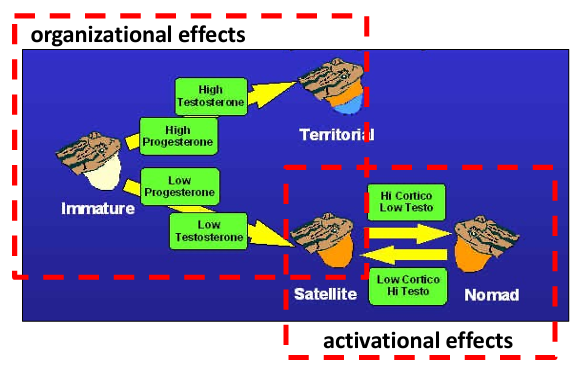
• orange-throated males switch between sedentary (i.e., satellites) and nomadic behaviour in response to environmental conditions
• i.e., these strategies are developmentally plastic
• harsh conditions cause the hormone corticosterone to rise
Ø suggests activational, as opposed to organizational, effects
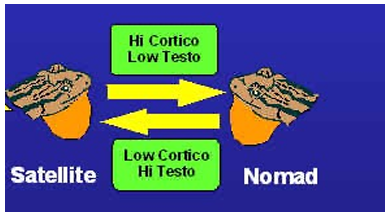
Hormones can explain differences among and within individuals
Otoacoustic emissions
• weak sounds produced by the inner ear
• can be evoked by clicks
• amplitude correlates with prenatal androgen levels
– strong in females
– weak in males
– intermediate in females from opposite
-sex fraternal twins
effects of androgens pre-natal
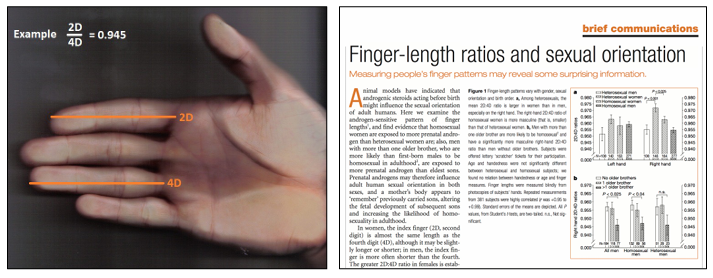
• ratio reflects pre-natal, but not adult, exposure to androgens
• male 2D:4D is 0.98
• female 2D:4D is 1.0
• intermediate in females from opposite-sex fraternal twins
Hormones affects fundamental behaviours
• sexual behaviour (rats)
• parenting/helping behaviour (Mongolian gerbils)
• territorial behaviour (common tree lizards)
• sexual orientation? (possibly humans)
Behaviour’s affect on hormones
• e.g., aggression in pukeko, song sparrows, barn swallows
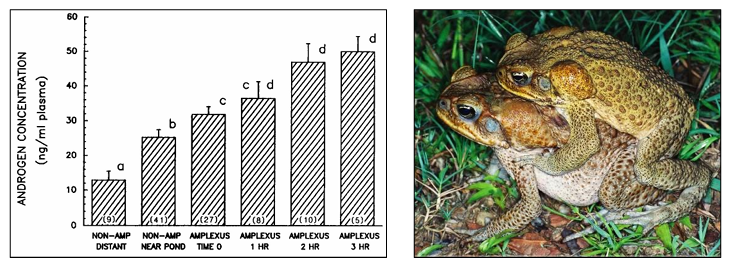
• e.g., sexual stimulation in marine toads (Rhinella marina)
androgen levels lower in unpaired bachelor males in the field
androgen levels higher in paired amplexing males in the field
• androgen levels correlated positively with hours spent in amplexus
• therefore, behaviour causes changes in hormone levels
Hormones and status signalling in Pukeko*