TOPIC 6 CLASSIFICATION & CLADOGRAMS
 Call Kai
 Learn
 Practice Test
 Spaced Repetition
 Match
 Flashcards
 Knowt Play
1/82

There's no tags or description
Looks like no tags are added yet.
83 Terms
Systematics
is the scientific study of the diversity of organisms and their relationships. It includes the classification, naming, and determining the evolutionary relationships among species.
Taxonomy (Linnaeus, 1750s)
is a branch of systematics that focuses on the classification and naming of organisms based on shared characteristics and evolutionary history
Phylogeny
is the evolutionary history and relationship of organisms, often depicted in a tree-like diagram that shows how different species are related through common ancestors.
Order of Classifications (Inclusive → Exclusive)
Domain→Kingdom→Phylon→Class→Order→Family→Genus→Species (DO KEEP POTS CLEAN OR FAMILY GETS SICK)
Species Name
Genus specific epithet
Specific epithet
Which member of the genus
Cladogram
branching diagrams showing ancestry and derived characteristics
Phylogenetic Tree
includes length of time of extinction (more specific then the cladogram)
Sister Taxa
They are the same age because they share the same ancestor with no other species
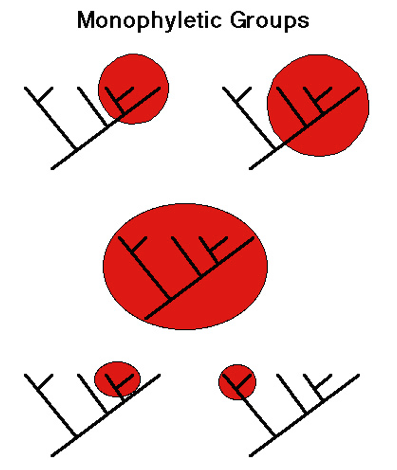
What type of clade is this?
Monophyletic

What type of clade is this?
Polyphyletic

What type of clade is this?
Paraphyletic
3 Domain System
Bacteria, Archea, Eukarya
6 Kingdom System
Bacteria, Archae, Protista, Plantae, Fungi, Animalia
What domain are humans most closely related to?
Archea
What domain are humans?
Eukarya
How old is the Earth?
4.5 billion years old
Bacteria & Archaea Characteristics
Microbes (1-10 micrometers)
Smaller than eukaryote cells
unicellular & prokaryotic
Ring of DNA - 0.001 times as much as eukaryotes
More abundant than eukaryotes
Important in medicine, industry and environment
Bacteria IS pathogenic archaea is NOT
What is Bioremediation?
Eco-friendly process that uses living organisms, to detoxify or remove environmental pollutants from soil, water and air
Ecology Importance of Prokaryotes
Decomposition, bioremediation
Industrial waste sites
Nitrogen fixation
Mutualistic relationships (lichens, intestines)
Commercial use
What is an intron?
Introns is a non-coding nucleotide sequence within a gene that is copied into RNA during transcription but it removed before the RNA is translated into a protein
Eubacteria
Common Name: Bacteria
No introns
Diverse nutrition and respiration
Prokaryotic Reproduction
1-3 hours
Binary Fission
Conjugation
What is Binary Fission?
Form of asexual reproduction and cellular division used by prokaryotic organism (like bacteria or archaea) to split into two genetically identical daughter cells
What is Conjugation?
The direct transfer of genetic material between two cells that are temporality joined together
Shapes of Eubacteria
Cocci
Bacilli
Sprilli
They only move forward and reverse
Peptidoglycan
Peptides and sugars in cell walls
Bacteria Stains
Pos. = purple
Neg. = pink/orange
Cyanobacteria
was ‘blue-green algae”
dominate aquatic environments
plant-like & photosynthetic
formed ozone layer, brought life to land
20-30% of worlds oxygen
some in lichen
Bacteria
can from endospores when exposed to harsh environments (go formant)
survive boiling water
only die at 248 F
Adapt quickly to their environment through natural selection
Have proteins with strongest bonds that do not denature in high heat, salt or acidity
Archaea
cell wall does not contain peptidoglycan
cell membrane has lipids not found in other organisms
gene are interrupted buy introns (like eukaryotes unlike eubacteria)
very abundant in plankton
many habitats (soil, marshes, oceans)
many are extremophiles
What is an extremophile?
Organism that has evolved to grow and thrive in environments once considered too harsh or hostile to support life
Methanogen
Produce methane poisoned by o2 (sewage treatment)
Thermophiles
Live in extreme temperatures
Halophiles
Live in high saline
Protists
“junk draw”
unicellular, complex (10x larger than most bacteria)
most aquatic
form colonies
colonial photosynthetic protists = algae (1/2 worlds oxygen)
reproduce both sexually and asexually
animal like, plant like and fungus like
How do protist feed?
Ingestive AND absorptive
How to protists move?
crawling with pseudopodia
swimming via flagella
swimming via cilla
Protist - ecological importance?
food chain
playtoplakton produce O2
decomposition
symbiotic relationships (mutual and parasitic)
medicine
Fungi (eukarya)
more on land
multicellular (exception of yeast)
heterotrophic
decomposers
closely related to animals
cell walls contain chitlin
main body is hyphae
sexual and asexual reproduction
diverse ~70,000 species known
Fungi - Nutrition
severe digestive enzymes (exoenzymes) into surroundings
absorb the organic molecules
great surface area to volume ratio
break down cellulose
decompose wood
some fungi are carnivores
external extracellular digestion
30% of fungi are parasites
mycorrhizae (80% of all plants)
live in roots
help feed them
lichens: green algae live in fungal hyphae
What are humans?
Internal extracellular
What is a hyphae?
A long, branching, thread-like tubular structure that makes up the main vegetative body of a fungus
All algae are…
Protist BUT blue/green
Nonvascular Plants
Bryophytes
mosses, close to water
Vascular Plants
Tissues allow height
seedless = pteridophytes (fern)
seedbearing = pollen
Gymnosperm - evergreen
Angiosperms - flowering plant (more successful)
Monoclat (Angiosperms)
foral in three parts
parellel leaf veins
one cotyldia
crops
Dicots (Angiosperms)
foral parts in fours
netlife leaf veins
most common trees
What is Alternation of Generations?
sporophyte produces haploid by meiosis
gametophyte produces haploid gametes (no meiosis)
Animals (Animalia)
from single celled protist ancestor
multicellular, heterotopic, feed by ingestion
lack cell wall
muscles for movement
have regulatory HOX gene
nervous tissue
respiratory/gas exchange & transport nutrients
skeleton support
Animals Body Plan - Tissue Type
only sponges lack germ layer of tissue in embryo
all others have germ layers
Diploblasts - Tissue Types
2: Cnidaria
Ectoderm
Endoderm
Triploblasts - Tissue Types
3: All other animals
ecotderm
mesoderm
endoderm
Embryotic Development - Protostomes
mouth develops first
arthropod
molluses
annelids
Embryotic Development - Deuterostomes
mouth develops second
chordates
echinoderms
Symmetry
Asymmetry
Bilateral
Radical
What is cephalization?
Having a definite head region, visually with felling and sensory features
What is a Echinoderm?
pentaradial symmetry (adults)
internal skeleton
gills
spiny skin
water vascular system for movement via tube feet
ex. sea stars, brittle stars, sea urchins, sea cucumbers, sea lilies
What is a mollusk?
Foot, soft body, mantle (thick tissue that protects body-and may secrete a shell)
What are the three major mollusks classes?
Gastropod (snails) *only terrestrial mollusk
Bivalve (clams)
Cephalopod (octopi)
Characteristic of Chordates
notochord
dorsal, hollow nerve cord
pharyngeal slits or clefts
muscular, post-anal tail
Notochord
longitudinal, flexible rod located between the digestive and the nerve cord
Dorsal, hollow nerve cord
eventually develops into the brain and spinal cord
Pharyngeal slits
become modified for gas exchange, jaw support, and/or hearing
Agnatha (Fish)
Lampreys and hagfish-jawless, most are parasitic
Chondrickthyes (fish)
Cartilage skeleton, sharks, rays, skates
Osteichtyhes (fish)
Bony skeleton swim bladder to adjust depth in water
rayfinned: fins supported by bony structures called rays
Osteichthyes (fish)
Bony skeleton, swim bladder to adjust depth in water
lobe-finned: fins long fleshy and muscular = can “walk” on seabed; ancestors of amphilbians
Platyhelminthes (flatworm)
bilateral symmetry, incomplete digestive system, acoelomate
some are free-living (planarians)
most are parasitifc (tapeworms, flukes)
Nematodes (roundworms)
Complete digestive system, bilateral many are parasistiv (ex. trichinella, causes trichinosis; heartworms in dogs), but most are free-living (often small/microscopic) in soil and water
Annelids
Segmented (for burrowing), coelomate, closed circulatory system
earthworm, leech, Lumbriculus
tube worms, bristle worms
Invertebrates are what percent of animals?
97%
Amphibia
evolved from lobe-finned fished… most return to water to reproduce (external fertilization) - external respiration, skin must stay moist (also have lungs for respiration)
What are the three order of amphibians?
Anura (frogs/toads)
Apoda (caecillians)
Caudate (salamanders)
Class Sauropsida (reptiles and birds)
Shelled amniotic egg, makes reproduction on land possible… also have internal fertilization and dry scaly skin
What are Aves?
Endothermic (all previous groups have been ectothermic), feather, air sacs, hollow bones, amniotic egg
archaeopteryz: oldest known bird, feathered wings but more like small bidpedal dinosaur
What are Arthropods?
External exoskeleton with chitin, segmented body (specialized), joined appendages—most successful group of animals
Subphyla (Arthropods)
Spider, ticks pincers or fangs
Crustacea: crabs—2 pairs of antennae
Hexapoda (Arthropods)
Insects—3 body parts
milli/centipedes: many segments
Characteristics of Mamalia?
hair/fur
mammary glands
increased brain capacity
specialized teeth
Monotremes (Animalia)
egg-laying (but still nurse young
spiny anteater (echidna) and duck-billed platypys, both in Austraulua
prototheria
duck-billed playpus
Marsupials
young born early, finish development in mother’s pouch—most in Australia (except opossum)
metatheria
tasmanian devil
kangaroo
Eutherian/placental mammals
Most mammals; placenta nourishes young within mother-safer, more efficient
eutheria