Ch. 3 Organic Chemistry Fundamentals

0.0(0)
Studied by 0 people
call kaiCall Kai
learnLearn
examPractice Test
spaced repetitionSpaced Repetition
heart puzzleMatch
flashcardsFlashcards
GameKnowt Play
Card Sorting

1/6

encourage image

There's no tags or description

Looks like no tags are added yet.

7 Terms

1
New cards
<p><u>Background and Introduction</u></p><p>This section covers the fundamentals of nomenclature in organic chemistry. Although this section will require memorization as your primary study technique, it is in your best interest to be comfortable, reading, hearing, and using this terminology. Although most of the terminology that appears on the MCAT is IUPAC, some common nomenclature is also used.</p><p><u>Alkanes</u></p><p>look at the table attached to this flashcard</p><p>In the case of an all-carbon containing ring, these are preceded by the prefix <strong>cyclo-</strong>. Hence, a six membered ring containing all -CH<sub>2</sub>-units is called <em>cyclohexane</em>.</p><p><strong>alkane</strong>: saturated hydrocarbon composed entirely of carbon (C) and hydrogen (H) arranged only with single covalent bonds</p><p>alkane examples: methane (CH4), ethane (CH3CH3), propane (CH3CH2CH3)</p><p>alkane: single bonds</p><p>alkene: double bonds</p><p>alkyne: triple bonds</p>

Background and Introduction

This section covers the fundamentals of nomenclature in organic chemistry. Although this section will require memorization as your primary study technique, it is in your best interest to be comfortable, reading, hearing, and using this terminology. Although most of the terminology that appears on the MCAT is IUPAC, some common nomenclature is also used.

Alkanes

look at the table attached to this flashcard

In the case of an all-carbon containing ring, these are preceded by the prefix cyclo-. Hence, a six membered ring containing all -CH2-units is called cyclohexane.

alkane: saturated hydrocarbon composed entirely of carbon (C) and hydrogen (H) arranged only with single covalent bonds

alkane examples: methane (CH4), ethane (CH3CH3), propane (CH3CH2CH3)

alkane: single bonds

alkene: double bonds

alkyne: triple bonds

Nomenclature for substituents

“yl” indicates a substituent in organic chemistry

<p><u>Nomenclature for substituents</u></p><p>“yl” indicates a substituent in organic chemistry</p>
2
New cards
<p><u>common functional groups</u></p><ol><li><p>alkane (single bond)</p></li><li><p>alkene (double bond)</p></li><li><p>alkyne (triple bond)</p></li><li><p>alkyl halide</p></li><li><p>alcohol</p></li><li><p>thiol</p></li><li><p>ether</p></li><li><p>epoxide</p></li><li><p>phenol</p></li><li><p>aldehyde</p></li><li><p>ketone</p></li><li><p>hemiacetal (OH, OR. The acetal is the OR, and the hemi is the OH)</p></li><li><p>acetal (OR, OR)</p></li><li><p>cyanohydrin (OH, CN)</p></li><li><p>amine (NR<sub>3</sub>)</p></li><li><p>imine (has a double bond, like a carbonyl group but with nitrogen instead)4</p></li><li><p>enamine (carbon double bond to an R group, nitrogen is attached to the same carbon)</p></li><li><p>carboxylic acid</p></li><li><p>acid halide</p></li><li><p><span style="color: rgb(17, 88, 227);">acid halide (the halide itself is the acid because the halide detaches)</span></p></li><li><p><span style="color: rgb(18, 102, 231);">acid anhydride</span></p></li><li><p>ester</p></li><li><p>lactone</p></li><li><p>amide</p></li><li><p>lactam</p></li></ol><p></p>

common functional groups

  1. alkane (single bond)

  2. alkene (double bond)

  3. alkyne (triple bond)

  4. alkyl halide

  5. alcohol

  6. thiol

  7. ether

  8. epoxide

  9. phenol

  10. aldehyde

  11. ketone

  12. hemiacetal (OH, OR. The acetal is the OR, and the hemi is the OH)

  13. acetal (OR, OR)

  14. cyanohydrin (OH, CN)

  15. amine (NR3)

  16. imine (has a double bond, like a carbonyl group but with nitrogen instead)4

  17. enamine (carbon double bond to an R group, nitrogen is attached to the same carbon)

  18. carboxylic acid

  19. acid halide

  20. acid halide (the halide itself is the acid because the halide detaches)

  21. acid anhydride

  22. ester

  23. lactone

  24. amide

  25. lactam


Difference between ether and ester

ether: does NOT have a carbonyl group

Ether - Wikipedia

ester: does have a carbonyl group

What Is an Ester in Chemistry?

Difference between amine and imine

  1. amine (NR3)

Amine - wikidoc
  1. imine (has a double bond, like a carbonyl group but with nitrogen instead)

Imine - Wikipedia
  1. en-amine (carbon double bond to an R group, nitrogen is attached to the same carbon)

Enamine - Wikipedia
  1. amide (carbonyl with nitrogen)

Amide - Wikipedia


3
New cards
  1. acid anhydride

Acetic anhydride - Wikipedia


  1. lactone

Lactones | Fisher Scientific
  1. lactam


4
New cards

Progress stopped

5
New cards
<p><u>abbreviated line structures</u></p><p>The prevalence of carbon-hydrogen (C-H) bonds in organic chemistry has led chemists to use an abbreviated drawing system, merely for convenience. Just imagine having to draw every (C-H) bond for large molecule like a steroid or polymer! Abbreviated line structures use only a few simple rules:</p><ol><li><p>carbons are represented simply as vertices</p></li><li><p>C-H bonds are not drawn</p></li><li><p>Hydrogen bonded to any atom <em>other</em> than carbon must be shown. </p></li></ol><p>look at the picture attached to this flashcard</p><p>Although the C-H bonds are not drawn, the number of hydrogens required to complete carbon’s valency are assumed. To clarify this, let’s look more closely at the abbreviated line structure of pentane: </p><p>look at the figure. </p><p><u>example 3-1: translate each of the following Lewis Structures into an abbreviated Line Structure</u></p><img src="https://assets.knowt.com/user-attachments/a17ad462-ccac-4861-afae-dcfabd51f2ef.jpg" data-width="50%" style="display: block; width: 50%; margin-left: auto; margin-right: auto;" data-align="center"><img src="https://assets.knowt.com/user-attachments/76916bb4-8f49-4afd-a3aa-aef574df1896.jpg" data-width="50%" style="display: block; width: 50%; margin-left: auto; margin-right: auto;" data-align="center"><p></p>

abbreviated line structures

The prevalence of carbon-hydrogen (C-H) bonds in organic chemistry has led chemists to use an abbreviated drawing system, merely for convenience. Just imagine having to draw every (C-H) bond for large molecule like a steroid or polymer! Abbreviated line structures use only a few simple rules:

  1. carbons are represented simply as vertices

  2. C-H bonds are not drawn

  3. Hydrogen bonded to any atom other than carbon must be shown.

look at the picture attached to this flashcard

Although the C-H bonds are not drawn, the number of hydrogens required to complete carbon’s valency are assumed. To clarify this, let’s look more closely at the abbreviated line structure of pentane:

look at the figure.

example 3-1: translate each of the following Lewis Structures into an abbreviated Line Structure


6
New cards

Nomenclature of alkanes


7
New cards

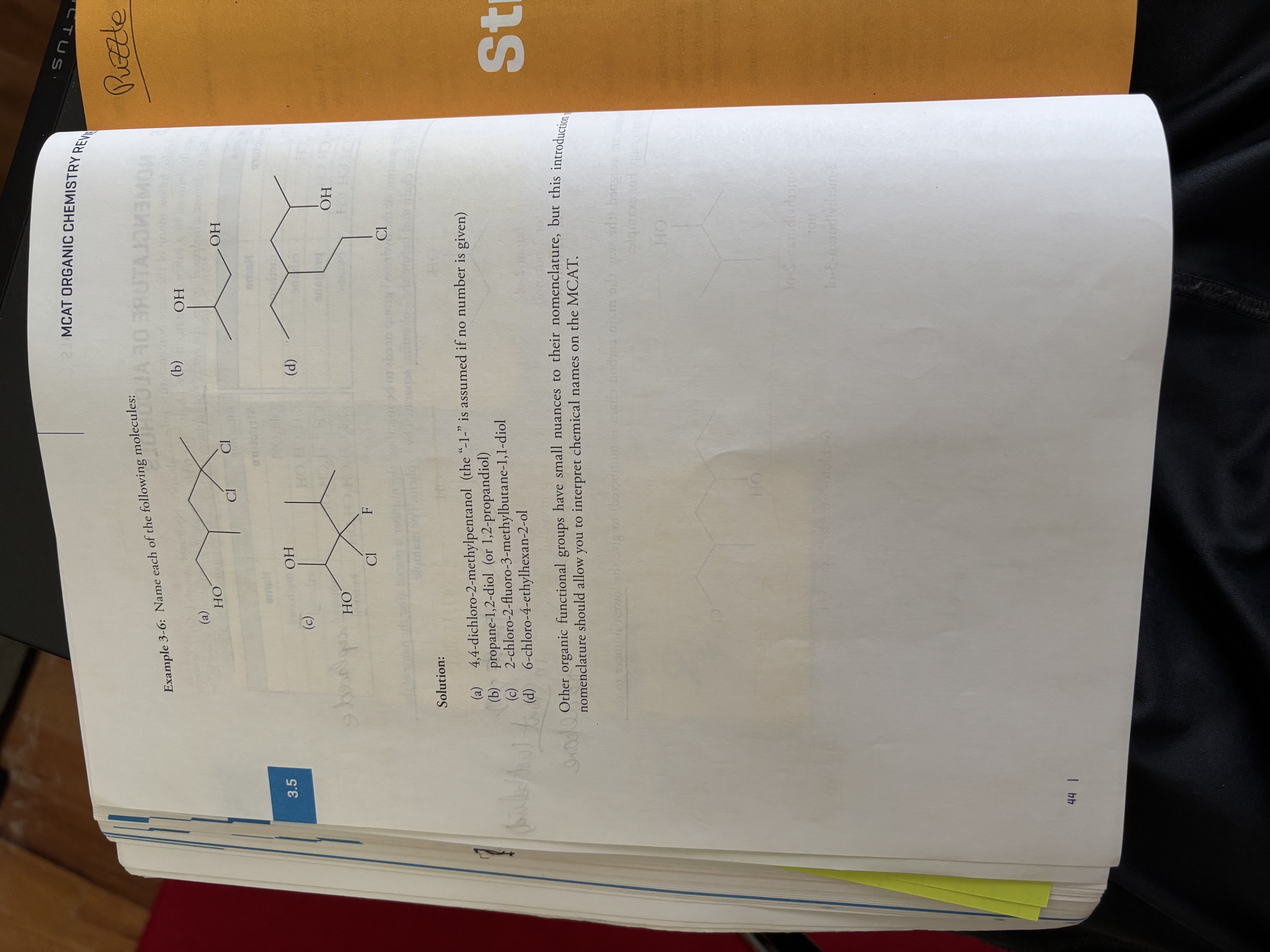
Nomenclature of alcohols