L7: Energy
 Call Kai
 Learn
Learn Practice Test
 Spaced Repetition
 Match
Match Flashcards
 Knowt Play
1/30

There's no tags or description
Looks like no tags are added yet.
Name | Mastery | Learn | Test | Matching | Spaced | Call with Kai | Chat |
|---|
No analytics yet
Send a link to your students to track their progress
31 Terms
Energy
capacity of a physical system to perform work
exists in many forms (e.g. mechanical, chemical, light, heat)
Heat of combustion: energy released (heat) during combustion of a
substance (food)
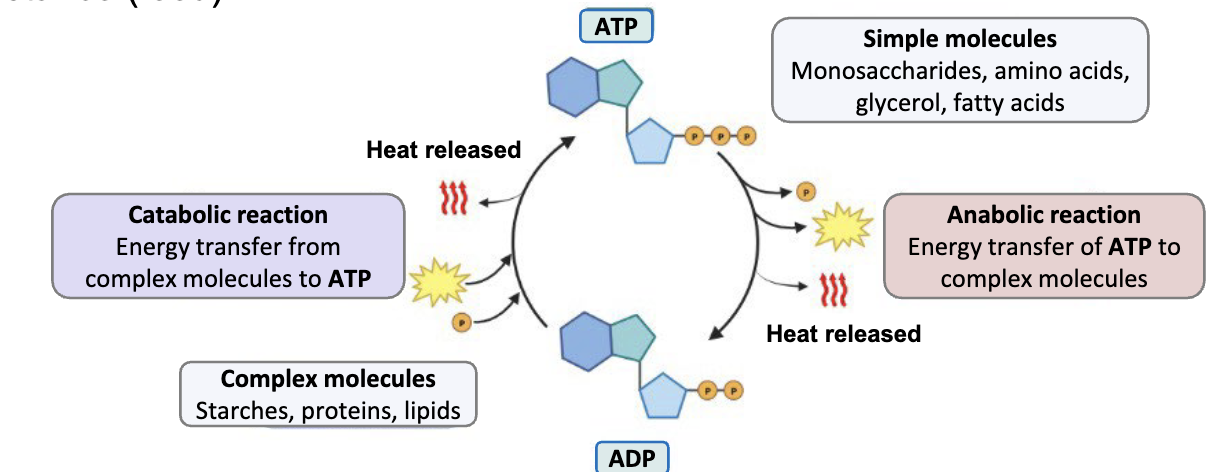
Food energy
chemical energy that animals derive from certain nutrients in food
energy derived from carbohydrates, proteins, and fats
nutrients are metabolized, during which energy is released/absorbed

Food energy is required to sustain an animal’s metabolism during...
maintenance
growth
reproduction (gestation and/or lactation)
physical activity
Endotherm and requirements
body temperature primarily determined by heat derived from metabolic activity
- Higher mitochondrial density per cell than ectotherms → ↑ metabolic rate → need more food

How does an endotherm cool down?
eating less
reduce physical activity
panting/sweating (evaporative cooling)
vasodilation

How does an endotherm warm up?
eating more
increase physical activity
shivering (muscle contractions)
(Some) non-shivering thermogenesis (brown adipose tissue)
insulation (fur, pelage, adipose tissue)
vasoconstriction

Ectotherm and characteristics
body temperature primarily determined by heat derived from the environment
Body temperature fluctuates with environmental temperature
Metabolic heat production is minor/negligible
Lower metabolic rate than endotherm

How does an ectotherm cool down?
Reduce physical activity
Seek shelter/shade/water
Vasodilation
Mucus secretions (replaces sweating)

How does an ectotherm warm up?
Increase physical activity
Seek external sources of heat
Countercurrent heat exchange

Pros and Cons of ectotherms
Pros
require less food
larger carrying capacity in a given environment
Cons
less functional or dysfunctional when cold
Changes in Body Temperature in Relation to Environmental Temperature in endotherms vs ectotherm

Homeotherm, characteristics, and who
Maintains a relatively constant body temperature (regardless of the environmental temperature, up to a point)
colloquially termed ‘warm blooded’ animals (no such thing scientifically)
mammals and birds (mostly)
Normal body temperatures of homeotherms
birds: 40 0C
placental mammals: 37 - 38 0C
marsupials: 34 0C
monotremes: 30 0C
Are homeotherms endothermic?
HOMEOTHERMS are not always ENDOTHERMIC
(e.g. some fish in tropical waters or very deep waters)

Poikilotherms, characteristics, and who
Body temperature that fluctuates considerably (usually according to environmental temperature)
Colloquially termed ‘cold blooded’ animals
Fish, reptiles, and amphibians (mostly)
The only mammalian poikilotherm is:
The naked mole rate

Thermoneutral Zone (TNZ)
environmental temperature range where endotherms do not need to warm/cool themselves
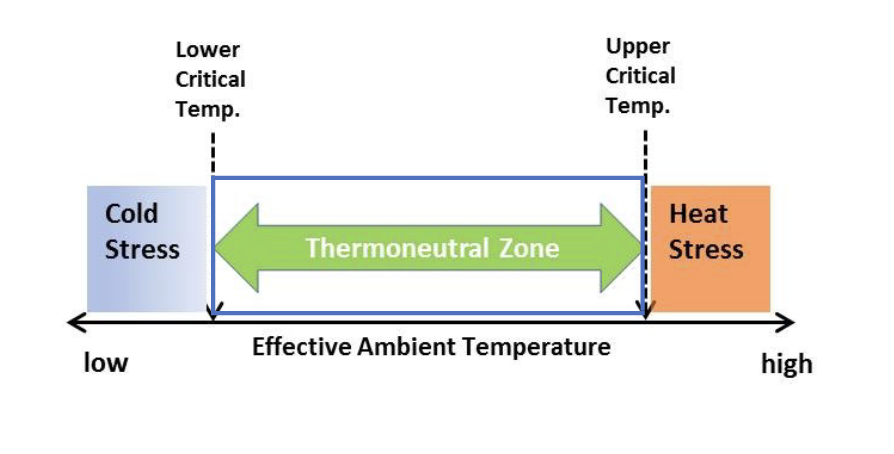
Factors that influence an animal’s TNZ
body composition (e.g. adiposity)
fur/pelage
life stage
body size (SA / V)
smaller animals have ↑ metabolic rates

Upper critical temperature
environmental temperature at the upper limit of an endotherm’s TNZ

If above the UCT for too long, heat stress ensues:
anorexia
excessive sweating/panting (dehydration)
cellular dysfunction (if severe)
death (if severe & long-lasting)

Lower critical temperature
environmental temperature at the lower limit of an endotherm’s TNZ

If below the LCT for too long, cold stress ensues:
excessive shivering
bodily processes may slow
cellular dysfunction (if severe)
death (if severe & long-lasting)

Basal metabolic rate
minimal amount of energy required by an endothermic animal each day to maintain homeostasis
*in the absence of factors that would affect energy expenditure
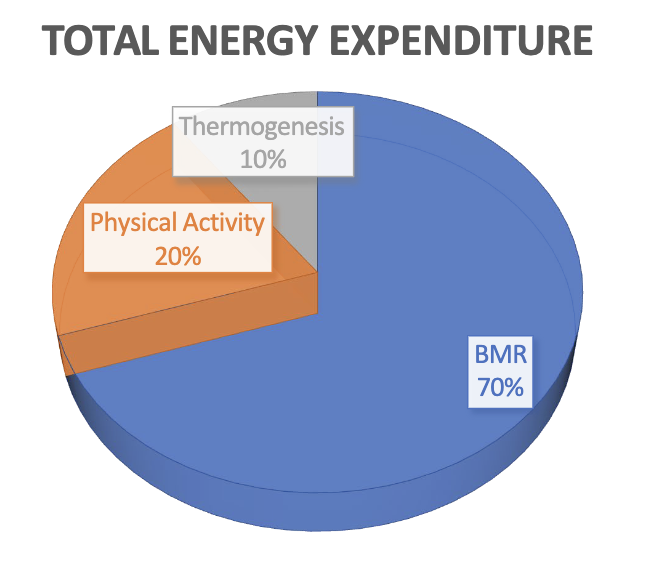
How can BMR be determined:
at rest (but awake)
in a post-absorptive state (12-h fast)
in a thermoneutral environment (TNZ)
without physical/psychological stress
Standard metabolic rate (SMR)
minimal amount of energy required by an ectothermic animal
How can SMR be determined
at rest (but awake)
in a post-absorptive state (12-h fast)
at a specific environment temperature
without physical/psychological stress
Metabolic body weight (BWx)
mass of an animal that is comprised of metabolically active tissue
Energy expenditure correlations with BW
not linear
100kg animal does not require 2 x the energy as a 50 kg animal
In most cases smaller animals have a greater energy requirement per unit BW
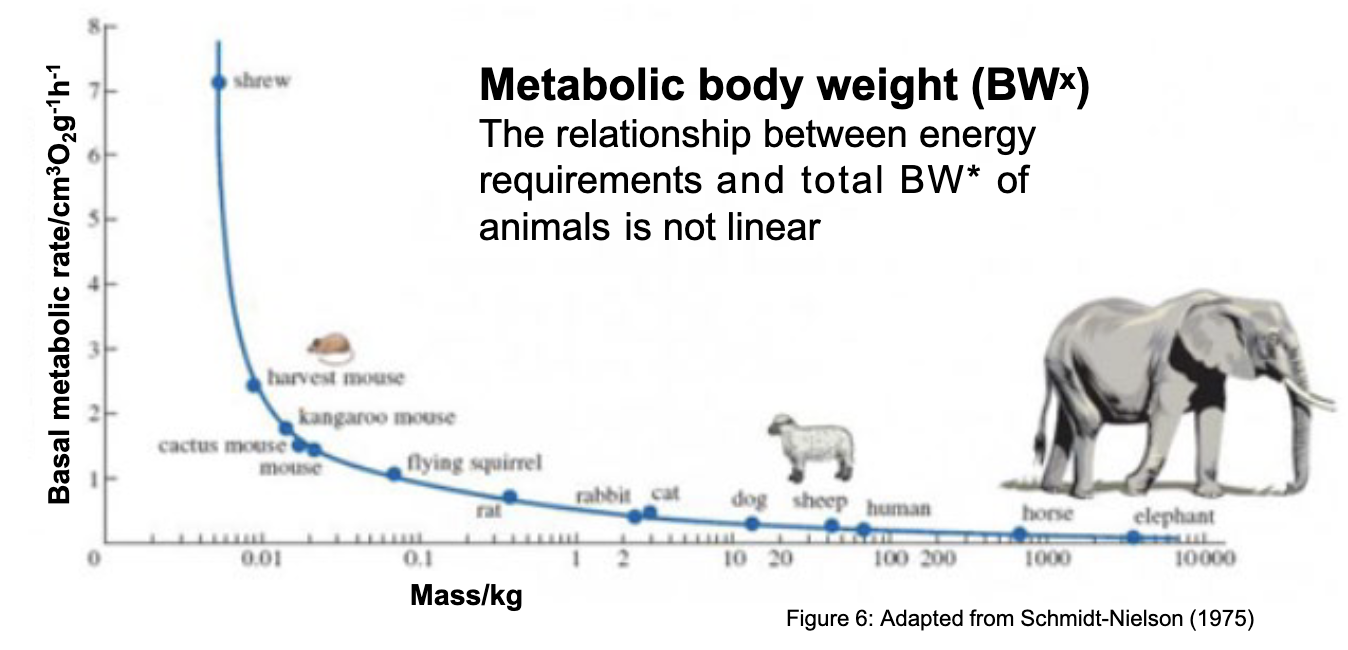
How to estimated BMR?
Max Kleiber developed an equation to estimate BMR:
based on metabolic body weight
for mature (not growing) endothermic animals
Kleiber’s Law: Y = 70 x BW 0.75 where,
Y = kilocalories per 24 hours
70 = constant
BW = metabolic body weight

Kleiber’s law on metabolic BW
metabolic BW follows the ¾ power-law of body mass (most animals)
Metabolic body weight = BW0.75

Daily Energy Expenditure (DEE)
energy used to support essential body functions (including digestion & metabolism) + physical activity
DEE = BMR + metabolic heat production + physical activity