Topic 2: Glycolysis
0.0(0)
Studied by 4 people Note
Note Call Kai
 Learn
Learn Practice Test
 Spaced Repetition
 Match
Match Flashcards
 Knowt Play
Card Sorting
1/7

There's no tags or description
Looks like no tags are added yet.
Last updated 9:58 PM on 3/28/23
Name | Mastery | Learn | Test | Matching | Spaced | Call with Kai | Chat |
|---|
No analytics yet
Send a link to your students to track their progress
8 Terms
1
New cards
Glycolysis
* Breaks down glucose to form 2 3-carbon molecules (pyruvate)
* ATP is formed by substrate-level phosphorylation
* Occurs in the cytoplasm
* Will occur whether or not O2 is present
* ATP is formed by substrate-level phosphorylation
* Occurs in the cytoplasm
* Will occur whether or not O2 is present
2
New cards
Substrate-level phosphorylation
* ATP is formed directly from ADP and a phosphate group that is transferred from a substrate molecule
3
New cards
Isomerization
A reaction that causes a structural change in a molecule, resulting in a different form of the same molecule
4
New cards
Kinase
An enzyme that adds a phosphate group to a molecule
5
New cards
NADH
A molecule that carries high-energy electrons and is formed during glycolysis
6
New cards
ATP
Adenosine triphosphate, a molecule that stores and releases energy for cellular processes
7
New cards
Pyruvate
A 3-carbon molecule that is the end product of glycolysis and can be used in cellular respiration or fermentation
8
New cards
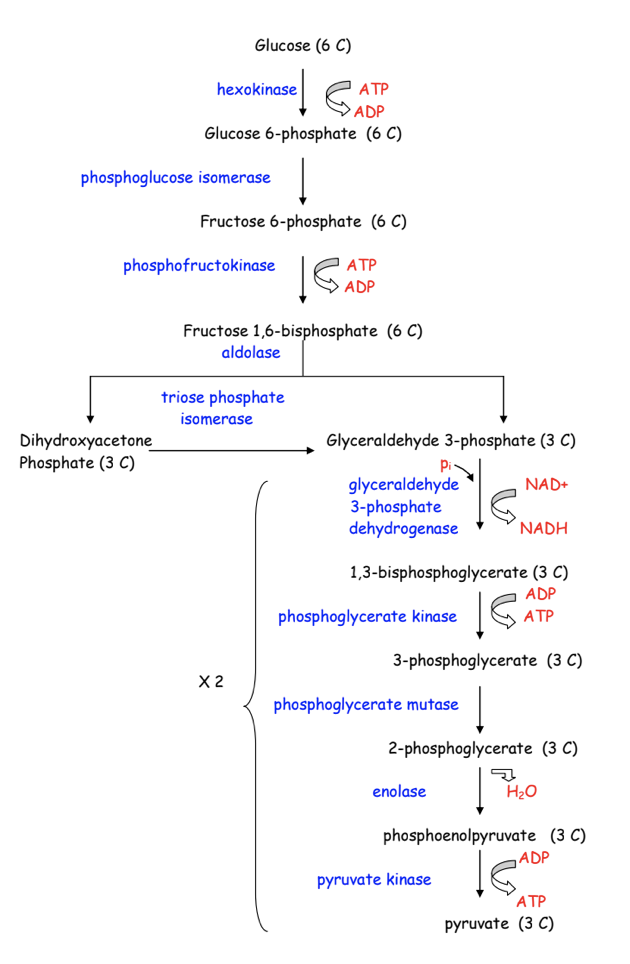
Glycolysis Steps
1. phosphate transfer
2. isomerization
3. phosphate transfer
4. molecule splits into 2 isomers
5. one of the isomers is converted to the same form as the other
6. phosphate added from cytoplasm and NAD+ reduced to NADH + H+
7. phosphate transfer and ATP formed
8. isomerization
9. water molecule is removed
10. phosphate transfer, left with pyruvate