Aldehyde and Ketone Reactions
 Call Kai
 Learn
 Practice Test
 Spaced Repetition
 Match
 Flashcards
 Knowt Play
1/18

There's no tags or description
Looks like no tags are added yet.
19 Terms
How do you form a carbonyl?
oxidize an alcohol

what oxidizing agent will not over oxidize a primary alcohol?
Pyridinium Chlorochromate (PCC)
will not make 1° alcohol into carboxylic acid

oxidation of a primary alcohol
PCC: aldehyde
all other oxidizing agents: carboxylic acid

oxidation of secondary alcohol
ketone

oxidation of tertiary alcohol
NO REACTION

what are the reactive portions of a carbonyl?
1. have very acidic α protons (when proton removed, electrons can delocalize into pi system, addition reaction
2. electrophilic carbonyl carbon → nucleophile attack

Hydride reduction (ketone or aldehyde products, solvent)
NaBH₄ or LiAlH₄,
aldehyde→ primary alcohol
ketone→secondary alcohol
cannot form tertiary alcohol

how do you recognize nucleophilic addition reactions?
a pi bond is broken and two sigma bonds in product result
Organometallic Reagents purpose?
used for nucleophilic addition
Gringard and Lithium reagents.
Grignard formation
Important to form it and react it in aprotic solvent (basic) to prevent unwanted protonation

Grignard addition
need to do in steps.
form alkoxide intermediate than do acidic workup to protonate alcohol

important uses of Grignard reagents!
can form a tertiary alcohol (cannot do with hydride reduction)
What is the purpose of a protecting group?
To prevent unintended reactions, such as a gringard reacting with an alcohol or carboxylic acid or amino group. remove the reactive nature of protic groups.

What must you do with protic groups after reacting?
need to neutralize with HCL
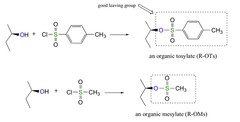
Mesylate and Tosylates
1. good for protecting group
2. turn a bad LG (-OH) into a good leaving group to make easier for nucleophilic addition/substitution
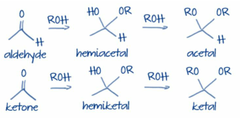
acetals and hemiacetals: synthesis
synthesized via nucleophilic addition reaction to aldehydes and ketones.
form when aldehydes or ketones react with alcohols in presence of acid.
Acetal formation mechanism
**** ACID CATALYZED****
goes through step with hemiacetal
series of protonations and de-protonations

cyanohydrin formation
must have acid in order for -OH to be protonated to leave.

imine formation (what type of amine?)
acid catalyzed
pH around 5 (weakly acidic conditions)
**must be a primary amine reacting with carbonyl to form imine
