Financial Accounting EXAM 2
 Call Kai
 Learn
 Practice Test
 Spaced Repetition
 Match
 Flashcards
 Knowt Play
1/43

There's no tags or description
Looks like no tags are added yet.
44 Terms
Describe Merchandising Operations and Inventory Systems
completing a service = selling time (ex. law firm or any service based companies)
merchandising companies sell products (grocery store, dicks sporting goods)
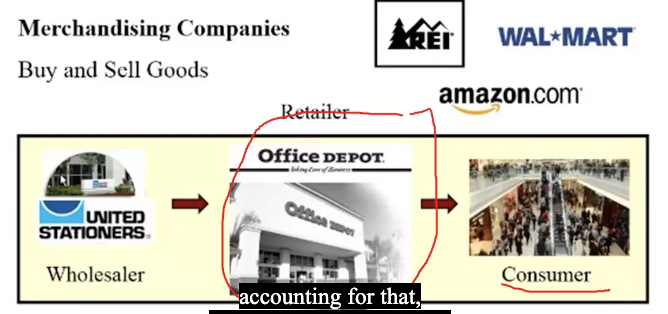
goes from a wholesaler to retailer (office depot, target, staples) to consumer which is us who buy products.
stores buy in bulk (a lot cheaper) and stock their shelves, and then mark it up to a higher price and sell to consumers
selling at a higher price is how they make their money and the difference is their profit
the primary source of revenues is referred to as sales or sales revenue
Merchandising Operations
1) Cost of goods sold is the total cost of merchandise sold during the period

Operating Cycles
the operating cycle of a merchandising company is ordinarily longer than that of a service company.
the operating cycle has an extra step

Flow of Costs: Merchandising Company
for a merchandising company, its inventory process is as follows:
beginning inventory + good purchased determines the good available for sale
those good not sold by the end of the accounting period represent ending inventory
goods that are sold are assigned to cost of goods sold


inventory is an asset because you can own them right now (they are in your store right now but you’re not gonna use it) and you hold it till they can sell it.
supplies and equipment are things that you’re using in the business for yourself
^difference
starts as an asset (inventory) —> after sold reclassifies as cost of goods sold
Flow of costs: Perpetual System
Perpetual means every time there’s a sale, you make that classification from inventory to cost of goods sold.
better control over inventory because at any point you know exactly what you have
maintains detailed records of the cost of each inventory purchase and sale
records continuously show inventory that should be on hand for every item
company determines cost of goods sold each time a sale occurs.
Flow of costs: Periodic System
Periodic is where companies just periodically update the accounting records at the end of the accounting records, at the end of the month.
*not as good as you don’t really know in real time what you have from an accounting perspective.
does not keep detailed records of the goods on hand throughout the period
cost of goods sold determined by count at the end of the accounting period.
Calculation of cost of goods sold:
determine the cost of goods on hand at the beginnings of the accounting period
add the cost of goods purchased
subtract the cost of goods on hand as determined by the physical inventory count at the end of the accounting period
Comparing Perpetual and Periodic

for periodic you would have to make an adjusting entry at the end
Advantages of the perpertual system:
traditionally used for merchandise with high unit values.
shows the quantity and cost of the inventory that should be on hand at any time.
provides better control over inventories than a periodic system.
FOB shipping point/destination:
FOB shipping point: as soon as the seller loads it onto the truck; it is no longer theirs and it transfers to the buyer — transfers from seller to buyer
the buyer should pay the shipping (freight cost)
if it gets damaged, its the buyers problem
FOB destination: title doesn’t pass until it gets to destination
seller still owns while its on the truck
seller should pay the shipping chargers (freight cost)
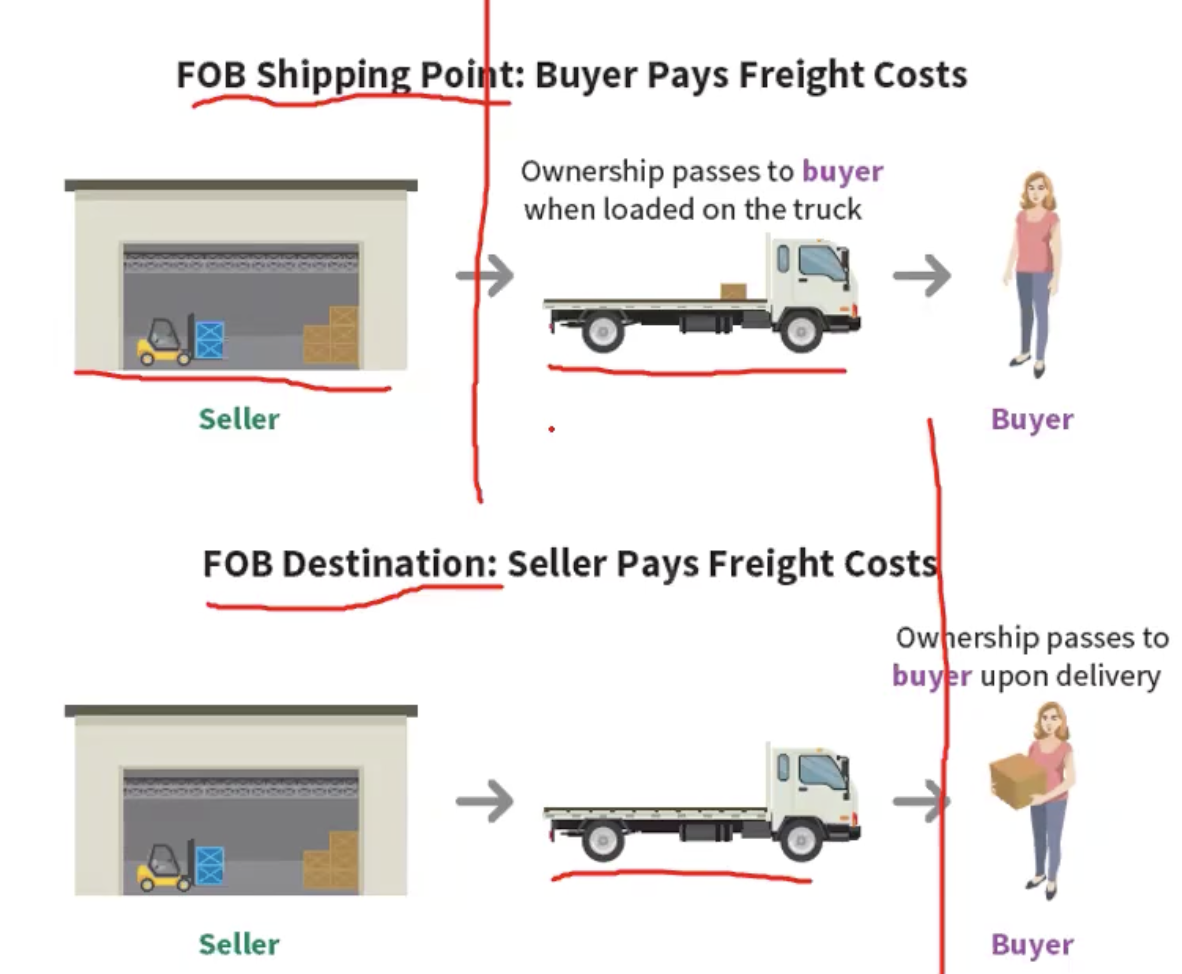
freight costs incurred by the seller are an operating expense.
Record purchases under a perpetual inventory system:
made using cash or credit (on accounts)
normally record when goods are recorded from the seller
purchase invoice should support each credit purchase
*normally pay on account
Example:


Example continued: Freight costs


buyer paying shipping:
why is it a debit to inventory?
when you’re buying inventory (the asset) and you pay shipping to get it in the door, the shipping is considered a part of the cost so you add it to the inventory account
seller paying shipping:

Purchase returns and allowances:
return: where you bought something and then you send it back.
purchaser may be dissatisfied because goods are damaged or defective, of inferior quality, or do not meet purchaser’s specifications
Purchase return:
physically send them back some or all of the units, and then you don’t have to pay for them.
return the goods for credit if the sale was made on credit, or for a cash refund if the purchase was for cash.
Purchase allowance:
keep all your units (nothing wrong with them) but get a little money back.
may choose to keep the merchandise if the seller will grant an allowance (deduction) from the purchase price.

Example:

Purchase Discounts
credit terms may permit buyer to claim a cash discount for prompt payment
advantages:
purchases saves money
seller shortens the operating cycle by converting the accounts receivable into cash more quickly
Example(s)
credit terms may read 2/10, n/30
net 30 means the balance is due in 30 days
2/10 means if you pay within 10 days you get 2% off (trying to incent you to pay early)

Example:



Example continued:
(Discount = $3,500 × 2% (.02) = $70)

Should discounts be taken when offered?

Summary of purchasing transactions:

Recording sales under a perpetual inventory system:
(we are the seller)
made using cash or credit (on account)
sales revenue, like service revenue, is recorded when the performance obligation is satisfied.
performance obligation is satisfied when the goods are transferred from the seller to the buyer
sales invoice should support each credit sale
Journal entries to record a sale


Example:

Sales returns and allowances
“Flip side” of purchase returns and allowances
Contra-revenue account to sales revenue (debit)
Sales not reduced (debited) because:
would obscure the relative importance of sales returns and allowances as a percentage of sales
could distort comparisons between total sales in different accounting periods
Example (not defective goods):


Example continued (defective goods):


Allowance example:

an allowance has no impact on inventory or cost of goods sold since no items are returned.
Sales Discount
offered to customers to promote prompt payment of the balance due
contra-revenue accounts (debit) to sales revenue
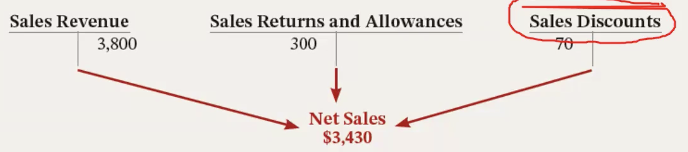
Example:


Example continued:


Data analytics and credit sales:
credit sales, sales returns and allowances, and sales discounts all provide rich opportunities for the use of data analytics.
effectively analyzing data regarding current and potential customers can help a company expand its sales base while minimizing the risk of unpaid receivables.
companies have refined their customer return policies as a result of data analytics applied to their data on product returns.
to achieve the optimal cost-benefit balance on sales discounts, companies statistically analyze past discount practices to determine how large the discount should be, how long the payment period should be, and other factors.
Adjusting entries for a merchandising company:
periodically, a company should actually count its inventory (test basis)
adjusting entries:
generally the same as a service company
one additional adjustment to make the records agree with the actual inventory on hand
the perpetual inventory records may be incorrect due to recording errors, theft, or waste.
involve adjusting inventory and cost of goods sold
What if you count inventory and it’s different?
if its a big different just check if something was recorded incorrectly or forgot to record that something got sold, or if something got stolen.
if its a small different you would just adjust.
Example:


Multi-step income statement
shows several steps in determining net income
two steps relate to principal operating activities
distinguishes between operating and non-operating activities
Example:

Single step income statement:
subtract total expenses from total revenues
two reasons for using the single-step format:
company does not realize any profit until total revenues exceed total expenses
format is simpler and easier to read
Example:

Inventory is classified as a:
current asset
so this is where you would see it on the classified balance sheet
chapter 5 example
canvas
Gross Profit Rate =
Gross Profit/Net Sales
How to classify and determine inventory:
merchandising company:
- one classification: merchandise inventory
manufacturing company
- three classifications: raw materials, work in process, finished goods
regardless of the classification, companies report all inventories under Current Assets on the balance sheet.

Determining inventory quantities:
involves counting, weighing, or measuring each kind of inventory on hand.
companies often “take inventory”
when the business is closed or business is slow.
at the end of the accounting period.
Determining ownership of goods:
goods in transit
purchased goods not yet received
sold goods not yet delivered
goods in transit should be included in the inventory of the company that has legal title to the goods. legal title is determined by the terms of sale