Prokaryotic Diversity L10 P2
 Call Kai
 Learn
 Practice Test
 Spaced Repetition
 Match
 Flashcards
 Knowt Play
1/9

There's no tags or description
Looks like no tags are added yet.
10 Terms
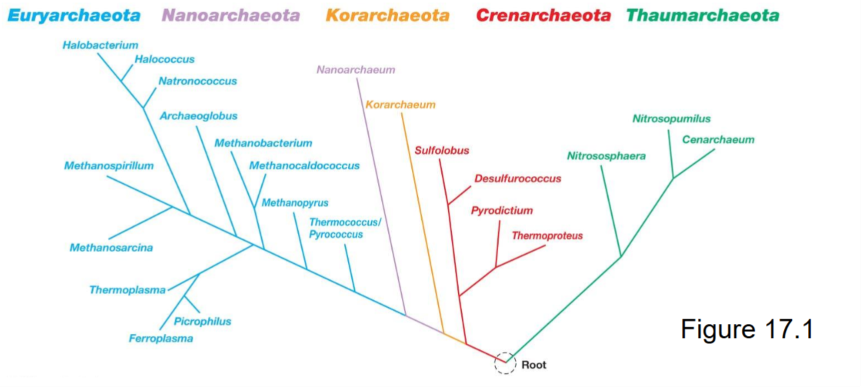
Characteristics of Archaea Diversity
Has 5 phyla’s
Many extremophiles
Common traits: Lack of peptidoglycan in cell wall, complex RNA polymerase, Ether-linked lipids
What is a extreme halophile
Needs salt to grow
Requires more than 1.5M NaCl for growth
What adaptations do extreme halophiles have
high levels of Na+ ions are necessary to maintain CELL WALL structure
intracellularly requires more KCl for activity, and contains higher levels of polar amino acids
What is a extreme thermophile
Needs high temperature to grow
What adaptations do extreme thermophiles have
Needs CHAPERONINS (heat shock proteins) to maintain properly folded proteins
reverse DNA GYRASE and also DNA binding proteins to prevent DNA from melting (separating)
Increased GC (Guanine and Cytosine) content in ribosomal RNA’s to maintain ribosomes
lipid MONOLAYER rather than a lipid BILAYER in the cell membrane
Characteristics of Euryarchaeota
Many methogens, produce CH4 as part of energy metabolism (METHANOGENESIS)
includes methanogens, halophilic Archaea and hyperthermophiles
Characteristics of Crenarchaeota
Mostly HYPERTHERMOPHILES
Most are obligate anaerobes
Metabolism is chemooranotrophic or chemolithotrophic
Characteristics of Thaumarchaeota
Adapted to EXTREME NUTRIENT LIMITATION
CHEMOLITHOTROPH AMMONIA-OXIDIZERS
nitrifying Archaea
Most abundance archaea in nature
Characteristics of Nanoarchaeota
Only grows when attached to another hyperthermophile
Only one species with a very small genome
Characteristics of Korarchaeota
Only one species found in GEOTHERMAL environments
Has a species name meaning secret filament of youth