Definition 1.16: What is the pivot of a matrix?
 Call Kai
 Learn
 Practice Test
 Spaced Repetition
 Match
 Flashcards
 Knowt Play
1/53

Earn XP
Description and Tags
The pivot of a row in a matrix is the leftmost nonzero entry in that row.
54 Terms
Definition 1.18: when is a matrix is row echelon form?
Definition 1.18. A matrix is in row echelon form if
(1) all rows consisting only of zeros are at the bottom
(2) the pivot of each nonzero row in the matrix is in a column to the right of the pivot of the row above it.
Definition 1.19: When is a matrix is reduced row echelon form?
Definition 1.19. A matrix is in reduced row echelon form if
(1) the matrix is in row echelon form
(2) the pivot in each nonzero row is 1
(3) each pivot is the only nonzero entry in its column.
Definition 1.26: what are pivot and non-pivot variables
Definition 1.26. Let C be the coefficient matrix for a system of linear equations in variables x1, . . . , xn. If the system of linear equations has at least one solution, we define the following.
(1) We say that xi is a pivot variable for the system if the ith column of rref(C) has a pivot.
(2) We say that xi is a nonpivot variable of the system if the ith column of rref(C) does not have a pivot.
Theorem 1.15 row equivalence
If two matrices are row equivalent, then the system of linear equations they represent as augmented matrices have the same solution sets.
Theorem 1.21 Gauss-Jordan
Theorem 1.21 (Gauss-Jordan). Every matrix A is row equivalent to a matrix in row echelon form B. Furthermore, if B is in reduced row echelon form, then B is unique.
Lemma 1.27 Pivot Paramaterization

Theorem 1.30 Rouche-Capelli

Proof of Theorem 1.30 Rouche Capelli

Definition 2.21: whats a linear combinition of vectors?

Definition 2.23: whats a span of vectors?

Definition 2.26: when is a set of vectors called linearly dependent?

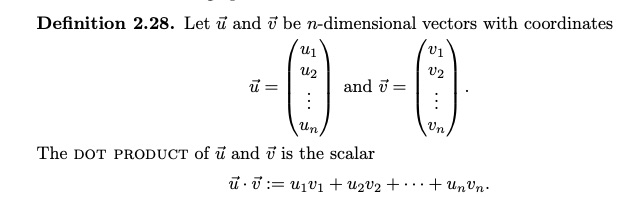
Definition 2.28: what is the dot product?
Definition 2.32: define norm, distance, and orthogonality. In words and in formula

Proposition 2.19 vector equations and systems

Proof of Proposition 2.19 vector equations and Systems

Theorem 2.27 Linear Dependence Theorem

Proof of theorem 2.27 Linear dependence theorem

Lemma 2.31 Properties of the Dot Product

Definition 3.3: what is a vector subspace of R^n? Support the definition with an example and a non-example.

Definition 3.5: what is a generating set? Support the definition with an example and a non-example.
Definition 3.6: what is a basis for a vector space? Support the definition with an example and a non-example.
Definition 3.10: Let V be a nonzero vector subspace of R n . Then, the dimension of V , denoted dim V , is… Also, provide an example and a non-example.
Definition 3.11: what is the standard basis for R^n? Provide an example and a non-example
Definition 3.16: what is the trivial vector subspace of R^n?
Theorem 3.4: Span-vector Space Equivalence Theorem
Proof of Theorem 3.4: Span-vector Space Equivalence Theorem
Theorem 3.9: Dimension Theorem
Proof of Theorem 3.9: Dimension Theorem
Lemma 3.12: Pivot Column Lemma
Proof of Lemma 3.12: Pivot Column Lemma
Theorem 3.13 Finding Bases
Theorem 3.14 Basis Characterization
Lemma 3.15 Subspace Dimension Lemma