Competition (exam 3)
 Call Kai
 Learn
 Practice Test
 Spaced Repetition
 Match
 Flashcards
 Knowt Play
1/30

There's no tags or description
Looks like no tags are added yet.
31 Terms
Define Competition
Competition is when organisms try to use the same limited resources
Define Interspecific Competition
Competition between different species
-vultures vs hyenas for food
Define Intraspecific Competition
Competition within the same species
-vultures vs each other for access to carcass
Liebig’s Law of the Minimum
“Under steady state conditions, the population size of a species is constrained by whatever resource is in shortest supply”
-This model couples the availability of resources to population growth
-Even if all other sources are abundant, one scarce resource can limit population growth rate, population size, and competition outcomes
-Example: A plant may have plenty of water and sunlight, but if phosphorus is scarce, phosphorus limits growth
Define the Gause’s Competitive Exclusion Principle
-If two species occupy the same niche and use the same limiting resources, one species will eventually outcompete and exclude the other
-Two species cannot indefinitely occupy the exact same niche
Paramecium aurelia vs Paramecium caudatum
Gause’s Competitive Exclusion Principle
-When P.aurelia and P.caudatum were grown allopatrically, both species grew well at an exponential rate
-When P.aurelia and P.caudatum were grown sympatrically, P.aurelia outcompeted P.caudatum
Define the R* Rule
-R* is the minimum number of resources required for a species to maintain its population
-Species with the lowest R* value wins competition
-Whoever can survive at the lowest resource level will win in competition
-Whoever wins depends on the environment and which resources are available/limited
Competition outcomes can change depending on:
-Which resource is limiting
-Environmental conditions
-Climate variation
-No species is always the winner
Niche
-Definition: A niche is the complete role or job of an organism in its environment
-Includes:
1. Habitat
2.Resource use
3.Interactions with other species
4.Environmental requirements
5.Feeding behavior/Diet
6.Predators and prey
7.Competitors and Mutualists
8.Needs
Habitat
-Definition: the physical place where an organism lives and it is determined by its niche
Geographic Range
-Definition: the area where a species could be found
-can be specific or flexible
Hutchinson’s Niche Concept
-Definition: a niche is an n-dimensional hypervolume
-This means that many environmental variables influence where a species can survive
-Examples:
1.water and food availability
2.temperature
3.prescence of mutualists, predators
Ecological Niche Modeling
-Definition: If the niche of an organism is known, scientists can predict where the species live, where it could live in the future, and where invasive species might spread to
-Use the Geographic Information System (GIS)
Define Niche Breadth
-Refers to the range of environmental conditions and resources a species can use or tolerate
-Species with a broad niche breadth can live in many environments and use different resources
-Species with a narrow niche breadth is more specialized and can only survive under specific conditions
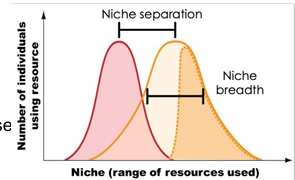
Define Niche Separation
-The difference between the niches of two species, which reduces the competition between them
-Species can coexist when they use resources differently

Barnacle Competition Study
-Joseph Connell
1.Semibalanus
-larger barnacle that lives in lower intertidal zones
-grows fast
2.Chthamalus
-smaller barnacle that livers high in intertidal zones
-Experiment
1.Connell removed Semibalanus from lower intertidal zones
Results
1.Chthamalus expanded downward and Connell concluded that Chthamalus can survive lower on the shore. Semibalanus was preventing Chthamalus from growing lower on the shower.
-Semibalanus is the better competitor. It physical can remove Chthamalus from the rocks.
Define Fundamental Niche
-All places a species COULD live if competition did not exist
-Example: Chthamalus could occupy most of the intertidal zone if Semibalanus was not present

Define Realized Niche
-Where the species actually lives under real conditions
-Example: Competition from Semibalanus restricts Chthamalus to the upper intertidal zone.
-Competition usually makes the realized niche smaller than the fundamental niche

Define Interference Competition
-Organisms utilizing fight, aggression or territorial behavior to prevent competitors from accessing/obtaining scarce resources
Ex: Hyenas and lions fighting over food
Define exploitation competition
-Organisms take all the resources for themselves before competitors can use them.
-No aggression
Define Apparent Competition
-Competition between 2 prey species indirectly caused by a shared predator
Example: Brassica nigra vs Nassella pulchra
-researchers thought the plants were competing directly
-In reality, mice lived near these plants and would eat Nassella seeds. The mice were preventing Nassella from growing
Competition Coefficients
-Measures how much one species affects the population growth of another species
Example:
Impact of species 2 on species 1
Impact of species 1 on species 2
Isoclines
-Definition: lines representing combinations of population sizes where the growth rate = 0
-Above the isocline: population decreases
-Below the isocline: population increases
-used to predict competition outcomes
Stable Equilibrium (Coexistence)
Characteristics:
Isoclines cross
Carrying capacities are relatively low
Weak competition against the 2 species
Result:
Both species survive together
If one species increases temporarily, the system returns to equilibrium.


Stable equilibrium: if population sizes end up in green (above the carrying capacity) the populations decrease; if in yellow (below K) then populations increase; if blue then both species can coexist
Unstable Equilibrium
Characteristics:
Isoclines cross
Carrying capacities are relatively high
Strong competition between the 2 species
Co-existing is temporary
Result:
Outcome depends on starting population sizes.
If Species 1 begins with an advantage:
Species 1 wins.
If Species 2 begins with an advantage:
Species 2 wins.
Small changes determine the winner


Unstable equilibrium: if population sizes end up in green (above the carrying capacity) the populations decrease; if in yellow (below K) then populations increase; if blue then species 2 is excluded or 1 can be excluded
Competition: Species 1 Wins
Characteristics:
Parallel isoclines
Species 1 outermost
ultimately end up where its stable
Result:
Species 2 eliminated

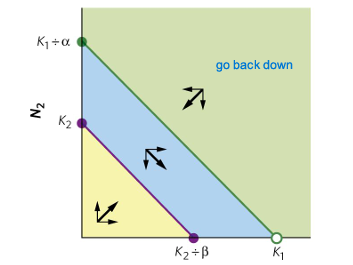
Species 1 “wins”: if population sizes end up in green (above the carrying capacity) the populations decrease; if in yellow (below K) then populations increase; if blue then species 2 is excluded
Competition: Species 2 Wins
Characteristics:
Parallel isoclines
Species 2 outermost
ultimately end up where its stable
Result:
Species 1 eliminated


Species 2 “wins”: if population sizes end up in green (above the carrying capacity) the populations decrease; if in yellow (below K) then populations increase; if blue then species 1 is excluded