2nd Exam - ABT 101
 Call Kai
 Learn
Learn Practice Test
 Spaced Repetition
 Match
Match Flashcards
 Knowt Play
1/83

There's no tags or description
Looks like no tags are added yet.
Name | Mastery | Learn | Test | Matching | Spaced | Call with Kai | Chat |
|---|
No analytics yet
Send a link to your students to track their progress
84 Terms
Central Dogma of Molecular Biology
detailed residue-by-residue transfer of sequential information

Deoxyribonucleic Acid (DNA)
semi-conservative
bidirectional
leading and lagging strand
replication fork
helicase
unwound DNA by breaking down hydrogen bonds between nucleotide in base pair
single-strand binding protein (SSB)
stabilize unwound strands so they wont bind again
topoisomerase/gyrase
relieves supercoiling
DNA primase
stretch of RNA attaches to this
RNA primer
attaches to DNA primase to provide a free 3′-OH group required by DNA polymerase to start DNA replication
DNA Pol III
synthesizing new DNA strands in 5’ to 3’ direction
possesses 3’→5’ exonuclease (free nucleoside triphosphates) activity for proofreading

Okazaki fragments
discontinuous segmentsd
DNA ligase
glues/bonds adjacent nucleotides that are not held together by phosphodiester bonds (between fragments)
DNA Pol I
remove RNA primers and replace with correct nucleotides (proofreading)

DNA Pol II
backup and repair enzyme
genes
‘beads on a string’
basic unit of info
gene linear arrangement
UPSTREAM
enhancer - binds proteins to boost gene transcription
recognition site - where protein will bind
regulatory region - regulate the expression of gene
repressor - blocks transcript
promoter - RNA pol binding site that initiates transcription
DOWNSTREAM
transcription start site (TSS) - loc where transcription begins (+1 position - ATG)
5’ UTR - non-coding that control how, when, and how much protein the cell makes from that mRNA
signal peptide sequence - dictates protein transport to continue the expression
exons - coding region for proteins and kept for the final mRNA as they contain information for making proteins
introns - non-coding for proteins that organize and regulate those instructions but are spliced out during RNA processing (removed during splicing)
terminator site - signal RNA pol to cease transcription
3’ UTR - to control gene expression by regulating mRNA stability, translation efficiency, and subcellular localization
poly A signal - prevents early decay of mRNA (decay = lesser proteins)
introns
intervening sections that are removed but can help regulate the gene and allow different exon combinations
exons
useful sections that are exported/expressed in the mature mRNA
mRNA
codes for protein
rRNA
forms basic structure of ribosomes and catalyze protein synthesis
tRNA
central to protein synthesis as adaptors between mRNA and amino acids
promoters
PROKAYOTES
pribnow box (-10 element) - TATAAT
(-35 element) - TTGACA (eg. e. coli, lacto bacillus)
EUKARYOTES
TATA box (-25-30 element) - TATAAA(A) (eg. plant)
DNA binding motifs
Help proteins attach to specific parts of DNA to control gene expression
zinc finger - zinc ion (Zn²⁺) to stabilize its structure
helix-turn-helix - two α-helices connected by a turn
leucine zipper - Two α-helices zip together through leucine interactions, forming a dimer

DNA Supercoiling
as RNA pol proceeds to transcribe the DNA strand, it results to squeezing tension and untwisted strands
Topo Type I & II - snip to fix then glue
types of RNA polymerase
Polymerase I - makes rRNA
Polymerase II - makes mRNA
Polymerase III - makes tRNA
RNA Polymerase II
carboxy terminal domain (CTD)
addition of phosphate groups
phosphorylation causes disconnection of polymerase from transcription factors (proteins that bind to specific dna sequence) to move and build the mRNA
newly phosphorylated tail hold the three major mRNA processing teams
capping
splicing
polyadenylation
capping
addition of 5’ cap to pre-mRNA
protects RNA and helps with translation
methyl group is added to the guanine nucleotide at the 5’ end
cap binding complex (CBC) proteins - also protect the cap then later direct transcript its exit from nucleus

polyadenylation
addition of poly(A) tail to the 3’ end
increases mRNA stability and protects from degradation

splicing
introns are removed while exons still intact
produces mature mRNA
begins with GT (5’ splice site) and ends with AG (3’ splice site)
branch site (A) helps form the lariat loop (shape made when the intron is removed)
GT-A-AG
cutting - GT loops around A then cut at AG

spliceosome
multi-protein and RNA machine that performs splicing
made of five snRNAs (U1, U2, U4, U5, U6) combined with proteins to form snRNPs
U1 - binds to GU
U2 - binds to A
U4/5/6 - trimer (U5_5’ exon, U6 binds to U2)
Cell Avoids Splicing Mistakes
introns very large, while exons are small (around 150 bases long)
exons are easier to spot
exon definition to mark the pieces
RNA processing
heterogenous nuclear RNA (hnRNA) —»»» mature mRNA
Transcription terminators
specific DNA sequence near the end of a gene that tells RNA polymerase to stop transcription
rho-independent termination
no rho protein
RNA → 🪮 hairpin forms → RNA polymerase pauses → RNA is released
rho-dependent termination
rho protein - moves along the newly made RNA then eventually catches up with RNA polymerase
causes RNA-DNA interaction to break
tRNA
anticodon - 3’ to 5’ sequences that complements mRNA (codon)
acceptor arm - amino acid code on 3’ end
T and D loops - structure for interface w/ aminoacyl-tRNA synthetase
wobble position - 3rd base meets the 1st base of anticodon
ribosome
cell's protein-building factories
large subunit(LSU) and small subunit (SSU)
PROKARYOTIC RIBOSOME (70S total)
50S LSU
5S rRNA
23S rRNA
30S SSU
16S rRNA
EUKARYOTIC RIBOSOME (80S total)
60S LSU
5S rRNA
28S rRNA
5.8S rRNA
40SSU
18S rRNA
LSU sites
A site (Aminoacyl) - next incoming tRNA enters
P site (Peptidyl) - growing protein/polypeptide chain
E site (Exit) - empty tRNAs exit the ribosome
Translation Elongation
EF-Tu + GTP — deliver new tRNA to the ribosome bound to a high-energy molecule (GTP)
built-in delay and hybrid holding step boost translation accuracy
wrong match — tRNA binds weakly, slips out, and dissociates before any energy is used
correct match - strong base pairing triggers EF-Tu to split GTP into GDP and phosphate (P), EF-Tu changes shape and detaches from tRNA
Translation terminators
stop codon - UAA, UAG, UGA
no tRNA binds to this set of codons
while in A site, release factors will appear
ribosome adds water to the last peptide (carboxyl end)
Post-Translational Modification (PTM)
chemical tag (eg. phosphate,methyl, or sugar grps) attached to a protein after it has been built by the ribosome to change its shape, location, or job
Proteome - complete set of functional, active proteins in a cell
Genome - Your complete set of DNA/genes (the recipe library)
1 GENE = receive many diff PTMs = Proteome larger and more complex
protein folding as they are translated to interact with other molecules
four possible pathways of new proteins
Folds Automatically (No Help Needed)
Folds with a Helper (Molecular Chaperones)
Destroyed and Recycled (The Proteasome)
Clumping Up (Protein Aggregates) - misfolded proteins
Molecule Chaperones
elper proteins that act like "babysitters" or "folding assistants" to make sure other proteins fold correctly instead of clumping into toxic messes
Hsp70 — grabbing raw, uncoiled amino acid chains as they are being made Prevents early clumping)
Hsp60 — like an isolated barrel or chamber for final folding checks (Quality control & cell survival regulation)
protein destruction
marked for destruction by the addition of ubiquitin on exposed lysine residues
most common PTM types
phosphorylation
glycosylation
acylation
alkylation
hydroxylation

phosphorylation
phosphate group added to certain amino acid
serine (ser), threonine (Thr), Tyrosine (Tyr)

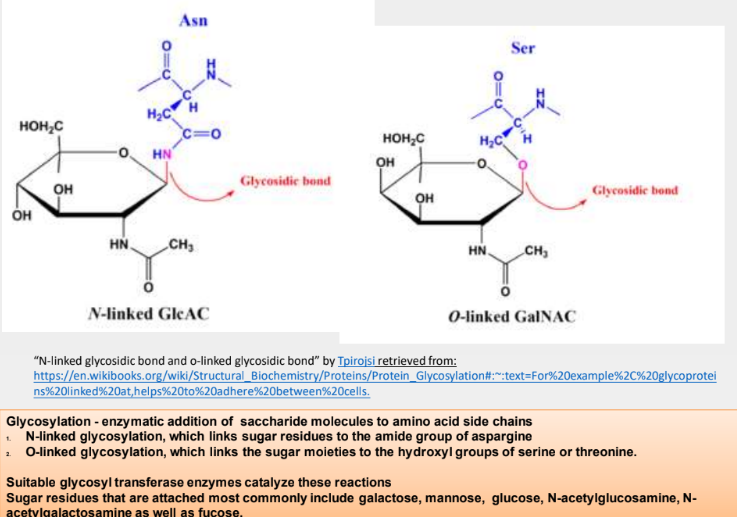
glycosylation
sugar moieties attachment to nitrogen/oxygen atoms in side chains of amino aids
Aspargine, Serine, Threonine
Acylation
acyl group linked to the side chain of amino acids
aspargine, glutamine, lysine

alkylation
alkyl group (eg. methyl grp) added to amino acids
lysine or arginine
longer chain alkyl grps may also attach in some cases

hydroxylation
PTM mostly found on proline and lysine residues which make up the collagen tissue
enables crosslinking which strengthens muscle fibers

protein synthesis
PTM
Protein translation
Cytosol
Signal sequence
Endoplasmic reticulum
Cleaved protein
proteins
polymers of amino acids joined together by peptide bonds
final products of gene expression
protein classification (CSSR)
by CHARGE
anionic (negative) - 95-97%
cationic (positive) - 3-5%
by SHAPE
globular - ball-like/compact for functional
fibrous - long, strand-like for structural
by SIZE
small, medium, large
based on amino acid length
based on molecular weight
by ROLE/FUNCTION
metabolic proteins
structural proteins
regulatory proteins
amino acid structure
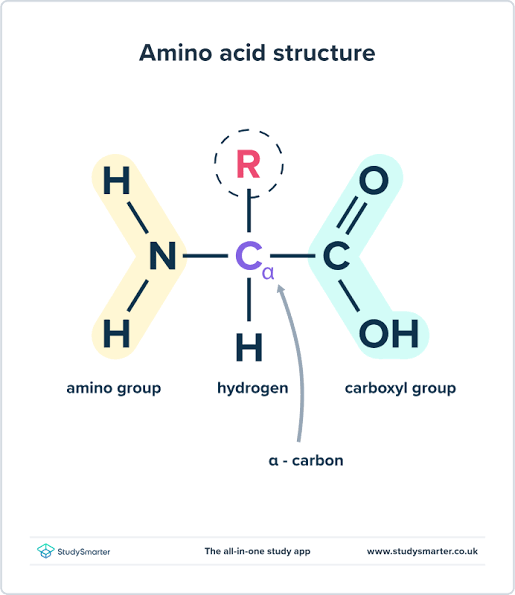
peptide bond formation
-OH release to connect to the amino group of another amino acid
Chemical Families of Side Chains
nonpolar, aliphatic
polar, uncharged
positively charged
negatively charged
nonpolar, aromatic
nonpolar, aliphatic (hates water)
glycine
alanine
valine
leucine
methionine
isoleucine
polar, uncharged
serine
threonine
cysteine
proline
asparagine
glutamine
positively charged
lysine
arginine
histidine
negatively charged
aspartate
glutamate
nonpolar, aromatic
phenylalanine
tyrosine
tryptophan
Structures of proteins
amino acid sequence determines how a protein folds, and the final shape determines what the protein can do
Primary
Secondary
Tertiary
Quaternary

primary protein
PROTEIN FOLDING
exact sequence of amino acids in a polypeptide
had diff R-group to interact w/ other R groups, water, and protein backbone
Primary structure → determines folding → determines 3D shape → determines function
secondary structure
local spatial conformation of the polypeptide backbone
two common structural elements (repetitive)
α-helix
backbone coils like a spring
β-sheet
backbone folds back and forth, creating a sheet-like structure
holds together by hydrogen bonds between peptide backbone

beta turn (non-repetitive structural)
4 residues
Carbonyl O of residue n «» N-H of residue n+3
short structure that reverses the direction of the polypeptide chain
omega loops
flexible region that connects structured regions such as α-helices and β-sheets
α-helix → loop → β-sheet → loop → α-helix
tertiary structure
three-dimensional structure of a single polypeptide chain
R-group interactions
charges - attractions help stabilize the protein's structure
hydrophobic - inside protein
hydrophilic - outside protein
disulfide bonds - Cys – S – S – Cys
(some amino contain sulfure)
relatively stronger due to covalent bonds
more resistant to denaturation (structure and biological activty)

quaternary structure
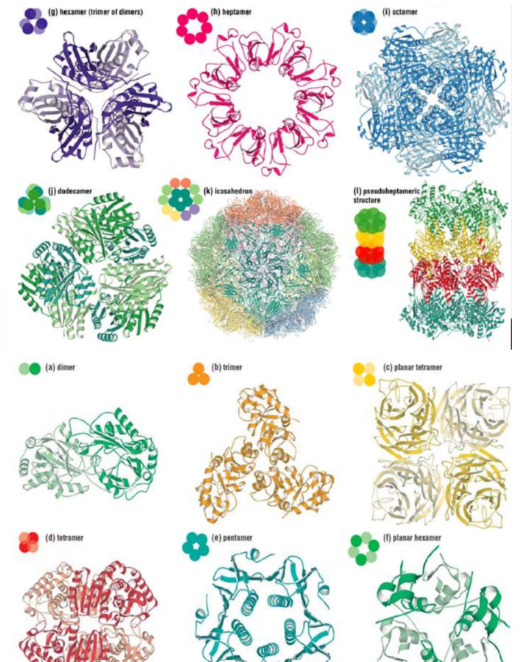
TWO OR MORE polypeptide chains
individual chains are called: Subunits

Recombinant DNA
DNA made by combining genetic material from two different sources
Polymerase Chain Reaction
amplification
increase the number of copies of a particular DNA sequence
Plasmid
acts as a vector that carries foreign genetic material into a host cell
Restriction endonuclease
cuts the sugar-phosphate backbones
sticky ends
produced when annealing the fragment to the plasmid when both molecules are cut by the same restriction enzyme
DNA ligase
seals the sugar-phosphate backbone of DNA fragment that have been joined
Transformation
plasmid to bacteria
Electroporation
Heat shock
Electroporation
bacteria exposed to a sudden change in temperature create temporary openings in the bacterial membrane
Heat shock (42C)
short electric pulse create temporary openings in the bacterial membrane
Blue-white screening
Selection of bacteria with transformants
Blue - plasmid w/o inserted gene
White - plasmid w/ inserted gene
Ampicillin
kills the cells that lack the inserted gene
Antibiotic resistance gene
helps identify bacteria that successfully received the plasmid
Tissue-specific promoter sequence
controls where the transgene is expressed (eg. leaves, roots, fruits)
Transgene (gene of interest)
desired gene inserted to produce a specific trait or function
stop sequence
signals the end of gene transcription
telling to stop copying the gene into RNA
Techniques to Insert Genes in Plants
Particle Bombardment or Biolistics (Gene Gun)
Agrobacterium-mediated
Particle Bombardment or Biolistics (Gene Gun)
uses gene construct/naked DNA
coated onto very small metal particles, commonly gold or tungsten
Microparticle Bombardment Biolistics and Gene Gun
use of high-velocity microprojectiles to penetrate the out/inner layer of the plant cell
DNA → coat tiny particles → shoot → penetrate → DNA enters cell → gene expression
Agrobacterium-mediated
Agrobacterium tumefaciens
naturally transfer a piece of its DNA into a plant cell
Ti (tumor-inducing) plasmid
allows Agrobacterium to cause tumor formation in infected plants
T-DNA in Ti plasmid
fragment transferred from the bacterium into the plant cell
left and right border tells what DNA region should be transferred
RB - T-DNA transfer starts
LB - end of transfer
Binary Vector system
introduce foreign DNA to agrobacterium cells
created from Ti plasmid but with modification instead of having one huge Ti plasmid containing everything, the functions are separated into two plasmids
Modern Biotechnology
Polymerase chain reaction (PCR)
Electrophoresis
Sothern, Northern, and Western Blotting