Lifesci 7a - Week 1 Chemistry of Life and Cell Organization
 Call Kai
 Learn
 Practice Test
 Spaced Repetition
 Match
 Flashcards
 Knowt Play
1/55

There's no tags or description
Looks like no tags are added yet.
56 Terms
In the early 1900s, Ernest Rutherford produced a beam of very small positive particles and directed it at a thin piece of gold foil just a few atoms thick. Most of the particles passed through the foil without changing their path; very rarely, a particle was deflected. What conclusions can you draw from this experiment about the structure of an atom?
One conclusion is that atoms consist mainly of empty space, so most positively charged particles passing through the gold foil do not come close enough to any other positive charge to be deflected. Another conclusion is that the positively charged protons in the nucleus must be small and densely packed.
What are atoms made up of? Describe each component.
An atom is made up of positively charged particles called protons, neutral particles called neutrons, and negatively charged particles called electrons.
The dense central nucleus of an atom is made up of protons and neutrons.
Electrons orbit around the nucleus, and the regions of space where they are most likely to be found are called orbitals.
What is the logic behind how the periodic table of the elements is organized?
The periodic table of elements is organized based on the increasing atomic number of each atom. The atomic number is the number of protons found in the nucleus of an atom. Hydrogen appears first in the periodic table because it has an atomic number of one. The elements in a column share similar chemical properties, and each has the same number of electrons in its outermost orbital. Elements in a row have the same number of shells (energy levels), and thus the same number and types of orbitals.

From their positions in the periodic table (Fig. 2.3), can you predict how many lithium (Li) atoms and hydrogen atoms can combine to form a molecule?
Hydrogen and lithium are in the same column, or group, in the periodic table. Each has one valence electron in its outer orbital. As a result, one atom of lithium combines with one atom of hydrogen to make lithium hydride, which contains a full complement of two electrons in its single molecular orbital.
What are the differences between covalent bonds and polar covalent, hydrogen, and ionic bonds?
A covalent bond is present when two atoms share their valence electrons (the electrons in the outermost orbital of an atom). Each shared pair of valence electrons makes a covalent bond, depicted by a single line connecting the two chemical symbols for the atoms.
A polar covalent bond is present when the valence electrons are not shared equally by the two atoms, thus giving areas of the molecule a positive or negative charge.
A hydrogen bond forms when a hydrogen atom that is covalently bound to an electronegative atom (giving the hydrogen a partial positive charge) interacts with an electronegative atom of another molecule. A hydrogen bond is typically depicted by a dotted line connecting the two chemical symbols for the atoms.
An ionic bond is formed by the attraction between a molecule that has a positive charge (due to the loss of one electron) and a molecule that has a negative charge (due to the gain of one electron). The two molecules are not covalently bound, but they associate with each other due to their opposite charges.
Why do containers of water, milk, soda, and other liquids sometimes burst when frozen?
Ice is less dense than liquid water. As a result, when water freezes, it expands in volume and can burst closed containers, such as cans of soda or water pipes in houses. This property is unusual. For most substances, the solid phase is more dense than the liquid phase.
What are three properties of water that make water conductive to life?
Water has unusual properties and is conducive to life. Water is a polar molecule. Because of its regions of positive and negative charge, some molecules are attracted to water (hydrophilic) and some are repelled by it (hydrophobic). It is this property that allows lipid cell membranes, and thus cells, to form. The polar nature of water also makes it a good solvent-hydrophilic compounds dissolve readily in water.
Water has a neutral pH (around 7), the approximate pH of most cells. Since many chemical reactions can be carried out only in a solution with a near-neutral pH, it is important that the pH of the cell remain within this range to function.
Water forms extensive hydrogen bonds. As a result, water resists temperature changes better than other substances. This phenomenon allows chemical reactions, which produce heat as a by-product, to occur inside the cell without changing the internal temperature. In a similar way, but on a global scale, the oceans act as a temperature regulator and keep Earth in a temperature range that supports life. The network of hydrogen bonds that forms when water freezes makes ice less dense than liquid water. As a result, ice floats on water, which allows aquatic life to survive below the ice in the winter. Finally, hydrogen bonds result in cohesion and surtace tension, which facilitate water transport in plants.
An ionic bond occurs due to…
an attraction of opposite charges
The structural formula for hydrogen gas (H2) is represented as H–H. The dash (–) represents a(n)…
chemical bond
A molecule of common table salt, or NaCl, is the result of ______ bond forming between a sodium (Na) atom and a chlorine (Cl) atom.
an ionic
A woman's doctor tells her to gargle with salt water. She stirs a tablespoon of salt into a cup of warm water and watches the salt dissolve.
Why does the salt dissolve in water?
The partial positive charges on hydrogen atoms in water molecules are attracted to chlorine ions, and the partial negative charges on oxygen atoms in water molecules are attracted to sodium ions.
The unique properties of water are due to the ______ of water molecules and the ability of water to form ______ with other water molecules and with other polar molecules.
polarity; hydrogen bonds
Water is able to dissolve many compounds as a result of which fact?
the fact that water molecules are polar
Which of the statements is true regarding a polar molecule?
A polar molecule is hydrophilic and will dissolve in water.
T/F: Water is neither hydrophilic nor hydrophobic, because these terms only define the interaction of other molecules with water molecules.
False
The ability of atoms to attract electrons is referred to as…
electronegativity
Of the following types of bonds or interactions between atoms in aqueous solutions, which is the WEAKEST?
van der Waals forces

Take a close look at Fig. 2.22. How is glucose different from galactose?
Glucose and galactose differ only in the orientation of the -OH and -H groups attached to carbon 4.
What are the essential functions of proteins, nucleic acids, carbohydrates, and lipids?
Proteins act as catalysts to facilitate chemical reactions and also provide structural support of the cell. Nucleic acids encode and transmit genetic information. Carbohydrates provide a source of energy and make up the cell wall in bacteria, plant, and algae cells. Lipids store energy, act as signaling molecules, and make up the membranes of the cell.
How is diversity achieved in polymers? Use proteins as an example.
Diversity is achieved in polymers through numerous combinations of subunits. A protein, for example, is a polymer of amino acid subunits. As we discuss in Chapter 5, there are 20 different kinds of amino acids. Thus, any combination of subunits can be made, each resulting in a different protein. In this way, polymers are capable of displaying virtually limitless diversity.
What are the basic structures of amino acids, nucleotides, monosaccharides, and fatty acids? Sketch your answers.
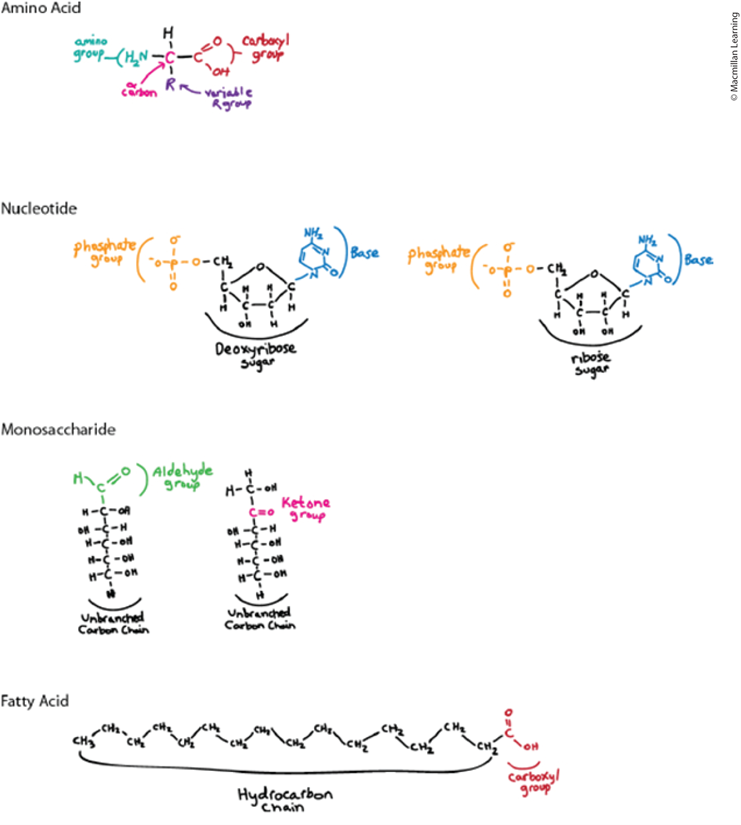
What are the three basic tenets of the cell theory?
The cell theory states that all organisms are made up of cells, the cell is the fundamental unit of life, and cells come from preexisting cells.
What are the major differences between prokaryotic and eukaryotic cells?
Compare their organization, degree of compartmentalization, and relative size.
Prokaryotic cells lack a nucleus and extensive internal compartmentalization. Prokaryotic cells are small (usually 1-2 micrometers in diameter or smaller). Because of their small size, they have a large surface-area-to-volume ratio, which means they are able to absorb nutrients from the environment to meet their metabolic needs. Eukaryotic cells have a nucleus and specialized internal structures called organelles. They are 10 times larger in diameter and 1000 times larger in volume than a prokaryotic cell.
How do lipids with hydrophilic and hydrophobic regions behave in an aqueous environment?
In an aqueous environment, the polar hydrophilic head group readily interacts with the polar water molecules. In contrast, the nonpolar hydrophobic tail does not readily interact with water, but instead interacts with other nonpolar tail groups or hydrophobic molecules. For example, a micelle forms when the polar head group of a lipid interacts with water and the hydrophobic tails of the lipids interact with each other, excluding the water. Lipids can also form bilayers and liposomes (Fig. 3.5).
Like cell membranes, many fats and oils are made up in part of fatty acids. Most animal fats (like butter) are solid at room temperature, whereas plant fats (like canola oil) tend to be liquid. Can you predict which type of fat contains saturated fatty acids and which type contains unsaturated fatty acids?
Saturated fatty acids are less mobile within the membrane compared to unsaturated fatty acids. As a result, saturated fatty acids tend to be solid at room temperature, whereas unsaturated fatty acids tend to be liquid. Butter and many other animal fats contain saturated fatty acids and are solids, whereas many plant (and fish) oils contain unsaturated fatty acids and are liquids at room temperature.
What are two ways in which proteins associate with membranes?
Proteins can associate with membranes in the following ways. First, integral membrane proteins are permanently associated with the membrane and cannot be removed without destroying the membrane itself. Most integral membrane proteins span the cell membrane, so they have both hydrophilic and hydrophobic regions. Second, peripheral membrane proteins are temporarily associated with the membrane and can easily be experimentally separated. These proteins can be associated with either the internal or external side of the membrane. They are mostly hydrophilic and interact with the polar heads of the lipid bilayer, or the hydrophilic regions of integral membrane proteins.
What would happen in the FRAP experiment if proteins did not move in the plane of a membrane?
An experiment showing that proteins move in membranes uses the fluorescence recovery after photobleaching (FRAP) technique. First, the proteins embedded in the cell membrane are labeled with a fluorescent dye. A laser is then used to bleach a small area of the cell surface so that it no longer fluoresces. Eventually, the fluorescently labeled proteins from other parts of the cell move into the bleached area and cause it to fluoresce once again. If the proteins did not move in membranes, that area would stay bleached over time.
What are the names and functions of the major organelles of the endomembrane system in eukaryotic cells?
The nucleus encloses the cell's genetic information and is the site of transcription. The endoplasmic reticulum (ER) is the organelle in which proteins and lipids are synthesized. The Golgi apparatus modifies proteins and lipids produced by the ER and acts as a sorting station as those molecules move to their final destinations. Lysosomes contain enzymes that break down macromolecules such as proteins, nucleic acids, lipids, and complex carbohydrates.
How do lysosomes illustrate the importance of compartmentalizing certain reactions in different spaces in the cell?
Lysosomes have an acidic environment, with a pH of about 5. This environment works well for degrading macromolecules, which is one of the functions of lysosomes. It's important that these reactions are confined to lysosomes because many of the cell's proteins required for cellular function would unfold or degrade at such a low pH.
Are mitochondria present in animal cells, plant cells, or both?
Mitochondria are present in both animal and plant cells.
What are three similarities between mitochondria and chloroplasts?
Both mitochondria and chloroplasts are organelles involved in energy metabolism; they are descendants of free-living bacteria; they are surrounded by a double membrane; and they contain circular genomes.
All cells have…
genetic information
The lipid components of cellular membranes often include…
phospholipids and cholesterol.
The plasma membrane is composed of a phospholipid bilayer and associated proteins.
What else is commonly found in the plasma membranes of animal cells?
cholesterol
The exterior region of a phospholipid bilayer is characterized as…
hydrophilic and polar
If cells had single-layer membranes like micelles, how would the structures of transmembrane proteins be affected?
Transmembrane proteins would possess a hydrophobic region in the cell interior and a hydrophilic region in the extracellular space.
How do eukaryotic plant and animal cells differ from one another?
Animal cells do not have chloroplasts and cell walls, and plant cells do.
Which eukaryotic cell structure plays a role in generating energy for the cell?
mitochondria
A bacterial cell, a plant cell, and an animal cell have which component in common?
genetic material
Which eukaryotic organelle is associated with the storage of the cell's genetic material?
nucleus

Six carbon atoms are linked by single covalent bonds such that they form the shape of a hexagon (see below). All of the unshared electrons form covalent bonds with hydrogen atoms.
How many hydrogen atoms should this molecule have to exist in nature?
12

Consider the molecule shown here (Molecule X). The minus sign next to oxygen represents a full negative charge on that atom. Answer the following questions about Molecule X.
T/F: Molecule X contains at least one ionic bond.
False

Consider the molecule shown here (Molecule X). The minus sign next to oxygen represents a full negative charge on that atom. Answer the following questions about Molecule X.
T/F: Molecule X is hydrophilic.
True

Consider the molecule shown here (Molecule X). The minus sign next to oxygen represents a full negative charge on that atom. Answer the following questions about Molecule X.
T/F: Molecule X is able to form a hydrogen bond with another Molecule X.
False
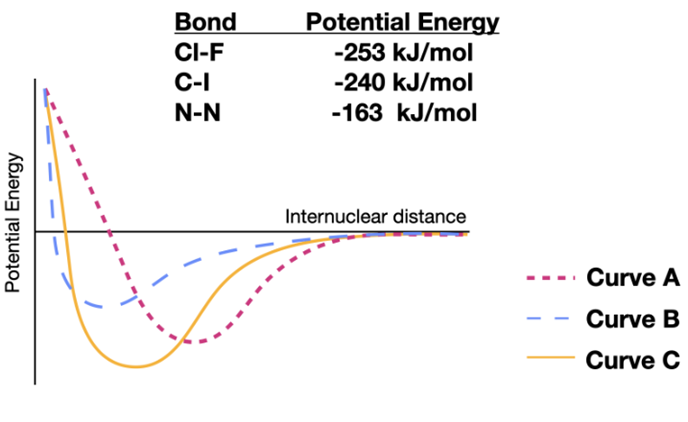
The following image shows the relationship between internuclear distance and potential energy for three different pairs of atoms. Each curve (A, B, and C) represents the interaction between one of the pairs of atoms shown in the table. The table shows the potential energy at the observed bond length for each pair of atoms. Use this diagram to answer the following questions.
Which atom pair forms the strongest bond?
Cl - F

The following image shows the relationship between internuclear distance and potential energy for three different pairs of atoms. Each curve (A, B, and C) represents the interaction between one of the pairs of atoms shown in the table. The table shows the potential energy at the observed bond length for each pair of atoms. Use this diagram to answer the following questions.
T/F: Breaking a bond between two N atoms would release 163 kJ/mol of energy.
False
Which organelles would you find in relatively high abundance in cardiomyocytes (heart muscle cells that pump blood throughout the body)?
Mitochondria
Which of the following molecules (see below) would most likely require a transport protein to cross the plasma membrane of a red blood cell?
C6H12O6
H2O
CO2
O2
C6H12O6

The beaker in the illustration contains two solutions of salt with different concentrations (measured by molarity, M). The two solutions are separated by a membrane.
If the membrane were permeable to water but not to salt, what would occur in this container?
diffusion of water from A to B, but no diffusion of salt
The diagram below shows a cell with three different membrane transport proteins: The Na+/K+ Pump, the Na+/Waste Co-transporter, and the Na+ Channel.
The Na+/K+ Pump is a primary active transporter, and the Na+/Waste Co-transporter is a secondary active transporter; arrows show the direction of net movement of molecules through the Pump and Co-transporter. Lastly, the Na+ Channel can exist in either a closed state (no Na+ can pass through) or an open state (Na+ can pass through by facilitated diffusion); unless otherwise stated, you can assume the Na+ Channel to be in its closed state.
What will happen when the Na+ channel is open?
There will be net movement of Na+ into the cell through the channel
The diagram below shows a cell with three different membrane transport proteins: The Na+/K+ Pump, the Na+/Waste Co-transporter, and the Na+ Channel.
The Na+/K+ Pump is a primary active transporter, and the Na+/Waste Co-transporter is a secondary active transporter; arrows show the direction of net movement of molecules through the Pump and Co-transporter. Lastly, the Na+ Channel can exist in either a closed state (no Na+ can pass through) or an open state (Na+ can pass through by facilitated diffusion); unless otherwise stated, you can assume the Na+ Channel to be in its closed state.
Assume you were to insert a Waste transport channel (in its open state) into the plasma membrane of this cell. After this change, what would happen to the concentration of Waste inside the cell?
It would increase
The diagram below shows a cell with three different membrane transport proteins: The Na+/K+ Pump, the Na+/Waste Co-transporter, and the Na+ Channel.
The Na+/K+ Pump is a primary active transporter, and the Na+/Waste Co-transporter is a secondary active transporter; arrows show the direction of net movement of molecules through the Pump and Co-transporter. Lastly, the Na+ Channel can exist in either a closed state (no Na+ can pass through) or an open state (Na+ can pass through by facilitated diffusion); unless otherwise stated, you can assume the Na+ Channel to be in its closed state.
Imagine you were to remove all K+ both inside and outside of the cell. How would this affect the movement of Waste out of the cell?
Net movement of Waste out of the cell will continue for some time, and then all net movement of Waste in or out of the cell will stop
You have two samples of plankton collected from the same location. One was collected 100 days ago, and the other 100 years ago. When you compare them, you find that the membrane phospholipids have shorter fatty acid tails in the 100-day-old plankton compared to the 100-year-old plankton. Use this information to answer the following two questions.
What other differences in the membranes would you predict you would find in the 100-day-old plankton compared to the 100-year-old plankton?
Decreased proportion of saturated fatty acid tails compared to unsaturated.
You have two samples of plankton collected from the same location. One was collected 100 days ago, and the other 100 years ago. When you compare them, you find that the membrane phospholipids have shorter fatty acid tails in the 100-day-old plankton compared to the 100-year-old plankton. Use this information to answer the following two questions.
Which explanation is the most reasonable for the difference in length?
Plankton changed their membrane fluidity because the water became colder over time.
The image below shows a hypothetical cell with multiple membrane transport proteins that each move the specified molecules in the direction indicated by the arrows. The rounded rectangle on the left of the cell (“?” on the key) does not have arrows indicating the direction of movement, but it represents a secondary active transporter that transports N– and P+. Use this information to answer the following questions.
T/F: The membrane transport protein represented by the rounded rectangle moves P+ from outside the cell to inside the cell.
True
The image below shows a hypothetical cell with multiple membrane transport proteins that each move the specified molecules in the direction indicated by the arrows. The rounded rectangle on the left of the cell (“?” on the key) does not have arrows indicating the direction of movement, but it represents a secondary active transporter that transports N– and P+. Use this information to answer the following questions.
Which of these membrane transport proteins is a passive transporter?
Triangle