PSYC 2150 Midterm #2 (Willingham)
 Call Kai
 Learn
 Practice Test
 Spaced Repetition
 Match
 Flashcards
 Knowt Play
1/169

There's no tags or description
Looks like no tags are added yet.
170 Terms
attention
- a process that enables continued cognitive processing
- ability to focus on specific stimuli or locations
attentional capture
- rapid shifting of attn. usually caused by a stimulus such as a loud noise, bright light, or sudden movement
properties of attention (2)
(1) limited: not all sensory stimuli simultaneously get continued processing
(2) selective: attn. must be selective exactly bc it is limited (can't attend to everything)
consequence of selectivity
sometimes you're attending to the wrong thing
how are stimuli attended to
stimuli → processing physical characteristics → processing semantics → awareness
early filter
- everything is processed for physical characteristics (filter before semantics)
- what you attend to is processed for meaning and to awareness
late filter
- everything processed for physical characteristics and semantics
- selection doesn't occur until messages are processed enough to determine meaning
- what you attend to goes into awareness
dichotic listening (cherry) - early results for early filter
- 2 diff messages; asked to shadow what is heard in attended ear
- don't remember words from unshadowed
- don't notice if speech is played backwards or if lang. changes
- DO notice if a pure tone is played or there's a gap
shadowing
procedure of repeating what you are hearing (in dichotic listening task)
cocktail party phenomenon
- ability to focus on 1 stimulus while they filtering out others nearby
- monitoring background noise to see if anything demands attn. (testing the name works, but only 1/3 the time)
- early filter says this would never work
treisman's dichotic listening experiment
- mixed up sentences; switch to unattended ear when sentence switches then go back
- evidence for late filter bc how could you switch between attended & unattended at the right time if you weren't picking up semantics
dichotic listening & GSR (corteen & wood)
(1) classical conditioning; shock associated with 3 city names (train until GSR response)
(2) dichotic listening: shadow irrelevant message from one ear - the other ear gets words, plus occasional city names
- results: participants showed the GSR response most to the old city names (38%), then 23% new city names & 10% new nouns
- conclusion: unattended material is evaluated for meaning (all stimuli are evaluated for their semantic content)
load theory
- attn. resources are limited so w/ low-load primary task, you have remaining cognition resources to spare (might be able to process at semantic level)
- high-load (demanding): difficult, not as well practiced so use up processing capacity (no cog. resources remain)
task: x or n? (load theory)
- N with circles vs. N with other letters
- N with circles = low-load task = more cog. resources to spare, more easily distracted (by spongebob image)
- distraction less likely for high-load bc no capacity remains to process distracting stimuli
stroop effect
- demonstrates how a powerful task-irrelevant stimulus can capture attention → reading words is highly practiced & has become so automatic that it is difficult NOT to read them
bottom up selection & scanning
- physically salient stimuli attract attn. (saliency map)
- meaningful (cog. factors) attract attn. (schemas; look longer at out-of-place)
- scanning based on task demands ("just in time" strategy)
strategies employed to avoid distraction
- faces are socially important & it's hard NOT to attend to them (change your place or space)
- habituate: continued exposure no longer demands attn. (effective for stimuli that don't change much aka static; complexity ok)
overt top down selection
- moving eyes
- visual search (harder when it's a configuration of visual clues; i.e. waldo)
- you have a specific thing in mind that you want to attend to
- searching by color is relatively easy (much harder by meaning)
saccadic eye movement
- rapid, jerky movement from one fixation to the next
covert top down selection
- NOT moving eyes
- attn. as a spotlight that enhances perceptual processing (metaphor only partly correct)
- "attn. beam"
attentional cues experiment
- cross on screen --> arrow in direction to direct attn --> delay --> go signal
- when cue is valid, RT fast
- when cue is invalid, RT slow
neural basis of the beam
- neural evidence shows that damage to diff parts of the brain support 3 separate processes: disengage, move, engage
disengage damage
- posterior parietal cortex
- valid trials = okay on either side
- invalid trials = really bad on contralateral side; difficult to disengage attn.
move damage
- superior colliculus
- valid trials = very slow to show advantage of cue (but do show it)
- invalid trials = slow but not a special problem (at short delays, cue is not used)
- don't show cost or benefit
engage damage
- thalamus
- valid trials = don't use cue much
-invalid trials = don't use cue much (easily distracted by irrelevant stimuli) -you can't really see an advantage or disadvantage bc response times are always really slow bc attention is never engaged...it's always drifting.
beam metaphor conclusions
- couple of predictions of metaphor do NOT work
- moving attn. greater distances doesn't take a longer time
- moving attn. isn't sowed down by intervening stuff
- beam implies attn. selects space
selection: spatial vs. object-based
- can attend to just 1 word, based on color, even though another word overlaps in space
- implication: when you switch, you are switching not to a location in space, but to another object or object part
BUT
- diff parts of parietal lobe are maximally active during b/w objects shifts & w/n objects shifts
- implication: possible that both mechanisms are present
automatic processing (reduction in demands w/ practice)
- little or no attn. cost
- w/ or w/out intention
- no affected by motivation
- can happen w/out awareness
controlled processing
- attn. cost
- occurs only w/ intention
- affected by motivation
- only w/ awareness
switching in complex tasks (spelke, hirst, neisser)
- initially huge interference in complex tasks but after continued practice sessions subjects developed automaticity
can you practice switching & get generally better at it?
- younger people are better at multitasking but it doesn't follow age, follows WM capacity
- it's not practice, it's working memory
cost of multitasking
- high multitaskers have worse attn. control
- switching NOT sharing
change blindness
- failing to notice changes in the environment
- attn. in necessary for perception
- i.e. movie continuity
attn. as the "binder" of experience
- sometimes you know what you want to attend to, but you're not currently attending to it, so you need to redirect attn. to appropriate target
binding
- the process by which features (color, form, motion, location) are combined to create our perception of a coherent object
broadbent's filter model of attention
input --> filter --> detector --> memory
- attended message is separated from incoming signal early in the analysis (all other messages filtered out)
- filter identifies message being attended to based on physical characteristics & sends it to detector to process it for higher-level characteristics (meaning) before sent to STM
attenuator model of attention (triesman)
- analyzes incoming message in terms of physical characteristics, language & meaning
- analysis of message proceeds only as far as its necessary to identify the intended message
- "leaky filter" model where the attended massage emerges at full strength (unattended messages are present, but weaker)
inattention blindness
- failing to see visible objects when our attention is directed elsewhere
feature integration theory (triesman)
- objects are analyzed into their features & their attn. is necessary to combine these features to create perception of an object
- binding occurs by proposing 2 stages of processing
(1) preattentive stage: objects analyzed into separate features (independent)--> illusory conjunctions
(2) focused attn. stage: free-floating features are combined so we can perceive the object (eliminates illusory conjunctions)
illusory conjunctions
combinations of features from different stimuli
conjunction search
search for combination of two or more features in same stimulus
attn. take possession of the brain
- covert attn. to an object or location enhances brain activity associated with the object or location
- topographic "attn." map
for automaticity, must be ______
consistent
sperling's partial-report method
- sensory memory demonstration: letters presented --> blank screen --> tone indicates which row of letters to recall
- showed people can see & recall
- measuring the capacity & duration of sensory store (sensory memory fades fast)
properties of sensory (iconic) memory
- large capacity (up to 20 characters)
- physical properties; little semantic
- rapid loss through decay or masking
modal model of memory
3-stage memory model that divides memory into sensory, STM & LTM

STM vs. working memory
STM: storage
WM: storage + thinking
short term memory
- window on the present
- holds 5-7 items for 15-20s
- sensory
patient clive
- viral encephalitis: damage to hippocampus
- problem: storage, can't get anything from STM to LTM
- had extreme anterograde (can't encode new) BUT also lost some retrograde
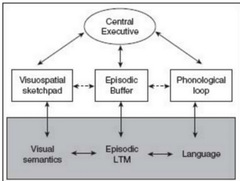
components of phonological loop
- phonological store: stores about 2s (limited) of auditory info (from the environment)
- articulatory control/rehersal process: info enters store from this process of talking to yourself (prevents decaying)
properties of phonological loop
- limited capacity
- temporary, sound-based storage (~2s)
- must be attended to periodically & rehearsed in order to be preserved
phonological similarity effect
- impaired serial recall for items similar in sound (issue is pronounciation not # of items)
- acoustic info is the storage code in the phonological loop
word-length effect
- serial recall of sequences declines as the length of time it takes to say each word increases
- memory for lists of words is better for short than long
3 ways to code
- acoustically
- visually
- semantically (meaning)
visuospatial sketchpad
- where you store visual or spatial info
- similar to mental imagery
central executive
- attentional controller that selects & regulates the flow of info within working memory
- helps maintain info WM stores & coordinates other cog. processes
- decides how to divide attn.
WM capacity & focused attn.
- individuals with stronger working memory are better able to focus & ignore distractions
- better self regulation & impulse control
memory
- process involved in retaining, retrieving, and using info about stimuli, images, events, ideas and skills after original info is no longer present
persistence of vision
- continued perception of a visual stimulus after it is no longer present (i.e. sparkler)
iconic memory
- persistence of vision
- duration of visual sensory memory is < 1s
echoic memory
- persistence of sound
- auditory sensory memory is 2-4s
proactive interference
- info learned previously interferes with learning new info
retroactive interference
- new learning interferes with remembering old learning
digit span
7 ± 2 items (capacity of STM)
- more recent estimates 4 but can be expanded by chunking
chunking
- small units can be combined into larger meaningful units
- using prior knowledge to group items together (strong associations)
- meaning matters for memory
working memory
- limited capacity system for temporary storage & manipulation of info for complex tasks such as comprehension, learning, and reasoning
- sustained activation of representations
- behaviors that depend on WM can be disrupted by damage to the prefrontal cortex
articulatory suppression
- repetition of irrelevant sound reduces memory because speaking interferes with rehearsal
- overloads the phonological loop
mental rotation
- reaction times longer for greater differences in orientation
- rotate image of object in mind to solve the problem
event-related potential (ERP)
brain response that indicates how much space is used in WM as task is carried out
episodic buffer
- component of working memory where WM info interacts with LTM info
- makes interchange/connection so greater storage capacity is possible
encoding
- process of getting info & transferring it into LTM
- phase of experiment when info might go into LTM
factors that affect getting into LTM
- imagery
- emotion
- repetition
- thinking about meaning (depth)
- effort/desire to learn
what's the effect of emotion on memory?
- emotion at encoding boosts memory
- BUT maybe it's not the emotionality of the object, but some other property (i.e. guns attract attn. bc they're most likely to be "active in a scene"
cahill experiment with emotion & memory
- slideshow about kid visiting his dad (surgeon) at work
- some subjects told dad was operating on victims of accident vs. drill operation on dolls (showing identical slides and prompting high or low emotional responses with just slight changes in the accompanying story.)
- emotional response at encoding does lead to better memory
repitition
- sheer repetition does NOT necessarily lead to memory for the stimulus
- generally good for memory, but must be the right type of repetition
effort to learn (hyde & jenkins)
- intention or effort is irrelevant
- depth has a big effect
limitations of levels of processing
(1) definition of levels & circularity
(2) we can't ignore what's happening at retrieval
circularity
- defining a procedure as deeper bc it results in better memory
- then using that procedure to show that deeper processing results in better memory
- doesn't prove anything
flashbulb memories
- happen during very high emotion
- similar accuracy but higher confidence
- accuracy & longevity thought to maybe indicate special memory process
transfer-appropriate processing
- when type of process is same at encoding & retrieval, memory will be successful
- cue matches what you thought about during encoding
- dangerously circular idea
- shows that deeper processing at encoding does NOT always result in better retrieval
anterograde amnesia
- old memories mostly intact
- can't encode new mems
retrograde amnesia
- old mems lost
- new memories encoded normally
temporal gradient (retrograde amnesia)
- not all past memories are equally affected
- recent mems very affected, distant not so much
- test for public events or famous faces
consolidation
- initially, mems are fragile --> must be consolidated after they're encoded
- process by which memories become more stable, even if they are not practiced
- takes years for a mem to be fully consolidated
- mems don't sit passively after they are encoded --> mems are consolidated for years after (even those not thought about)
evidence of consolidation in anterograde amnesia
- if you have anterograde, you always have some degree of retrograde
- parts of the brain that encode new mems are the same that consolidate them
free recall
- minimal info from experimenter --> "remember"
- context usually implied, occasionally described
cued recall
- experimenter gives part of info (retrieval cues) to aid in recalling the previously experienced stimuli
recognition
- to-be-remembered info is presented along with distractors & must distinguish new from old
savings in relearning
- learn some material to a criterion & # of trials required is noted
- later, relearn material to the same criterion (if fewer trials are required, that is savings)
difficulty of memory retrieval
- free recall is hardest --> cued recall --> recognition --> savings
sensitivity of memory retrieval
savings --> recognition --> cued recall --> free recall
a better way to think about cues
- different cues are more/less likely to make you think about material the way that you thought about it at encoding
memory is a combo of _____ and _____
- actual events
- relevant prior knowledge
schemas
- memory representation of a type of event
- characteristics generally true of event not a specific even
- things that conflict more attended to remembered
script / event schemas
- things that conflict with schema are attended to & remembered
- at encoding: schemas make atypical things stand out & memorable
- at retrieval: schemas make it seem likely that typical things happened, even if they didn't
retrieval
- process of transferring info from LTM to working memory
- before material that has been encoded can be used, it must be retreived
maintenance rehearsal
- rehearsal that involves repetition without any consideration of meaning or making connections to other info
elaborative rehearsal
- better way to establish LTM bc you are making meaningful connections
levels of processing theory
- memory (retrieval) depends on how info is encoded into the mind
- depends on the depth of processing (shallow vs. deep)
deep processing
- close attention to meaning
- relating it to something else