Week 2 Tuesday: Natural Processes in Artificial Systems (9/8)
 Call Kai
 Learn
 Practice Test
 Spaced Repetition
 Match
 Flashcards
 Knowt Play
1/12

There's no tags or description
Looks like no tags are added yet.
Name | Mastery | Learn | Test | Matching | Spaced | Call with Kai | Chat |
|---|
No analytics yet
Send a link to your students to track their progress
13 Terms
Ecosystem succession levels
First colonized by pioneer species, then intermediate species, and finally the climax community
Secondary succession
When an ecosystem is disturbed and set back to an earlier state (different starting point compared to primary succession). Many of the organisms remain like seeds and microorganisms
Intermediate disturbance hypothesis
Species diversity is highest in areas that experience a moderate amount of disturbance
Island biogeography theory
The number of species on an island depends on a dynamic balance between immigration and extinction rates. Relate this to habitat patches (which are the island) in an agricultural field
Important: the size of the island and distance from other islands/source habitats (like semi-natural forests)
Habitat amount hypothesis
Local species richness at a location is driven by total surrounding habitat area, not by individual patch size or isolation.
Patch-matrix-corridor model
Patches: Non-linear habitat areas that differ from their surroundings; serve as core sources of resources, shelter, and reproduction (e.g., woodlots, fallow land).
Corridors: Linear strips of habitat linking patches that facilitate dispersal and movement (or act as barriers/filters) across the landscape (e.g., hedgerows, flower strips, riparian buffers).
Matrix: The dominant landscape (e.g., arable fields); its permeability dictates how easily organisms can move between patches and deliver ecosystem services.
Habitat redundancy
When multiple distinct habitat patches within a heterogeneous landscape provide the same ecological resources or support the same ecosystem services
Fragmentation
destroys habitat redundancyby breaking up a continuous landscape mosaic into isolated pieces
Ecosystem services
The benefits people obtain from ecosystems
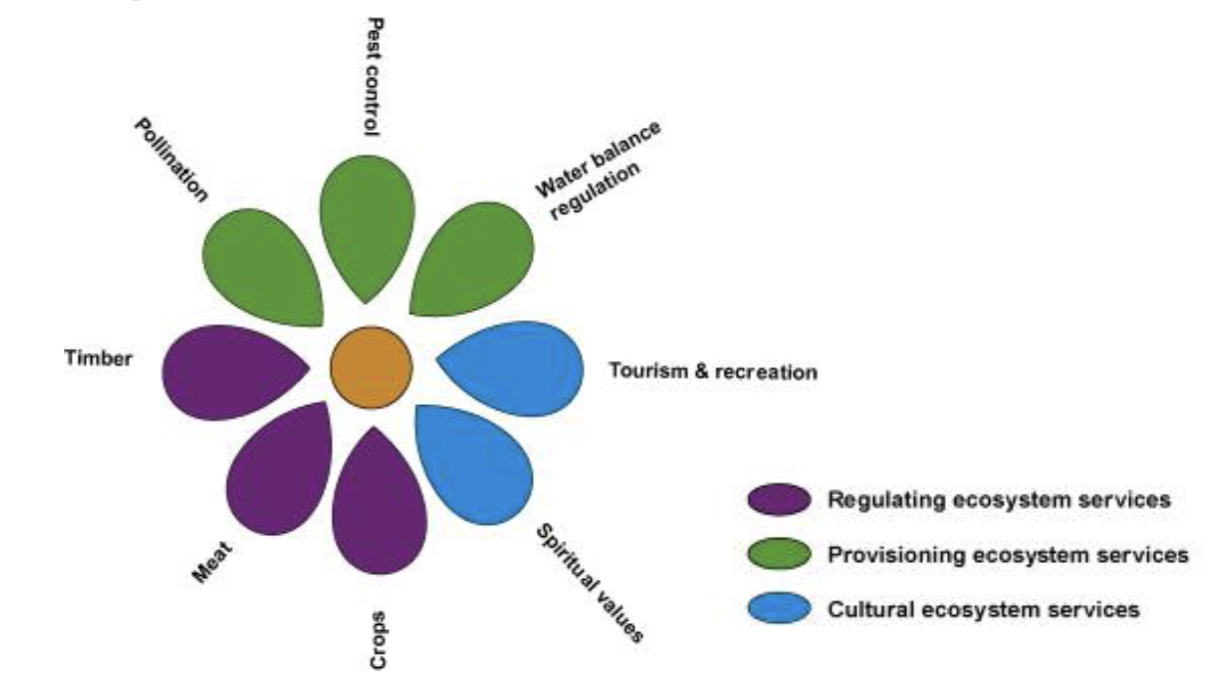
Include things like: pollination, pest control, water balance regulation, tourism and recreation, timber, meat, and crops
Ecotone
Areas of steep transition between ecological communities, ecosystems, and/or ecological regions along an environmental or other gradient
Spillover
Pattern of unidirectional (one way) movement from a donor habitat to a different, adjacent recipient habitat
How do the organisms that provide ecosystem services move?
Delivered by organisms dispersing from supply patches via corridors or permeable matrices to demand patches, or by abiotic flows.
Matrix permeability
The degree to which the dominant surrounding landscape (the matrix) facilitates or hinders the movement, foraging, and dispersal of organisms between habitat patches:
High Permeability: Heterogeneous or low-intensity management (e.g., organic practices, cover crops, reduced pesticides) that allows organisms to traverse or forage through the matrix safely.
Low Permeability (Hostile Matrix): Intensive, homogeneous land use (e.g., heavily sprayed monocultures, bare exposed soil) that acts as a physical or physiological barrier to movement, isolating patches.