Biology - Transport in and out of cells>Topic 1 Key Concepts (Summer term Y9)
 Call Kai
 Learn
Learn Practice Test
 Spaced Repetition
 Match
Match Flashcards
 Knowt Play
1/10

There's no tags or description
Looks like no tags are added yet.
Name | Mastery | Learn | Test | Matching | Spaced | Call with Kai | Chat |
|---|
No analytics yet
Send a link to your students to track their progress
11 Terms
Diffusion
movement of molecules from a high concentration to a low concentration
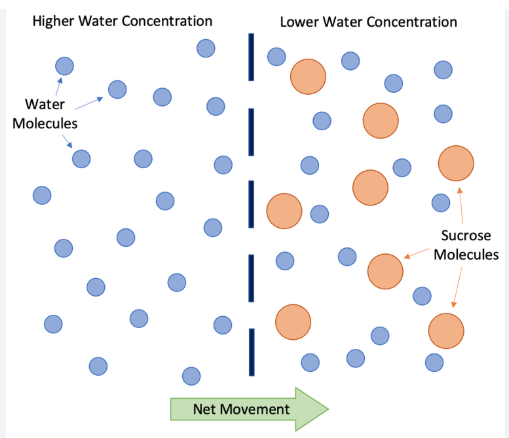
Osmosis
movement of water molecules from a high water potential to a low water potential across a partially permeable membrane
What happens to ANIMAL cells in osmosis
High water Potential in cell > crenated (shrivelled)
High water potential outside cell (solution)> lysed (bursting)

what happens to PLANT cells in osmosis
High water Potential in cell > plasmolysed
High water potential outside cell (solution)> turgid

Active Transport
the movement of molecules across a partially permeable membrane from low to high concentration using ENERGY
against concentration gradient

Why does Active Transport need Energy
Because the CARRIER PROTEIN uses energy to change shape

Active Transport Example
Root Hair Cells
-Mineral Ions are absorbed by root hair cells by active transport
mineral ion concentration is higher in root hair cell than in the soil

Root Hair Cell Adaptations
-lots of mitochondria > releases energy for active transport
-large surface area > more carrier proteins for active transport
Percentage Change in Mass

The Visking Tube Practical
-visking tubing acts as a partially permeable model membrane to demonstrate osmosis
CORE PRACTICAL: Potato Chips
-Investigates how different concentrations of sucrose solution (sugar) affect the mass of the potato cylinders through Osmosis