Economics - Topic 5 - Perfect, Competitive, Monoply Markets
 Call Kai
 Learn
 Practice Test
 Spaced Repetition
 Match
 Flashcards
 Knowt Play
1/34

35 Terms
1. How does profit maximisation influence firms' behaviour?
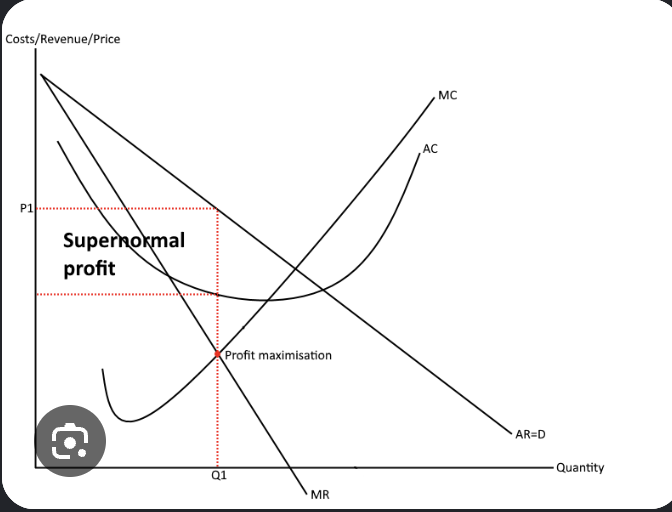
Point: Firms may maximise profit by producing where MC = MR.
Because: Before this output, additional revenue exceeds additional costs, making further production profitable.
Leads to: Firms expanding production until additional revenue equals additional cost.
Therefore: Total profit is maximised at MC = MR, provided MC crosses MR from below.
Evaluation: Firms may prioritise revenue, growth or market share instead of profit.
2. Why might firms prioritise sales revenue maximisation?
Point: Firms may aim to maximise total sales revenue rather than profit.
Because: Managers may value sales growth, market presence and performance-related rewards.
Leads to: Firms increasing output beyond the profit-maximising level, until MR = 0.
Therefore: Total revenue is maximised, although profit may be lower.
Evaluation: Shareholders may resist if lower profits reduce dividends.

3. How can the divorce of ownership from control affect firms?
Point: Separation of ownership and management may cause conflicting objectives.
Because: Shareholders often prioritise profits, while managers may seek higher salaries, job security or business growth.
Leads to: Managers pursuing objectives that do not maximise shareholder returns.
Therefore: Principal-agent problems may reduce profitability and productive efficiency.
Evaluation: Performance-related pay and shareholder oversight can align objectives.
4. Why might firms pursue satisficing rather than profit maximisation?
Point: Firms may aim to achieve an acceptable level of profit.
Because: Managers face uncertainty and may lack the information required to identify maximum possible profit.
Leads to: Decisions that balance profitability with employee welfare, growth and stability.
Therefore: Firms achieve satisfactory outcomes without necessarily maximising profits.
Evaluation: Satisficing may reduce returns compared with an achievable profit-maximising strategy.
5. How does perfect competition achieve allocative efficiency?
Point: Perfect competition can achieve allocative efficiency in long-run equilibrium.
Because: Firms are price takers and face P = AR = MR.
Leads to: Profit-maximising firms producing where MC = MR, meaning P = MC.
Therefore: The price consumers pay equals the marginal cost of production, supporting allocative efficiency.
Evaluation: Assumes no externalities and that competitive market conditions hold.

6. How does perfect competition achieve productive efficiency?
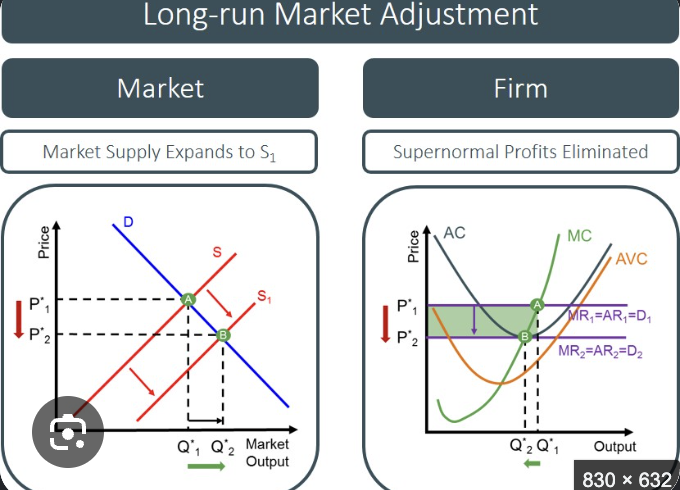
Point: Perfect competition can achieve productive efficiency in the long run.
Because: Supernormal profits attract new firms due to low barriers to entry.
Leads to: Increased market supply, reducing prices until firms earn normal profits.
Therefore: In long-run equilibrium, firms produce at minimum AC, minimising average production costs.
Evaluation: Real-world markets rarely satisfy all assumptions of perfect competition.
7. Why may perfect competition reduce dynamic efficiency?
Point: Perfect competition may weaken incentives for innovation.
Because: Low entry barriers and intense competition eliminate supernormal profits in the long run.
Leads to: Firms having limited retained profits to fund expensive R&D.
Therefore: Investment in innovation may be lower than in markets where firms can earn sustained supernormal profits.
Evaluation: Competitive pressure can also encourage cost-reducing innovation to survive.
8. How does monopolistic competition benefit consumers?
Point: Monopolistic competition encourages product variety.
Because: Firms differentiate products through branding, quality, design and service.
Leads to: Consumers having a wider range of products suited to their preferences.
Therefore: Consumer satisfaction and welfare may increase.
Evaluation: Product differentiation may increase advertising costs and consumer prices.
9. Why is monopolistic competition productively inefficient in long-run equilibrium?
Point: Firms under monopolistic competition typically operate with excess capacity.
Because: Product differentiation gives firms downward-sloping demand curves, while free entry removes supernormal profits.
Leads to: Long-run equilibrium occurring where AR = AC at an output below minimum AC.
Therefore: Firms do not produce at the lowest possible average cost.
Evaluation: Consumers may value greater product variety more than the additional production costs.

10. How can oligopoly encourage dynamic efficiency?
Point: Oligopolistic firms may achieve dynamic efficiency through innovation.
Because: Large firms can earn substantial supernormal profits due to barriers to entry.
Leads to: Greater potential funding for R&D and investment in advanced technology.
Therefore: Innovation may improve product quality and reduce long-run production costs.
Evaluation: Weak competitive pressure may encourage firms to retain profits rather than invest.
11. How can oligopoly benefit consumers through economies of scale?
Point: Oligopolistic firms may achieve lower average costs.
Because: Large-scale production enables purchasing and technical economies of scale.
Leads to: Lower long-run average costs and potentially greater productive efficiency.
Therefore: Consumers may benefit from lower prices and higher output.
Evaluation: Firms with market power may retain cost savings as profits instead of reducing prices.

12. How can collusion disadvantage consumers?
Point: Collusion allows oligopolistic firms to increase their collective market power.
Because: Firms cooperate to restrict output or agree on higher prices rather than compete.
Leads to: Lower market output and higher prices than under effective competition.
Therefore: Consumer surplus falls, while participating firms may earn greater profits.
Evaluation: Cartels may collapse because individual firms have incentives to secretly undercut agreements.

13. Why can oligopolistic markets experience price rigidity?
Point: Oligopolistic firms may avoid changing prices due to interdependence.
Because: Rivals may match price reductions but not price increases.
Leads to: Price cuts generating limited extra sales, while price rises cause substantial customer losses.
Therefore: Firms may maintain stable prices even when marginal costs change moderately.
Evaluation: The kinked demand curve is only one model; price wars and price leadership also occur.

14. How can non-price competition benefit consumers?
Point: Oligopolistic firms may compete through quality and innovation.
Because: Cutting prices risks retaliation from competitors and reduced profit margins.
Leads to: Firms investing in product differentiation, advertising and customer service.
Therefore: Consumers may benefit from improved products and greater choice.
Evaluation: Higher advertising expenditure could increase average costs and prices.
15. How can price wars benefit or disadvantage consumers?
Point: Price wars can temporarily reduce consumer prices.
Because: Firms aggressively cut prices to attract customers from their rivals.
Leads to: Lower prices increasing consumer surplus and potentially sales volumes.
Therefore: Consumers benefit in the short run, but persistently low margins may force weaker firms out.
Evaluation: If competition decreases after firms exit, prices could subsequently rise.
16. How can monopoly power cause allocative inefficiency?
Point: Monopoly power may lead to allocative inefficiency.
Because: A profit-maximising monopolist restricts output to where MC = MR and charges the corresponding price on AR.
Leads to: Price exceeding marginal cost, meaning P > MC.
Therefore: Some mutually beneficial transactions do not occur, creating deadweight welfare loss.
Evaluation: Economies of scale may allow a monopolist to produce at substantially lower costs.

17. How can monopoly power cause productive inefficiency?
Point: A monopolist may operate above minimum average cost.
Because: Strong barriers to entry reduce competitive pressure to minimise production costs.
Leads to: Firms potentially tolerating higher costs, managerial inefficiency or organisational slack.
Therefore: Production may occur above minimum AC, creating productive inefficiency.
Evaluation: Large monopolies may still achieve substantial economies of scale.

18. How can monopoly power encourage innovation?
Point: Monopoly power may increase dynamic efficiency.
Because: Barriers to entry can protect supernormal profits from immediate competition.
Leads to: Firms having greater financial resources and incentives to invest in R&D.
Therefore: New technology can improve product quality and lower long-run costs.
Evaluation: Firms may innovate less when there is little threat from competitors.
19. How can natural monopolies benefit consumers?
Point: Natural monopolies may minimise production costs through economies of scale.
Because: Industries such as water infrastructure have very high fixed costs and declining average costs across relevant output levels.
Leads to: One large provider potentially producing output more cheaply than several smaller firms.
Therefore: Society may benefit from lower resource costs and reduced duplication of infrastructure.
Evaluation: Regulation may be needed to prevent excessive prices and poor service.

20. How can price discrimination benefit firms?
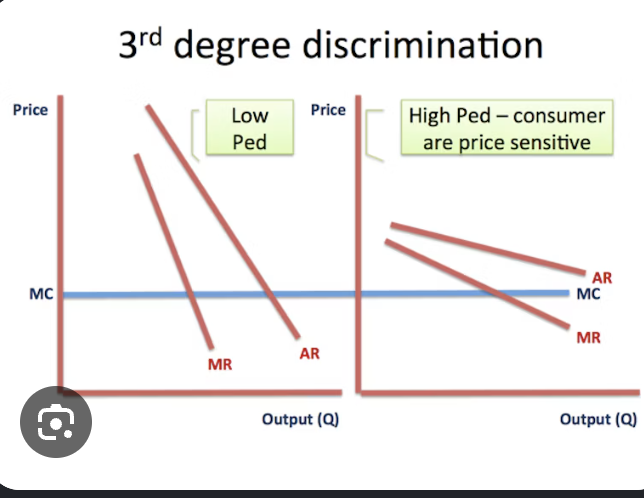
Point: Price discrimination can increase firms' total revenue and profits.
Because: Firms charge different prices to customers with different willingness to pay and demand elasticities.
Leads to: Higher prices for less price-sensitive customers and lower prices for more responsive customers.
Therefore: Firms can capture more consumer surplus and potentially increase output and profits.
Evaluation: Requires market power and the ability to prevent or limit resale.

21. How can price discrimination benefit consumers?
Point: Price discrimination can improve access for price-sensitive consumers.
Because: Firms may offer lower prices to groups with more elastic demand, such as students.
Leads to: Consumers who could not afford the standard price being able to purchase the product.
Therefore: Output and consumer welfare for these groups may increase.
Evaluation: Other consumers may face higher prices and lose consumer surplus.
22. How can competition increase dynamic efficiency?
Point: Competition can encourage innovation and technological development.
Because: Firms risk losing market share if competitors produce superior products.
Leads to: Increased investment in R&D, productivity improvements and product quality.
Therefore: Consumers may benefit from better products and lower long-run costs.
Evaluation: Excessively intense competition may reduce profits available to finance R&D.
23. How can contestable markets reduce monopoly power?
Point: The threat of new entrants can discipline established firms.
Because: Low barriers to entry and exit allow competitors to enter when incumbent firms charge excessive prices.
Leads to: Incumbents potentially reducing prices to discourage entry.
Therefore: Consumers may benefit from competitive prices even when few firms currently operate.
Evaluation: High sunk costs and economies of scale can limit the credibility of potential entry.
24. How can creative destruction benefit the economy?
Point: Creative destruction can improve long-run efficiency.
Because: Innovative firms introduce technologies or products that outperform existing alternatives.
Leads to: Consumers switching towards newer firms, while less efficient competitors lose sales.
Therefore: Resources shift towards more productive businesses, potentially increasing economic growth.
Evaluation: Short-run unemployment and business closures may impose significant adjustment costs.
25. How does an increase in competition affect consumer surplus?
Point: Greater competition may increase consumer surplus.
Because: Firms face stronger pressure to reduce prices and improve value.
Leads to: Consumers paying less for goods and more consumers being able to afford them.
Therefore: Consumer surplus increases, potentially improving economic welfare.
Evaluation: Aggressive price competition may reduce firms' ability to invest in future innovation.

26. How can monopoly power reduce total economic welfare?
Point: Monopoly power can create a net welfare loss.
Because: A monopolist may restrict output below the socially efficient level to maximise profit.
Leads to: Higher prices, lower consumer surplus and unrealised mutually beneficial trades.
Therefore: Deadweight welfare loss occurs, reducing total economic surplus.
Evaluation: Cost reductions from economies of scale and innovation could offset some welfare losses.

Section 2 - Real Life Examples
Give a real-world example of an oligopolistic market
In October 2025, Tesco held 28.3% of Britain's grocery market, followed by Sainsbury's at 15.3%, Asda at 11.8% and Aldi at 10.6%. Together, these four held 66% of the market.
Application: High concentration means large supermarkets must consider rivals' pricing and promotions, illustrating interdependence.
Evaluation: Competition from Aldi, Lidl and online retailers can restrict market power.
Give another real-world example of an oligopolistic market.
In Q1 2026, six companies controlled approximately 91% of Britain's domestic electricity supply market, including Octopus Energy (25.7%), British Gas (20.4%) and E.ON Next (15.3%).
Application: High market concentration → firms are interdependent, considering competitors' pricing decisions and tariffs when competing for customers.
Evaluation: Competition from smaller suppliers and customers switching providers can limit market power.
Give a real-world example of illegal collusion.
In March 2023, the CMA fined 10 construction firms almost £60 million for rigging bids on demolition and asbestos-removal contracts.
Application: Collusion reduces genuine competition, potentially increasing contract prices and transferring surplus from buyers to firms.
Evaluation: Competition-law enforcement and large fines can deter future collusion.
Give a real-world example of entrenched market power.
On 22 October 2025, the CMA designated Apple and Google as having strategic market status in their mobile platforms, identifying substantial and entrenched market power.
Application: Network effects, switching costs and barriers to entry make it difficult for new competitors to challenge established platforms.
Evaluation: Their market power can coexist with investment and innovation; the designation is not a finding of wrongdoing.
Give an example of a large firm investing heavily in R&D
Samsung Electronics spent approximately 37.7 trillion South Korean won on R&D in 2025, up from 35 trillion won in 2024.
Application: Large firms can devote substantial resources to innovation, potentially improving technology and reducing long-run costs.
Evaluation: R&D spending does not guarantee commercially successful innovation.
Give a real-world example of third-degree price discrimination.
National Rail offers eligible 16–17 Saver Railcard holders 50% off adult Off-Peak fares, while standard National Railcards generally provide one-third off eligible Standard Class Off-Peak fares.
Application: Different eligible customer groups pay different prices for comparable journeys, allowing discounts to attract price-sensitive passengers.
Evaluation: Discounts can increase access, although eligibility and restrictions limit who benefits.
Give an example of the problems associated with natural monopoly power.
In May 2025, Ofwat imposed penalties totalling £122.7 million on Thames Water for breaches involving wastewater operations and dividend payments.
Application: Water-network infrastructure involves high fixed costs and limited direct competition, making effective regulation important.
Evaluation: A single network may avoid expensive duplication, potentially lowering overall production costs.
Give an example of legal barriers to entry protecting monopoly power.
NHS guidance updated in 2025 explains that pharmaceutical patents generally protect inventions for up to 20 years, with additional protections sometimes extending exclusivity.
Application: Patents prevent immediate generic competition, allowing pharmaceutical companies to potentially earn higher profits and recover R&D costs.
Evaluation: Patent protection can encourage innovation but may delay cheaper alternatives for patients.