9B: Augmentative and Alternative Communication
 Call Kai
 Learn
Learn Practice Test
 Spaced Repetition
 Match
Match Flashcards
 Knowt Play
1/23

There's no tags or description
Looks like no tags are added yet.
Name | Mastery | Learn | Test | Matching | Spaced | Call with Kai | Chat |
|---|
No analytics yet
Send a link to your students to track their progress
24 Terms
Augmentative and Alternative Communication
An area of clinical practice that provides communication interventions for people who have complex communication needs or little or no functional speech
for people who don’t have a way to express themselves
Augmentative communication _________ or ____________ speech and/or language
supplements or enhances
Alternative communication ___________ or __________ speech and/or language
substitutes or replaces
Assistive technology
to perform functions that would otherwise be too difficult
Goals of AAC
Assist with daily communication needs
Say what you want to say, when you want to say it, as quickly as possible
Facilitate development of speech/language
Facilitate return of speech/language
Symbols to create messages
bliss symbols
coloured pictures
objects
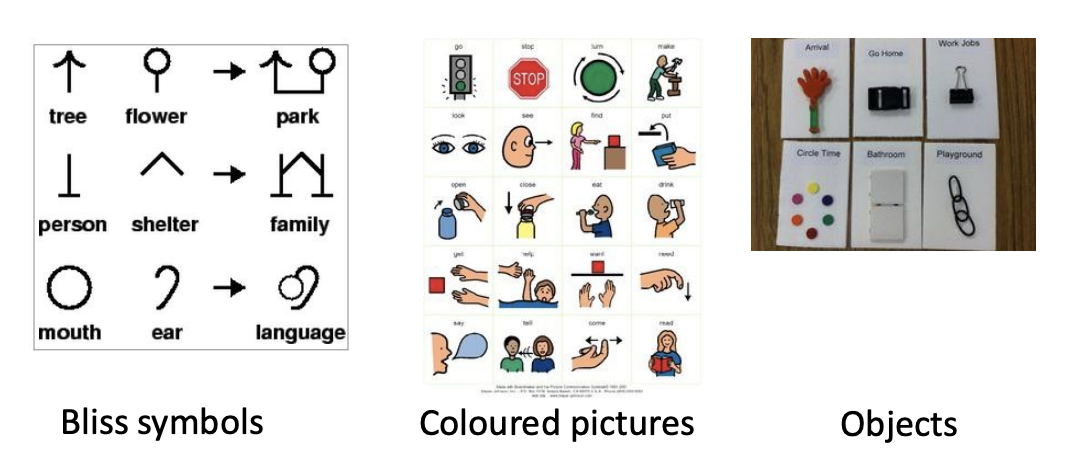
Two ways to access symbols
Direct selection
Accessing symbols with a finger or pointing device
Accessing symbols with another body part
Indirect selection
Alternate method for accessing symbols (eg. eye gaze)
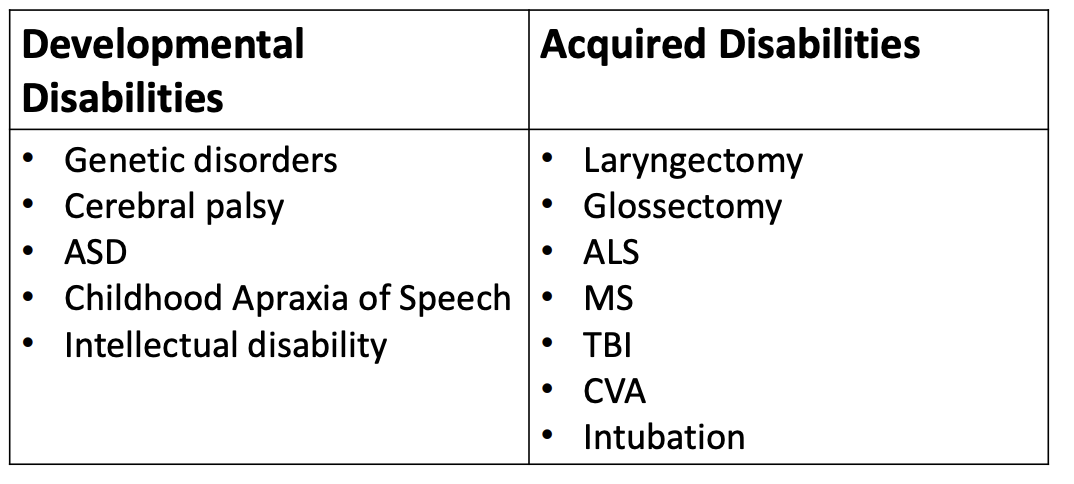
Who uses AAC?
Developmental disabilities
Acquired disabilities
AAC System Types
AAC systems and techniques may be used alone or in combination
AAC users may use multiple systems and techniques
Systems can be unaided or aided
aided vs unaided?
Choice determined by needs, abilities and communication environment
Often a combination of both to ensure optimal (multimodal) communication
Decided on what specific needs the child has
Ideal AAC system is (3 things):
highly intelligible
comprehensible
efficient
Unaided communication systems
Rely on user's body to convey messages
No external equipment
e.g., gestures, body language, sign language
*Anything you can do with your body is an unaided AAC system
Aided communication systems
Require use of tools or equipment in addition to user's body
more complex communication
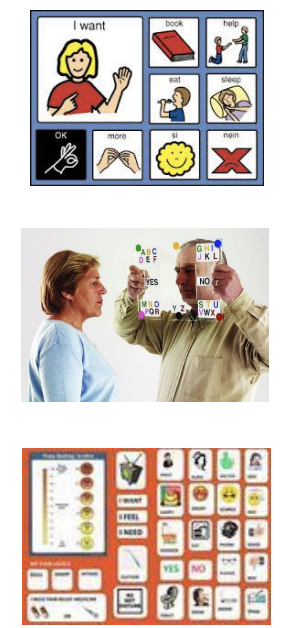
Wide range of methods, both electronic and non-electronic (i.e., can be low-tech or high-tech)
e.g., paper and pencil, communication books/boards, speech generating devices, written output
Low tech aided communication
May or may not uses power
Simple to develop or program
few moving parts
eg. pictures in a book, pointing to icons
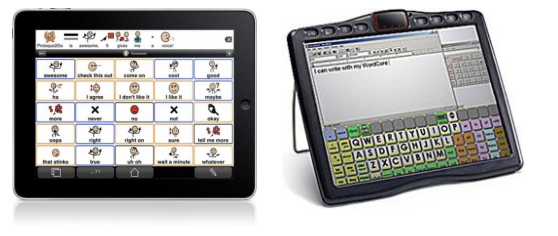
high tech aided communication systems
Uses power
Sophisticated programming, usually computer-based
Many are speech-generating devices
super customizable (unlimited vocab)
Can be dedicated or open
need special training to be able to prescribe and program high-tech systems
not just any SLP can use one
AAC clinics have long wait lists
AAC switches
Many devices include an electronic switch (or multiple switches)
The switch activates symbol scanning movement and can then be used to select an item/message
some people can use both eye gaze and switches
e.g.,
Push (button - needs enough muscle force)
Touch (light touch pad - good for people with no muscle)
Sound controlled (humming)
EEG-activated
AAC assessment
cannot do it by yourself
Requires team approach (team varies by case)!
e.g., Family, SLP, OT, PT, rehabilitation engineer, teacher, audiologist, psychologist, etc.
Ongoing
Trial approaches (e.g., aided, unaided)
Longer term due to changing needs
peoples communication changes over time
eg. a 4 year old will need different communication than a 28 year old
Goal is to determine:
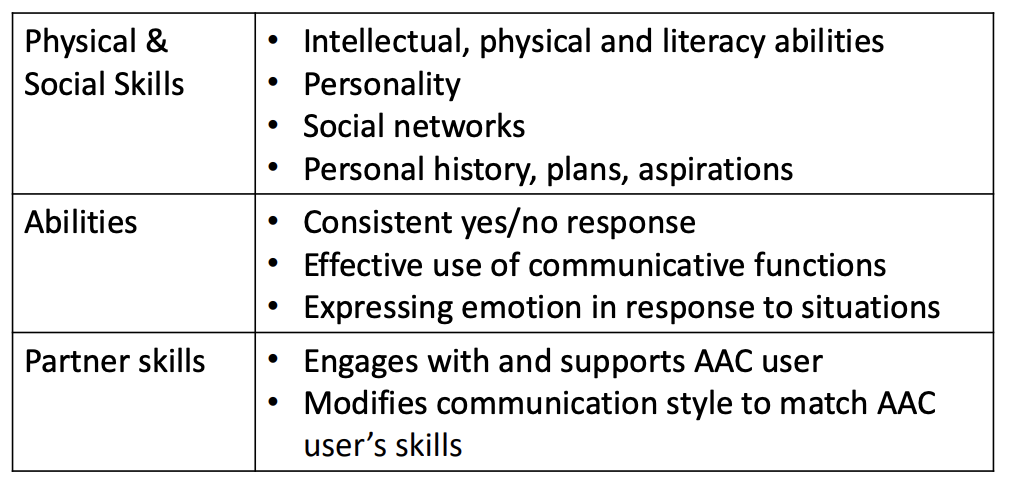
Current abilities and needs in language, literacy, mobility, physical access, hearing, and vision
Current and future language development and communication needs
Communication goals across environments and communication partners
The most appropriate AAC system
The most appropriate therapy program
AAC assessment considerations
Test may need to be adapted (people have different needs and functions… this invalidates tests however)
Time consuming and ongoing (assessments are VERY time consuming and resource heavy)
Team-based
Focused on communicative function
Emphasis on communication partners and environments
AAC intervention
To support the AAC user in communicating effectively
Training in the use of aided/unaided AAC
Involves family/caregivers
In naturalistic contexts to promote generalization
Focused on communicative effectiveness
Supporting independent communication
Participation Model (Beukelman & Light, 2020)
Functional intervention
Goal: easy communication with peers through communication opportunities and access
Based on the person’s participation requirements (participation inventory)
Communicative Competency Model (Light, 1989)
Goal: to help individuals develop functional operational, strategic, linguistic, and social skills
Operational competence (making sure they can operate ACC by themselves)
Strategic competence (symbols, facial expressions and complex messages)
Linguistic competence (making sure they can from sentences and be literate)
Social competence (function in social settings)
Examples of AAC implementation and intervention approaches
Provide direct instruction in use of system – e.g., picture meaning, picture location, access strategies.
Practice in multiple environments with multiple partners
Develop routines and scripts for predictable scenarios and activities
Train communication partners
Incorporate language and literacy instruction
Cultural considerations
selection of AAC type, symbols, and interaction style must consider the client’s cultural perspective
must integrate family’s values, beliefs, interaction styles, etc.
find out what the individual whats to get out of their AAC