Aggregate Supply and Economic growth
 Call Kai
 Learn
 Practice Test
 Spaced Repetition
 Match
 Flashcards
 Knowt Play
1/28

Earn XP
Description and Tags
L7 ECON 127
29 Terms
What are the two main components of the AD/AS model?
Aggregate Demand (AD) and Aggregate Supply (AS).
In the simple Keynesian model, how can economic growth occur from the demand side?
Through an increase in government spending (G) or investment (I). Injections would increase higher than the withdrawals.
What does the AD/AS model add to the Keynesian model?
The price level is taken into account
What is the aggregate demand equation?
AD = C + I + G + X - M
or
AD = Cd + Id + Gd + Xd
Why does the aggregate demand curve slope downwards?
Due to the international substitution effect, inter-temporal substitution effect, and real balance effect.
The higher the price, the lower real national income. With higher price, less uk products, more overseas, that’s why the higher the price the lower the gdp
Rising gdp of other country and not own
What is the international substitution effect?
When domestic prices rise relative to foreign prices, exports become less competitive and imports become more attractive.
What assumption underlies the short-run aggregate supply curve?
Constant input prices.
Why does the short-run aggregate supply (SRAS) curve generally slope upwards?
Because of diminishing returns and growing shortages of certain variable factors.
What is equilibrium in the AD/AS model?
The point where aggregate demand equals aggregate supply
Aggregate demand and aggregate supply graph. what happens if the price level is initially lower than the equilibrium.
The excess demand will cause the price level to rise to Pe.

What is a positive demand shock?
A rightward shift of the AD curve that increases both output and the price level. Increase income.
What is a positive supply shock?
A rightward shift of SRAS that increases output and lowers the price level.
Why - Better tech to increase productibility to increase income
What is a negative supply shock?
A leftward shift of SRAS that decreases output and raises the price level.
What causes the mainstream SRAS curve to become steeper as output approaches potential output?
Diminishing returns and rising marginal costs.
What happens when there is less steeper SRAS line?
With a flatter SRAS, at the same price, you can have a higher real national income.

What are "sticky" input prices?
Input prices that do not adjust immediately to changes in economic conditions.

how a profit-maximising firm responds in the short run when demand increases?
An increase in demand shifts the firm's average revenue curve from AR₁ to AR₂ and its marginal revenue curve from MR₁ to MR₂. The profit-maximising firm continues to produce where MR = MC. As a result, output rises from Q₁ to Q₂ and price rises from P₁ to P₂. This demonstrates that stronger demand leads to both higher output and higher prices in the short run.

Why does the SRAS curve become steeper as output increases?
As the economy approaches full employment, firms experience diminishing returns, shortages of labour and other resources, and rising marginal costs. Therefore, increases in AD cause more inflation and less growth in output.
exam type answer
The graph illustrates the mainstream view of short-run aggregate supply. As aggregate demand increases from AD₁ to AD₃, equilibrium moves from a to c, causing both real GDP and the price level to rise. However, as output approaches full employment, diminishing returns and rising marginal costs make aggregate supply less responsive. Therefore, further increases in aggregate demand generate increasingly large inflationary pressures and progressively smaller increases in output.
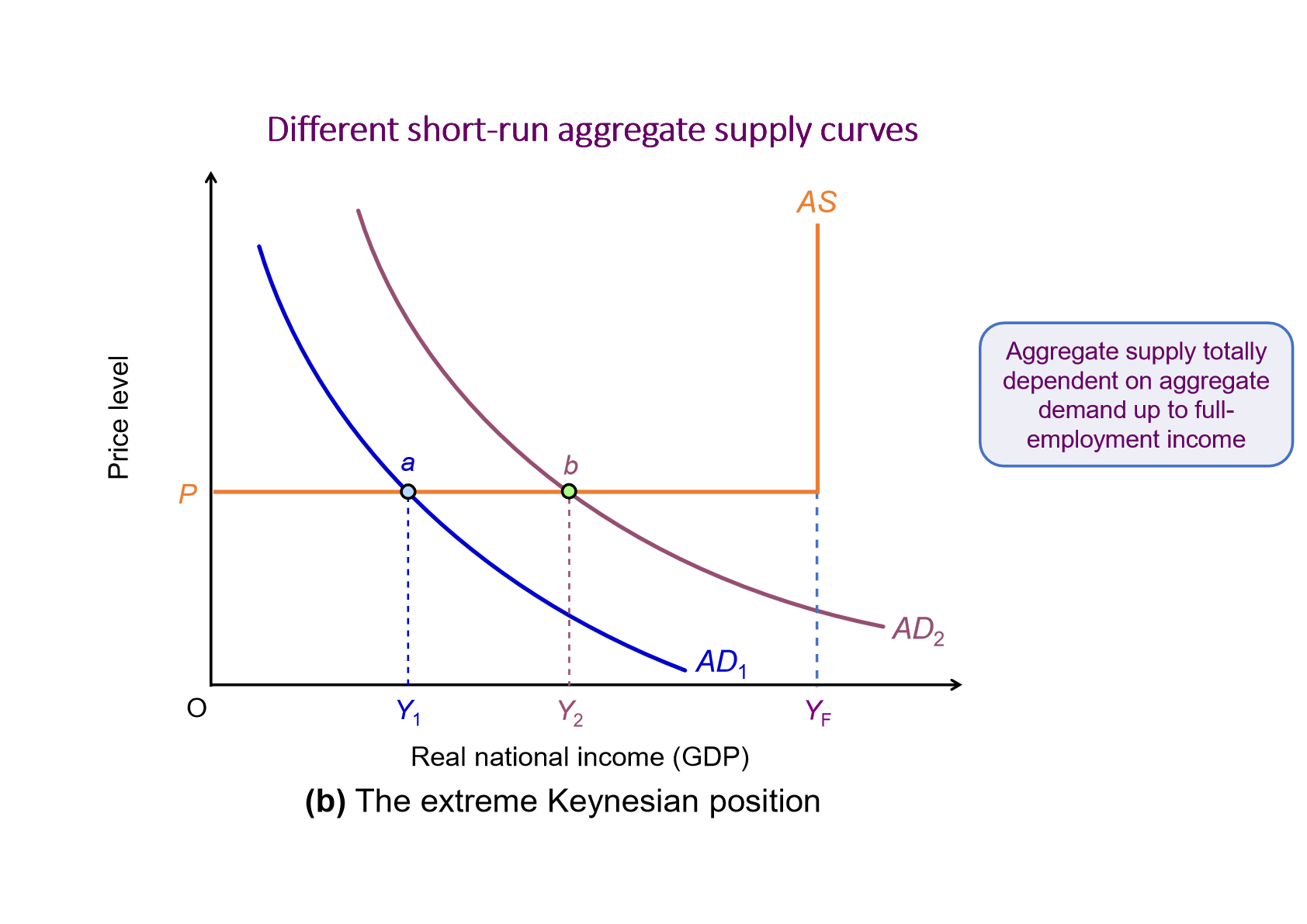
According to the extreme Keynesian position, what determines output in the short run? What does it look like?
Aggregate demand
There is a horizontal SRAS curve up to the full potential and then vertical.
Aggregate supply is totally dependent on aggregate demand up to full-employment income.
What is the new classical view of SRAS?
SRAS is vertical because markets clear continuously and rapidly.
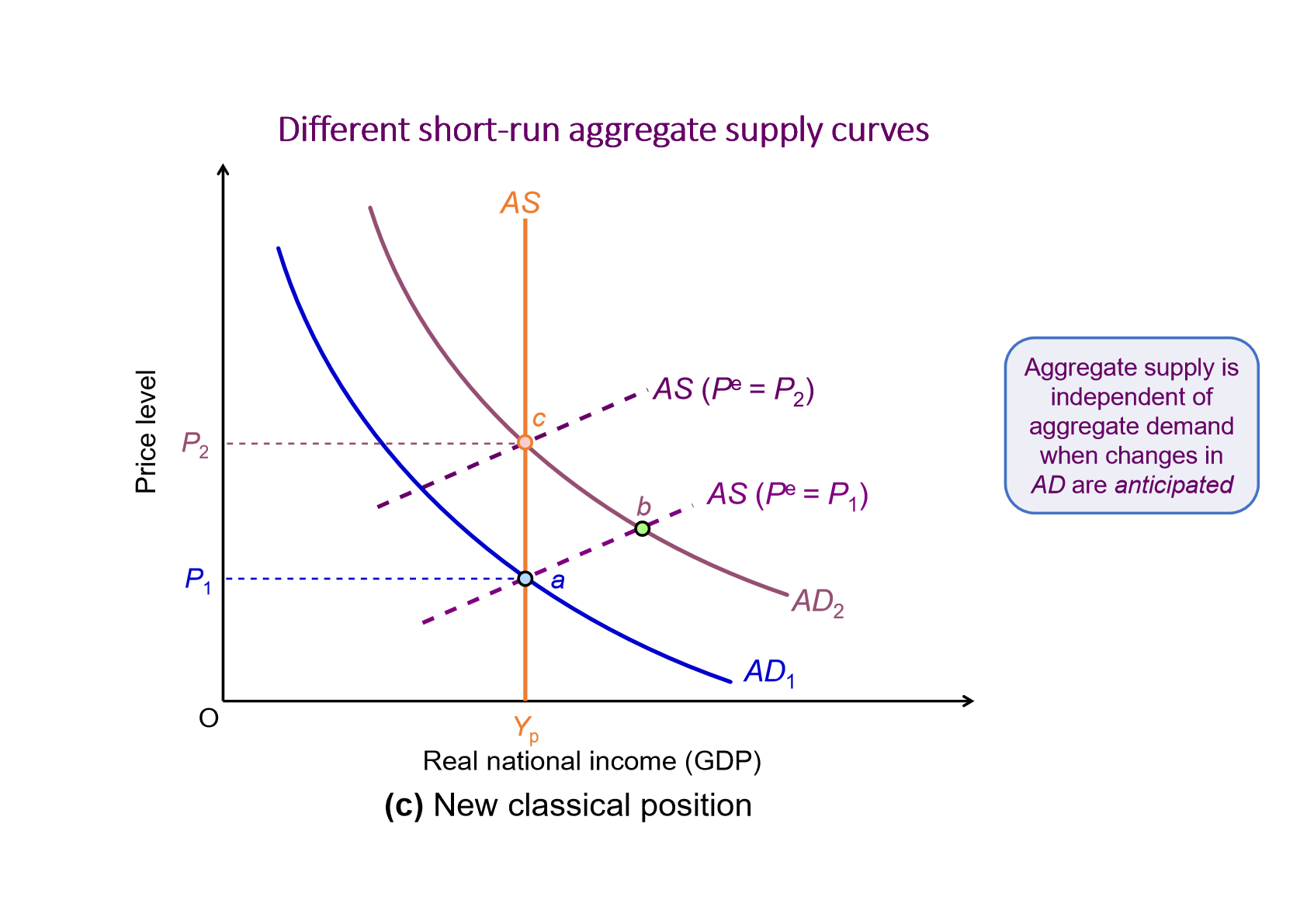
What role do rational expectations play in the new classical model?
People adjust expectations quickly, causing output to return to potential output.
According to the new classical view, what effect do unanticipated changes in AD have on output?
unanticipated changes in AD may give temporary upward-sloping SRAS but as soon as expectations adjust, output returns to its potential level
According to the new classical view, what effect do anticipated changes in AD have on output?
No effect on output.
What changes the output?
changes in output come about through changes on the supply side, not changes in AD. policy should focus on the supply-side policy.
What is the mainstream view of the long-run aggregate supply (LRAS) curve? and Whhy?
LRAS is vertical. Aggregate supply is unresponsive to demand in the long run.