9.2 The Composition & Architecture of Membranes
 Call Kai
 Learn
 Practice Test
 Spaced Repetition
 Match
 Flashcards
 Knowt Play
1/13

There's no tags or description
Looks like no tags are added yet.
14 Terms
Membrane Properties
flexible & self-healing
lot of dynamic processes: shape changes may occur during growth, division, end/exocytosis
only self-healing when reasonably fluid
thin
essentially 2D surfaces that enhance reactions rates (ex. e- transport)
diffusing in 2D increases chances of collision, thus enhanced rxn rate
selectively permeable
used for transport & signalling functions
polar molecules have limited ability to pass through membrane
formation is driven by the hydroPHOBIC effect
occurs bc of the associated geometry of lipids
when u have diff shapes of lipids → get diff types of curative assoc w membrane
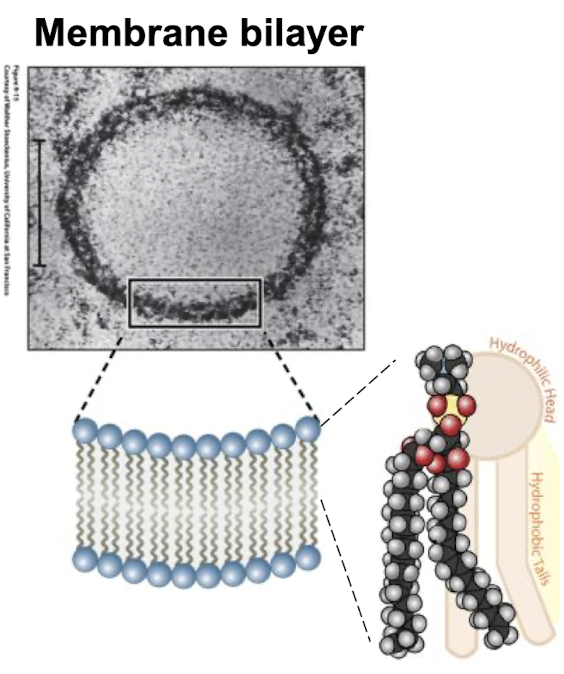
Membrane Components
carbs are on the extracellular face or lumen side if exported to cell surface
Fluid Mosaic model = dynamic aspects of individual lipids, as well as proteins - a mixture of diff components are moving relative to each/other

note: bilayers only contain lipids, unlike membranes that contain a bilayer of lipids + protein + carbs
Properties of Bilayers
bilayers have fluid-like properties:
individual lipids orient based on the distribution of PHOBIC & PHILIC character - limits lipid diffusion
lateral diffusion = occurs within a leaflet & is very rapid bc interactions b/w lipids are non-covalent & there is little barrier to motion
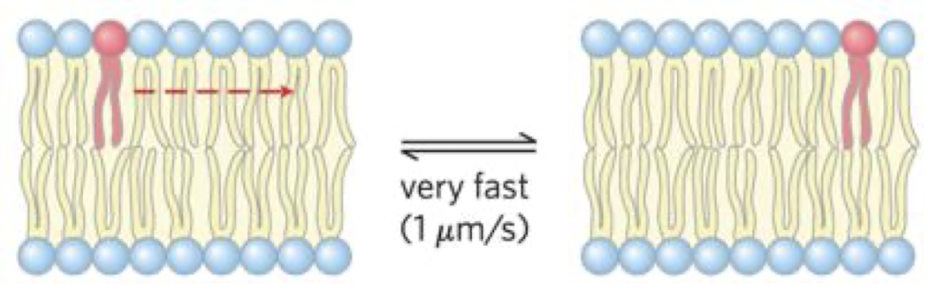
transverse diffusion = occurs b/w leaflets & is very slow (days)
bilayers have Phase Transitions = temperature-dependent transitions affect the motion of lipids in a membrane
diff areas of memb may experience diff levels of order, depending on composition
bilayers aren’t frozen or solid, but they’re also not completely disordered
increasing temp: liquid ordered state → liquid disordered state
maintain memb fluidity by altering membrane lipids (homeoviscous adaptation) to keep membranes b/w these 2 states

Membrane Composition: Composition varies Between cells & organisms
→ lipid/protein composition varies widely b/w cells & organisms
variations affect fxn
all membranes in a cell have diff lipid/protein composition
thus variations b/w membranes for organelles exist within a single cell
ex. myelin sheath = insulator for nerve signals
composition: slow in protein, high in lipids & neutral glycolipids (which have lower polarity then phospholipids)
ex. E.coli & IMM
composition: high in protein - important in energy production (oxidative phosphorylation/ e- transport)

Membrane Asymmetry
→ membrane leaflets have DIFF compositions
Applications of Membrane Asymmetry
glycoprotein/glycolipids have carb aspects facing EXTERIOR to cell (at plasma membrane)
synthesis of lipids is carried out by integral membrane proteins in the ER of eukaryotes
lipids are synthesized in one leaflet of the ER’s membrane → diffused to other leaflet & use protein transporters to speed up this process
the presence of specific lipids in other leaflets triggers special events
ex. the presence of phosphatidylserine in the outer leaflet of a membrane triggers cell engulfment/degradation
Lipid Asymmetry in Membranes
→ lipids are distributed asymmetrically in membranes, while proteins are absolutely oriented in membranes
thus, lipids are OPP direction b/w leaflets, while integral memb proteins are in the SAME orientation (affects classification)
→ lipid asymmetry b/w leaflets:
in RBC’s:
choline-containing lipids (sphingomyelin, phosphatidylcholine) are primarily in the OUTER leaflet
phosphatidylethanolamine are primarily in the INNER leaflet
phosphatidylserine is ONLY in the INNER leaflet
changes in distribution of lipids may signal/target a cell for death
ex. if phosphatidylserine is found in the outer leaflet

→ lipid asymmetry & transport of lipids b/w leaflets IN MEMBRANES:
movement of lipids b/w leaflets is slow in bilayers, BUT rapid in membranes - bc integral membrane proteins reduce the energy barrier for movement of lipids
membranes use active transport, requiring input of energy, to maintain asymmetry
proteins/enzymes involved:
Flippases = import lipids to inner PM from outer PM using active transport
gradients maintained: phosphatidylserine & phosphatidylethanolamine
Floppases = export lipids from cytoplasmic face to uncytoplamsic face using active transport
gradients maintained: phosphatidylcholine & sphingolipids
membranes use passive transport to equalize concentrations b/w leaflets:
via scrambles
passive (down [ ] gradient) + equalize [cholesterol]
Lipid Transport proteins:

Membrane Proteins
3 Primary Types of membrane proteins:
Peripheral = assoc w polar regions of membrane lipids
Lipid-linked = intimately associated w PHOBIC core
can be described as integral as well
Integral protein = intimately associated w PHOBIC core

Isolation of Membrane proteins
peripheral protein: can be removed from membrane thru moderates changes in pH or salt thru dissociation
glycosylated phosphotidylinositol-(GPI) linked proteins: may be released form membrane via phospholipase C or D
cleaves polar head group on either side of the P group at c3
integral membrane proteins: usually only isolated from membrane using detergents or organic solvents - as those mimic the PHOBIC environment of the membrane
Anchoring Proteins to membrane
proteins that are associated with the cytoksleteon may NOT diffuse laterally - as their association restricts/anchors them

the proteins may move at variable rates depending on interactions with membrane
Membrane Proteins: Integral Membrane Proteins
Integral Membrane Proteins = intimately associated w PHOBIC core, as they span the entire membrane
Classification of Integral membrane proteins
classified based on structural composition of transmembrane region - how they interact with the membrane
Types:
single helix
helical bundles = multiple helices
B-barrels = antiparallel B-sheet interaction with membrane → close 7 create anti-parallel B-barrel
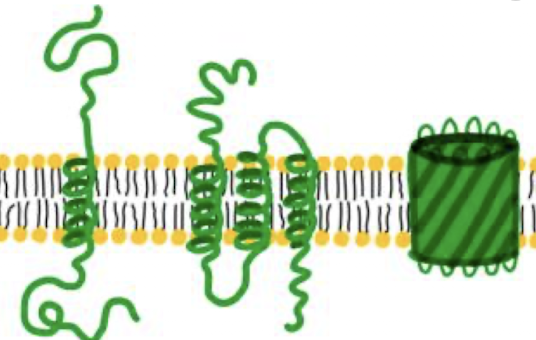
classified based on topology:
How many times it crosses membrane
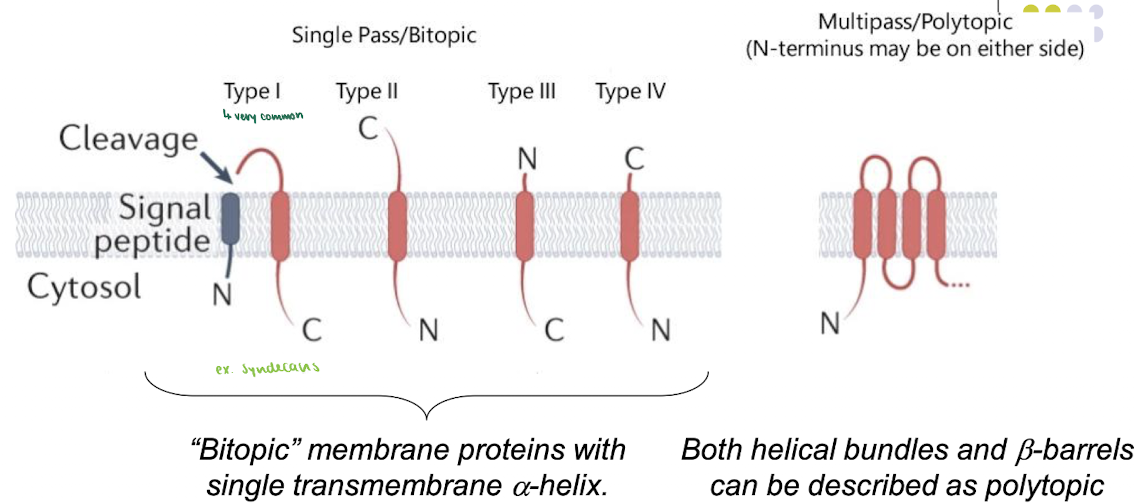
single-pass / bitopic = portion on either side of membrane, thus c- & N-terminals on OPP sides
multi-pass (poltopic)
N-terminal location : inside (cytosol) or outside (lumen or extracellular)
classified by type of single-pass or multi-pass:
Single-pass transmembrane proteins:
Type I = N-terminus/signal peptide is OUT
N-term is on un-cytoplasmic face
signal peptide is removed during synthesis
Type II = N-terminus IN + transmembrane near N-term
signal peptide ISNT removed
Type III = N-terminus OUT + transmembrane near N-term
signal peptide ISNT removed
Type IV = N-terminus IN + transmembrane near C-term
note: difference between/w type II & IV is the diff location of transmembrane section w respect to terminus
multi-pass membrane proteins:
helical bundles
beta barrels
ex. Glycophorin = erythrocyte protein / Type I membrane protein
single-pass & associated with signal peptides that’s removed in mature protein
3 domains: extracellular, cytoplasmic, transmembrane
N-terminal domain is extracellular + glycosylated
extracellular, thus it could contain bisulfides is cys was present
C-terminal domain is intracellular
PHOBIC domain crossing the membrane via single α-helix
N-terminal domain is heavily modified w sialic acid derivatives - thus has addition of oligosac structures via glycosylation
sialic acids confer (-) charge
thus, modifications occur to extracellular domain

note: this asymmetry is applicable to all integral membrane proteins
note: RBC’s repel e/o
Monotopic membrane proteins = found only associated with ONE side of the membrane
includes: peripheral & lipid-anchored proteins

Q.
note: box contains AA within the N-terminal domain
1. 15 Ser/Thr modified w oligosacc containing 2 sialic acid residues
-1 charge on each sialic acid
Ser/Thr are usually uncharted → now they’ll have 2 sialic acids each, thus -2
net charge:
N-term = +1
charged AA side chains: -4
E (8) = -8
D (2) = -2
K (2) = +2
R (4) = +4
mod: 15 ser/thr w -2 = -30
answer: net charge is -33