Section 1 - Fragile Systems/Storms
 Call Kai
 Learn
 Practice Test
 Spaced Repetition
 Match
 Flashcards
 Knowt Play
1/108

Earn XP
Description and Tags
09/23/26
109 Terms
what is a disaster?
physical damage
injury or loss of life and/or
a drastic change to the environment
what is the nomenclature of “disaster”
dis - hard, bad or unlucky
aster - star
"bad star” or “the stars are evil”
what is an element
a chemical _____ consists of identical atoms
what is an atom
protons (+) neutrons in a nucleus, and electrons (-) in orbit
atomic #
the number of protons in an atomic
atomic mass #
the number of protons + neutrons
isotopes
when atoms of the same element have the same number of protons, but a different number of neutrons
molecules
combinations of atoms, neutral charge
ions
incomplete combinations of atoms, that have a charge
what are the most common materials in the earth’s core by mass
iron
nickel
oxygen?
what are the most common materials in the earth’s crust by mass
oxygen
silicon
aluminum
what are the most common materials in the ocean by mass
oxygen
hydrogen
chlorine
what are the most common materials in the earth’s atmos. by mass
nitrogen
oxygen
argon
what is compressibility
able to be squeezed or expanded, so that the mass fills less or more space. this results in a change in density (mass / volume) of the object, because of the volume change
phases of matter and compressibility
solids are not very fluid and therefore not very compressible
liquids are very fluid, but not very compressible
gases very fluid and very compressible
what are crystals
crystals form when molecules align in a lattice.
can be cubic: table salt, pyrite
octahedral: diamond, fluorite
hexagonal: quartz and ice
fluids and viscosity
fluids:
liquids or gases flow easily, (i.e. change shape)
viscosity:
how thick a fluid is
measure of resistance to flow
depends on temperature and chemical structure
high viscosity = thick, slow flow
low viscosity = runny, quick flow
density
p = mass / volume (how much matter is in a space)
units kg/m3
stratification
less-dense materials float on top of denser materials, creating layers or strata
this happens inside the earth too, the most dense part is the inner core, then outer core, mantle, crust, ocean, and the atmosphere
strata and disaster
strata are important for disasters as each disaster occurs in one of them, where the strata defines the disaster
metric prefixes
k = kilo = thousand = 1×10³
M = mega = million = 1×10⁶
G = giga = billion = 1×10⁹
Tera = tera = trillion = 1×10¹²
c = centi = hundredth = 1×10⁻²
m = milli = thousandth = 1×10⁻³
μ = micro = millionth = 1×10⁻⁶
n = nano = billionth = 1×10⁻⁹
P = pico = trillionth = 1×10-12
disasters and energy
energy causes things to move or change
disasters release immense amounts of energy
and cause catastrophic changes
forces
a force pushes or pulls
force = mass x acceleration
measured in newton (N = kgm/s2)
gravity
a force that attracts matter to each other
objects of mass m near the earth’s surface are pulled with the force
F * mg
g = 9.81m/s2
work
the force that pushes an object times the distance the object moves
W = f * d
in Joules (J) = 1 N * m
no matter how much force you exert on something, if it doesn’t move, then get fucked
energy
potential energy
kinetic energy
sensible heat
latent heat
potential energy
the work needed to raise an object of mass m (in kg) a distance of h (metres) against the pull of gravity is called potential energy
PE = mgh
Kinetic energy
a moving object possesses kinetic energy
KE = 1/2 mv2
Sensible Heat
heat energy we can sense or feel (or measure)
when we measure temperature we are really measuring sensible heat
(on an atomic level this is really just particle motion)
latent heat
“hidden“ heat energy in chemical bonds b/w atoms
energy is “stored' as latent heat during melting or boiling (or sublimating)
latent heat released as sensible heat (or other energy) to the surroundings when condensing or freezing (or depositing, or crystallizing)
latent heat and phase changes
when liquid becomes gaseous, heat is taken from the surroundings
when gases become liquid, heat is transferred/released to the surroundings
whats the difference between a linear and logarithmic scale
linear scales usually have the y axis go up by a set amount every time
logarithmic scales have the y-axios go up by orders of magnitude each time
an exponential curve on a linear scale will look like a straight line on a logarithmic scale
what scale do earthquakes use?
the richter scale
OR
the moment magnitude scale
what scale do volcanoes use?
the volcanic explosivity index
what scale do wind and waves use?
the beaufort scale
what scale do hurricanes use?
the Saffir-Simpson Scale
what scale do tornadoes use?
the enhanced fujita scale OR
the torro scale
what scale do impacts use?
the torino scale
what is return period
the average number of years between disaster events of the same magnitude (M)
RP(M) = (time span of data) / (# of cases of mag. M)
whats a hazard?
any event or situation that could cause human (deaths/injuries) or economic harm (property/prosperity)
whats a vulnerability?
a weakness that could be affected by a disaster (pre-existing, there before the event)
what is risk?
not the event itself, its the probability that any given hazardous event might occur and the chance of a potential loss
Hazard (event) x Vulnerability (weaknesses) = Risk (chance smth bad happens)
is there a difference between perceived risk and actual risk
we perceive risk very poorly. cars kill much more people per year than volcanoes, and yet we’re not scared of cars
factors that influence risk perception:
where you are
your education
the infrastructure around you
media
risk and environment
risk pertains specifically to the possibility of damage to HUMANS
so a big ass earthquake in Antarctica will be low risk, while the same earthquake in Vancouver would be high
are disasters happening more and more?
yes , but only because our definition of a disaster requires people to be there, and the population is only growing
so is earth a fragile system?
no. what humans see as disasters are not disasters to the earth.
so, humans are the fragile system, not the earth
what are the three types of lightning?
cloud-to-ground
cloud-to-cloud
intra-cloud
what is the charge separation in a thunderstorm cloud?
the top of the cloud has a positive charge, and the bottom has a negative charge
and this big charge separation generates a huge potential difference, a.k.a. the huge voltage
and the ground, with its excess of protons, is encouraging the discharge
what does it mean that air is dielectric
dielectric, meaning it is an electrical insulator that can store electrical energy when exposed to an electric field
but, this property breaks down under this intense electric field and electrons flow in a massive current from the cloud to the ground
(air isnt usually a good conductor, but lightning overcomes this through the massive charge difference anyway)

name the parts of the lightning
the green parts are the negative step ladders, which come down from the cloud
the red are the positive upward leaders
these are too fast to be seen by a regular camera
if these connect, then there’s the charge discharge, and then the bright flash return stroke (what we typically call lightning
lightning and the sun and the formation of thunder
lightning is the hottest natural phenomenon we experience on the earth’s surface
thunder is he super-sonic shockwave formed by the rapid heating of he air that transitions to acoustic wave within a few metres
that acoustic wave is thunder
what kind of cloud-to-ground strikes are there?
there are negative and positive strikes
negative strikes:
are more numerous
come from the cloud base
positive strikes:
are less frequent
come from the anvil,
are often much stronger,
and are the primary case of natural wildfires
10-25% of Canadian CG lighting is positive
what happens if lightning strikes a tree?
the sap/water in the tree will superheat, and boil, and then the tree fucking explodes.
this is one of the reasons its bad to stand by a tree in a lightning storm, as well as side flashes
why would you survive if your car gets struck by lightning?
its because your car or airplane body acts as a faraday cage, and carries the electric current around you and into the ground
its not your tires, because if the lightning can get from the sky to the ground, it can skip your wheels
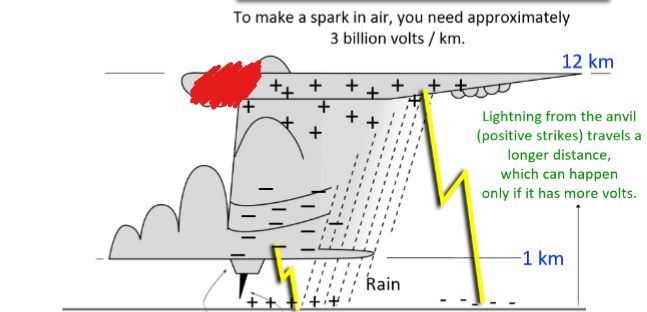
cloud-to-ground lightning diagram (fill in the blank)
that’s the anvil, where the cloud stops going upwards when it hits the tropopause. its the big flat part, and is positively charged
how far away is lightning
sound travels much slower than light
count the number of seconds between when you see the lightning and hear the thunder
divide that number by 3 to estimate the range in kilometers to the lightning
lightning safety
monitor the weather conditions
the 30/30 rule: if there’s 30 seconds or less between seeing the lightning and the thunder (meaning 10km away or less), then go inside and stay there until 30 minutes after the last lightning or thunder
where do i go in a thunderstorm?
safe places include:
1 a fully enclosed metal vehicle with the windows up
2. substantial permanent buildings (but don’t use any hard-wired telephones)
if stuck outside avoid unsafe areas:
small structures, huts, rains shelters
nearby metallic objects (pole, fence)
trees, water, open fields, hill tops, etc.
if caught in the open, do the lightning safety crouch with feet together, hands over ears
if people are struck by lighting, try reviving w/ CPR
thunderstorm basics
they are thick clouds with lightning & thunder
the cloud’s top is near he top of the troposphere (10-15km)
the cloud base is near the ground, abt 1 km
the look a bit like an anvil or mushroom
thunderstorm basics part two
strong updrafts & downdrafts (turbulent)
if the updrafts are very strong, then the dome of clouds can overshoot the anvil
the anvil can 100s of km in diameter
the main updraft is 15km diameter
the storm’s energy comes from temperature and humidity

cloud diagram (fill in the blank)
thats the flanking line
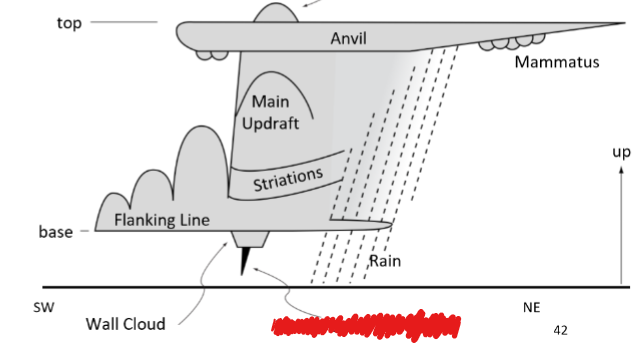
cloud diagram (fill in the blank)
that’s the funnel cloud (or tornado when it touches down)

cloud diagram (fill in the blank)
that’s the main updraft (the part that can overshoot the dome)
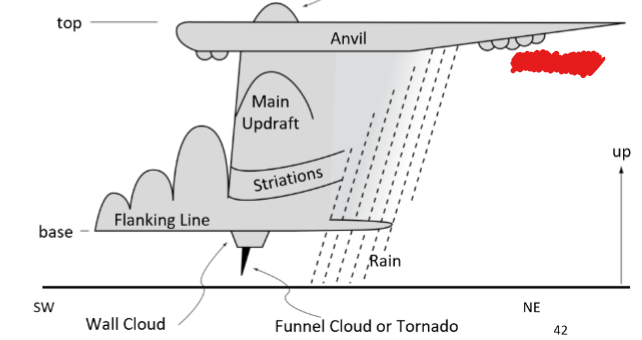
cloud diagram (fill in the blank)
those are the mammatus clouds

cloud diagram (fill in the blank)
those are the striations, which slowly rotate
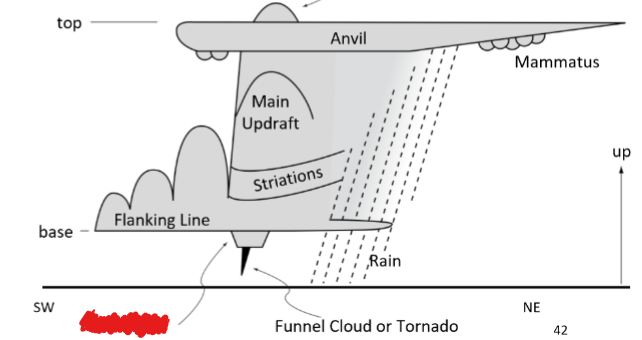
cloud diagram (fill in the blank)
that’s the wall cloud
what’s a thunderstorm cell?
cumulonimbus (thunderstorms) are made of large cells that evolve during about 15-45 min
most thunderstorms contain 2 or more cells, each in different stages of evolution.
these are called multicell thunderstorms, and typically last for longer than any individual cell
multicell thunderstorms
most thunderstorms contain 2 or more cells, each in different stages of evolution.
these are called multicell thunderstorms, and typically last for longer than any individual cell
each cell 15-45 minutes, but the cluster, made up of multiple cells at various stages in their lifecycle, can last for several hours
what’s a squall line?
its a line of thunderstorms, often developing on a cold front
whats a supercell thunderstorm?
a very large, rotating single-cell thunderstorm forms
the can cause tornadoes, large hail, frequent lightning, heavy rain, strong winds, and can last for several hours
there are three types:
low precipitation
classical
high precipation

the life cycle of a thunderstorm
cumulus stage: the updraft, no rain, and no anvil
mature stage: up and downdrafts, heavy rain, crisp anvil
dissipating stage: downdraft, light rain, fuzzy anvil
(this all happens in 15 - 45 minutes)
where does storm energy come from
the sun! is the source of atmospheric heat, which the storm uses for energy
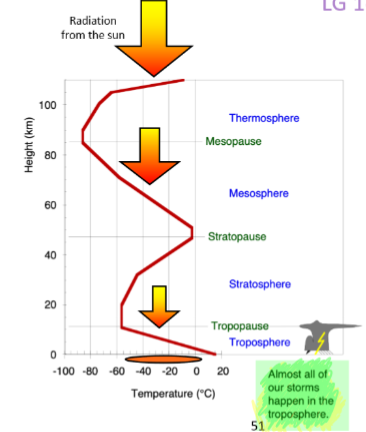
solar energy heights
at the top (thermosphere): there’s the absorption of non-visible light
in the middle (stratopause): absorption of ultraviolet by “good“ ozone
at the bottom (earth’s surface): light shines through the lower atmosphere with little direct heating of air, but heats the ground instead.
then the warm ground
surface heat budget
some solar energy reflects back into space from clouds and the ground
some is absorbed by the ground, making the ground warmer
the warm ground affects the air as follows:
sensible heat (warms the air)
so air temperature increases
latent heat (evaps. water from lakes, vegetation, etc.)
air humidity increases
both temperature and humidity are important because they are the fuel for stroms

daily cycle
solar heating during the day => input (like charging the battery)
infrared radiation (IR) cooling day & night → loss (battery discharge)
so, there’s the greatest accumulation of heat near sunset every day
so… late afternoon and early evening is the most likely time of day for thunderstorm foundation
what locations are favourable for thunderstorms
favourable locations are at the greatest supply of heat and moisture:
closer to the equator → warm ocean currents → warm, humid air
in USA → florida, gulf states
in Canada → prairies and central, because of advection
(warm humid air carried by the wind) and high temperatures
what are remote sensors?
an instruments that is remote from the storm, but can still measure it
we talk about radar and satellites
how do storm sensing radar work?
the radar sends a bunch of energy out at the storms, and measures the amount that comes back in decibels dBZ
this means, the more energy that comes back, the more things (precipitation) it bounced off of. so high energy reading = lots of precip in that area = storm there
storm sensing radar and birds
and little blue splots are birds, and stronger energy signatures are storms
what is dBZ?
its a disaster intensity scale for radar-echo strength (an indicator of rainfall-rate)
dBZ = radar echo intensity (in decibels)
what is a mesocyclone?
what we call a rotating storm
wind?
can cause damage itself
but also they blow in more warm, humid, air (storm fuel)
this is called moisture advection\
positive feedback loop = longer storms
how storms can become “organized"
forces and winds
forces create winds (f = ma)
acceleration is a change of velocity during an interval of time
combining these vnew = vold + (f/m) * Δt
tis equation applies to all objects, including air parcels
the movement of air parcels is wind
so this is the equation of the wind
what are the forces in the atmosphere
buoyancy force (vertical)
causes up & downdrafts
pressure-gradient force (PGF)
causes horizontal movement
how does buoyancy work?
warm air rises = updrafts
cold air sinks = downdrafts
because the temperature of air affects the density of the air, which makes it rise or fall
i.e. the buoyancy of an air parcel depends on the difference between the parcel temperature and the temperature of the surrounding air
how does buoyancy relate to thunderstorms
condensation in tstorms releases latent heat, which warms the tstorm air, making it buoyant and causing it to rise, which drives the violent updrafts in thunderstorms
pressure and tstorms
pressure = force / area
pressure difference on a single point isnt important
instead, we look at pressure gradients, which is the pressure difference between one side of the air parcel to the other side
temp, pressure, and thunderstorms
a change in temperature occurs
so a change in density occurs there too
so a change in pressure occurs there too
so a pressure gradient forms
high altitude pressure gradients make faster winds
and this drives the violent winds in hurricanes or atmospheric rivers
air continuity
air molecules tend to spread themselves smoothly and evenly
they don’t leave any gaps
they don’t get bunched together
this means that changes in one part of the air affect other parts
air continuity and circulations
air is distributed normally
a buoyant air parcel rises, leaves a hole where it used to be (meaning a new partial vacuum with lower pressure than the surrounding air)
the surrounding air is sucked into this low pressure zone to maintain continuity (drawing in humid/warm air…)\
air above the rising parcel is compressed: higher pressure, and expands laterally
net result: initial vertical motion due to buoyancy generates horizontal motion in surrounding air ==> circulation
continuity links horizontal and vertical motion
whats an atmospheric river?
a long, narrow band of concentrated water vapor in the atmosphere that acts like a river in the sky.
they can carry a shit ton of water, originating in the tropics/sub-tropical regions, and can be about 400-800km wide, 3ishkm deep, and 100s of km long
atmospheric rivers and mountain ranges
when the air hits mountain ranges and is forced to rise, it cools at the adiabatic lapse rate (10oC/km) causing water vapour to condense and rain to form
abbotsford flooding 2021
Heavy, prolonged precipitation from a series of atmospheric rivers
Led to severe and disastrous flooding in the Sumas Prairie
Before European colonization of these lands, Sumas Lake existed, which was drained by settlers to create the Sumas Prairie for farmland
Elders of the Sumas First Nations intentionally built their houses on ground higher than where the Sumas lake was as they believed there was a chance the lake would come back
hail
Hail begins as tiny crystals of ice that are swept into a thunderstorm’s updraft (usually a supercell)
• These ice embryos collide with supercooled water – liquid water that has a temperature below freezing
• The water freezes, causing the embryo to grow…
• …leaving layers of clear or cloudy ice as the hailstone moves around inside a
thunderstorm
hail safety
Bring or wear safety glasses, in case hail breaks the windows in
your car.
If possible, turn away from the storm and drive away.
Stay under a roof, inside a car, under a farm tractor, etc. to
protect yourself from falling hail.
how big are hurricanes
also 15km tall
but can be up to 300km wide, compared to 15km for tstorms
parts of the hurricane
the eye
the centre of the hurricane
relatively calm
relatively clear
low pressure at sea level
hurricanes are made of thunderstorms:
the eye wall: a ring of thunderstorms around the eye (very destructive)
spiral bands: bands of tstorms extending out from the eye wall
cross section of a hurricane
look! the eye can be tens of km across
the eye wall (ring of thunderstorms), can be much more

the saffir-simpson scale
it measures the wind speed, pressure in the eye, and the height of the storm surge
goes up to category five
how do hurricanes last for so long?
because they manipulate the environment to create new fuel for themselves from warm humid air from heat stored in the ocean