Motor development
 Call Kai
 Learn
 Practice Test
 Spaced Repetition
 Match
 Flashcards
 Knowt Play
1/14

There's no tags or description
Looks like no tags are added yet.
15 Terms
What is motor development?
The changes in human motor behaviours over the lifespan, the underlying processes of these changes, and the factors that affect them.
What are motor development characteristics?
Involves changes in movement behaviour
It is sequential, age-related, and continuous
It depends on underlying processes
What are the motor development stages?
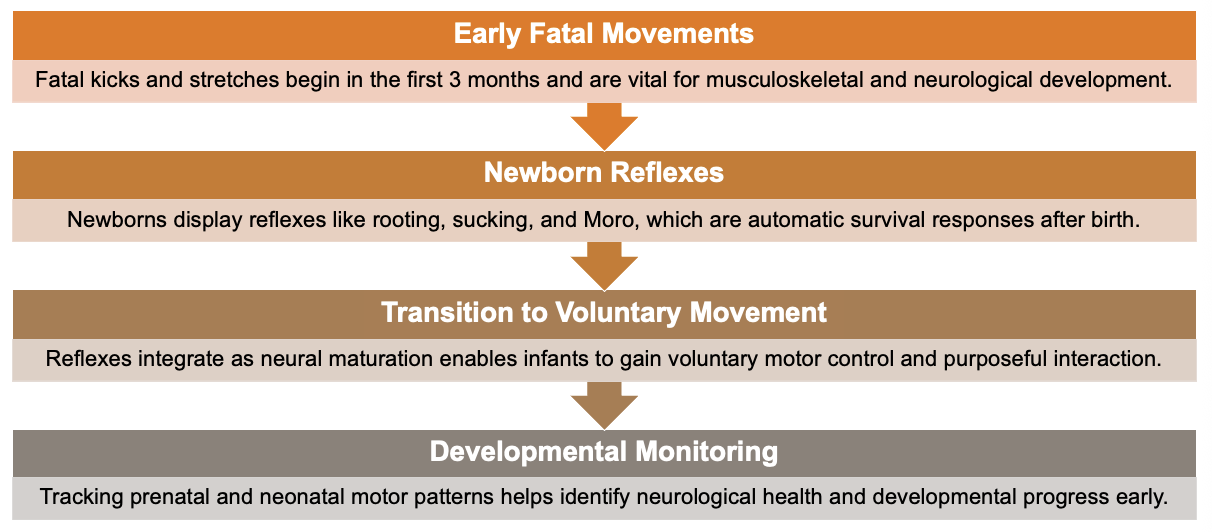
Children are born with few motor skills, and by the age of 1 year, they start to walk.
Motor development occurs in stages and is not a linear progression.
It consists of various milestones, which include the basic motor skills acquired in infancy and early childhood.
What is the cephalocodal principle of motor development?
It starts from the head to tail.
Develops head control, body, hip, legs
What is the proximodistal principle of motor development?
It starts from close to the body to further out.
Develops reaching and grasping
What is the differentiation principle of motor development?
The process of moving from gross, immature movement to fine, precise, well-controlled movement.
What is the integration principle of motor development?
The ability to function as a unit in coordination.
What is development, growth, and maturation?
DEVELOPMENT - refers to the progressions and regressions that occur throughout life
What is growth?
GROWTH - refers to the structural aspects of development
It is quantitative / structural
As we age, it slows
What is maturation?
MATURATION - refers to the functional changes in development
It is qualitative / functional
Continues throughout the lifespan
What are gross motor skills?
Gross motor skills involve large muscle groups for activities like crawling, walking, and running
They are essential for mobility and independence
They help children to get around in their environment
They depend on several sensory systems, including vision for coordination and proprioception for controlling
Proprioception is the sensation of movement and location based on stimulation arising from muscles and joints
What are fine motor skills?
They require precision and coordination of smaller muscles, enabling tasks such as writing
They help children to manipulate their environment
They develop with maturation
When infants are able to sit, they acquire the ability to transfer objects from hand to hand
By the age of 1 year, they start using the pincer grasp by using their index finger and thumb
What are the three fundamental sets of motor skills (Gallanhue)?
Locomotor: walking, running, jumping, hopping, skipping, climbing
Manipulative movements: throwing, catching, kicking
Stability movements: bending, stretching, rolling, balancing, one-leg standing
What is the brief history of motor development?
Precursor period (1787-1928)
Descriptive observation of human development
Maturational period (1928-1946)
Biological processes that shape human development (process and product)
Bayley’s scale of motor development
Normative/descriptive period (1946-1970)
Development of standardised norms
Product oriented
Kephart’s Slow Learner in the Classroom (activities enhance academic performance)
Process-oriented period (1970-present)
Process oriented
Information processing
Dynamical systems
Film analysis and biomechanics