VENTRICULAR DYSRHYTHMIAS & AV BLOCKS LECTURE
 Call Kai
 Learn
 Practice Test
 Spaced Repetition
 Match
 Flashcards
 Knowt Play
1/281

There's no tags or description
Looks like no tags are added yet.
282 Terms
What is a premature ventricular contraction (PVC)?
An early ectopic impulse originating in ventricular tissue.

A PVC can originate in which ventricle?
Either ventricle.
How does PVC QRS morphology compare with the underlying rhythm?
It differs from the QRS complexes of the underlying rhythm.
What type of pause usually follows a PVC?
A compensatory pause.
How common are PVCs among arrhythmias?
They are among the most commonly seen arrhythmias.
Are PVCs typically symptomatic?
They are typically asymptomatic.
What symptom may PVCs cause?
Palpitations.
Can PVCs occur in a structurally healthy heart?
Yes.
In which patients are PVCs more common?
Patients with heart disease.
What is the usual clinical significance of PVCs?
They are typically benign.
Which dangerous rhythms can PVCs rarely trigger?
Ventricular tachycardia or ventricular fibrillation.
An asymptomatic patient has infrequent PVCs. What treatment is indicated?
No treatment.
Where does ventricular tachycardia originate?
An ectopic site in the ventricles.
What ventricular rate is taught for ventricular tachycardia?
Approximately 140–250 beats/minute.
How many consecutive ventricular premature beats define VT in the lecture?
Three or more.
What is the most common form of VT?
Monomorphic VT.
Which VT subtype is usually meant by “VT” or “V-tach” in the lecture?
Monomorphic VT.
What symptoms can VT produce?
Palpitations, Dyspnea, Lightheadedness
Can ventricular tachycardia be asymptomatic?
Yes.
What duration defines nonsustained VT in the lecture? How does nonsustained VT terminate?
less <30 seconds, spontanousely
What is the usual clinical significance of nonsustained VT according to the lecture?
It is usually benign.
Sustained VT is often a complication of what cardiac events?
Myocardial infarction or Cardiomyopathy
An unstable patient has monomorphic VT with a pulse. What is the initial treatment of choice?
Cardioversion.
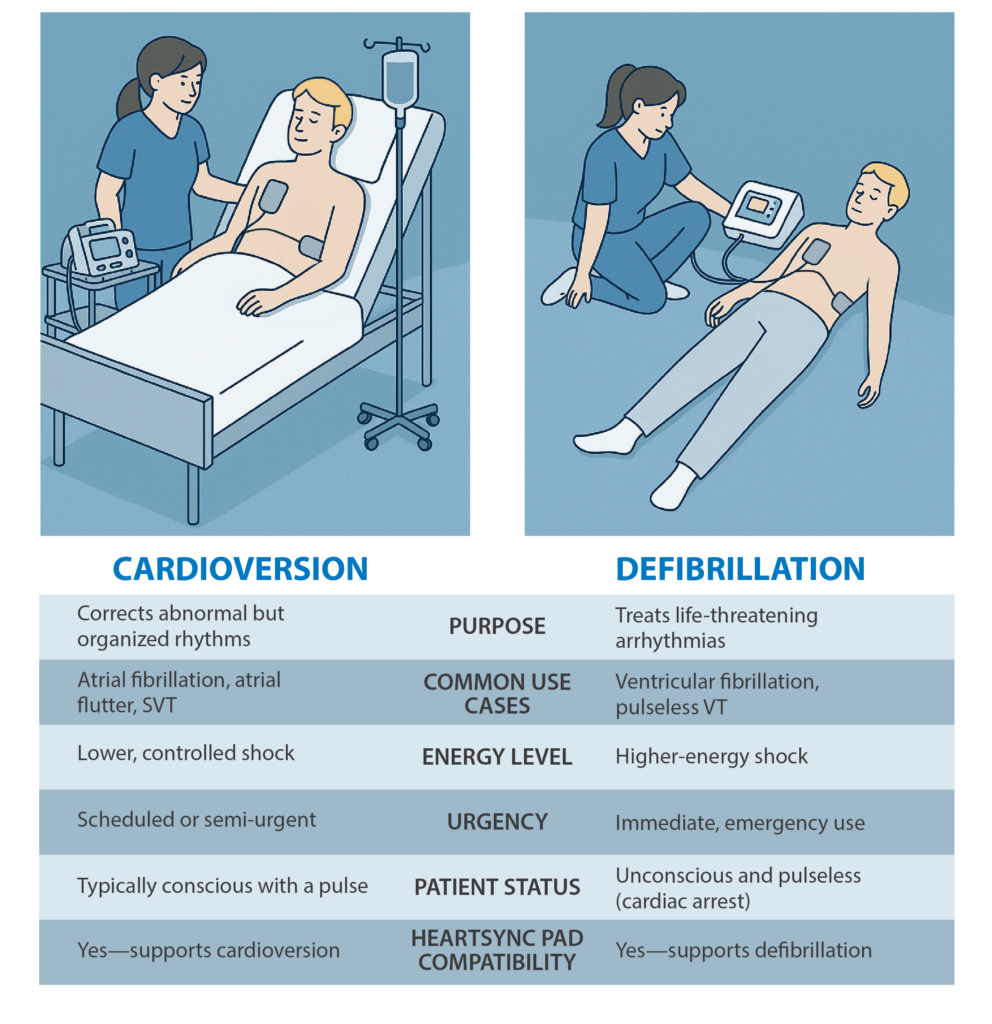
What blood pressure finding indicates instability in VT?
Hypotension.
What symptoms indicate instability in VT?
Chest pain, Altered mental status, ichmeia
Unstable monomorphic VT recurs after cardioversion. What medication should be given?
IV amiodarone.
After giving IV amiodarone for recurrent unstable monomorphic VT, what is the next electrical intervention?
Shock again.
A stable patient has monomorphic VT with a pulse. What medication is administered first?
Amiodarone.
What two alternative medications are listed for stable monomorphic VT with a pulse?
Lidocaine or procainamide.
Stable monomorphic VT persists despite medication. What is the next treatment?
Cardioversion.
What should precede cardioversion after unsuccessful medication for stable monomorphic VT?
Sedation.
What initial cardioversion energy is listed after medication fails in stable monomorphic VT?
200 joules.
After 200 joules, what is the next listed cardioversion energy for persistent monomorphic VT?
300 joules.
After 300 joules, what is the next listed cardioversion energy for persistent monomorphic VT?
360 joules.
What adrenergic-blocking drug class is listed for long-term VT management?
Beta-blockers.
What calcium channel blocker subclass is listed for long-term VT management?
Nondihydropyridine calcium channel blockers.
What ventricular tachycardia subtype is torsades de pointes?
Polymorphic VT.

Torsades de pointes is associated with what QT abnormality?
A prolonged QT interval.
What does “torsades de pointes” mean?
“Twisting of the points.”
What characteristic QRS pattern identifies torsades de pointes?
QRS morphology twists around the baseline or isoelectric line.
What is the QRS width characteristic in torsades de pointes?
Wide QRS complexes.
How do QRS heights behave in torsades de pointes?
They vary.
How do QRS widths behave in torsades de pointes?
They vary.
How do QRS shapes behave in torsades de pointes?
They vary.
What rate is typical of torsades de pointes in the lecture?
200–300 beats/minute.
What potassium abnormality may precipitate torsades de pointes?
Severe hypokalemia.
What magnesium abnormality may precipitate torsades de pointes?
Hypomagnesemia.
What inherited repolarization abnormality may predispose to torsades de pointes?
An inherited prolonged QT interval.
What medication-related repolarization abnormality may predispose to torsades de pointes?
A medication-induced prolonged QT interval.
According to this lecture, what is the initial electrical treatment for torsades de pointes?
An unsynchronized shock.
What initial shock energy does the lecture specify for torsades de pointes?
360 joules.
What magnesium loading dose is specified for torsades de pointes?
1–2 g.
Over what time should the magnesium loading dose for torsades be administered?
5 minutes.
What magnesium maintenance infusion amount is listed after the loading dose for torsades?
4 g.
What should be done with QT-prolonging drugs in a patient with torsades?
Discontinue them.
What metabolic precipitants should be corrected in torsades de pointes?
Electrolyte imbalances.
What is the rhythm regularity in ventricular fibrillation?
There is no regularity.
What identifiable ECG complexes or waves are present in ventricular fibrillation?
No complexes or waves that can be analyzed.
What immediate clinical event does ventricular fibrillation cause?
Sudden cardiac arrest.
What is the consequence of untreated ventricular fibrillation?
Imminent death.
What is the immediate electrical treatment for ventricular fibrillation?
Defibrillation.
pt has no pulse
What defibrillation energy does the lecture specify for ventricular fibrillation?
360 joules, the highest energy level.
Defibrillation for VF is unsuccessful. What resuscitation maneuver should begin?
CPR.
Defibrillation for VF is unsuccessful. What vascular access should be established?
IV lines.
Defibrillation for VF is unsuccessful. What airway intervention is listed?
Intubation.
What epinephrine dose is specified for ventricular fibrillation?
1 mg.
What epinephrine route is specified for ventricular fibrillation?
IV push.
How frequently may epinephrine be repeated during VF resuscitation?
Every 3–5 minutes.
What resuscitation maneuver accompanies epinephrine administration in VF?
CPR.
What protocol guides continued drugs, CPR, and defibrillation attempts in VF?
The ACLS protocol.
After successful resuscitation from VF, what should be treated?
The underlying cause.
What is the recurrence risk after ventricular fibrillation?
High.
What implanted device is often needed in survivors of sudden cardiac arrest?
An implantable cardioverter-defibrillator (ICD).
What does an AV block describe?
Delayed or blocked conduction of impulses from the atria to the ventricles.
What structure acts as the conduction bridge between atria and ventricles?
The AV node.
What physiologic change can cause AV block?
Increased vagal tone.
What ischemic process is listed as a pathologic cause of AV block?
Myocardial ischemia.
What inflammatory cardiac disease is listed as a cause of AV block?
Myocarditis.
What conduction-system structural change is listed as a cause of AV block?
Fibrosis.
What anatomical feature is used to classify AV blocks?
The location of the block.
What functional feature is used to classify AV blocks?
The severity of the conduction abnormality.
What are the two subtypes of second-degree AV block?
Mobitz I and Mobitz II.
In first-degree AV block, what proportion of atrial impulses reaches the ventricles?
All impulses.
In second-degree AV block, what happens to atrial impulses?
Some conduct to the ventricles and some are blocked.
In third-degree AV block, what proportion of atrial impulses reaches the ventricles?
None; all are blocked.
In first-degree AV block, conduction from the sinus node to the AV node behaves how?
It proceeds normally.
Where is the conduction delay in first-degree AV block according to the lecture?
The AV node.
What PR interval defines first-degree AV block?
0.20 seconds.
Which degree of AV block is the mildest?
First-degree AV block.
What is the typical symptom status of first-degree AV block?
Asymptomatic.
Is first-degree AV block typically physiologic or pathologic in the lecture?
Typically physiologic.
What specific treatment is usually required for first-degree AV block?
No specific treatment.
What is another name for Mobitz type I AV block?
Wenckebach.
Where do successive impulses encounter increasing conduction difficulty in Mobitz I?
The AV node.
What happens to successive PR intervals in Mobitz I?
They progressively lengthen.
What eventually happens to an atrial impulse in Mobitz I?
It fails to conduct to the ventricles.
What ECG complex is absent when an impulse fails to conduct in Mobitz I?
The QRS complex.
What term describes the absent QRS complex in Mobitz I?
A dropped QRS.
An ECG shows progressive PR lengthening followed by a dropped QRS. What is the diagnosis?
Second-degree AV block, Mobitz I.
Is Mobitz I typically physiologic or pathologic in the lecture?
Typically physiologic.