Nucleic Acids
 Call Kai
 Learn
 Practice Test
 Spaced Repetition
 Match
 Flashcards
 Knowt Play
1/74

There's no tags or description
Looks like no tags are added yet.
75 Terms
What are nucleic acids?
Long, linear polymers of nucleotides
DNA primarily stores hereditary information
RNA carries information and can also act in protein synthesis, regulation, processing, and catalysis
What is a gene?
A DNA segment whose nucleotide sequence contains the information to make a functional product, either a protein or a functional RNA.
Not every gene encodes a protein.
What are the three components of a nucleotide?
A nitrogenous base, a pentose sugar, and one or more phosphate groups.
The nucleotide sequence of a cell’s DNA specifies the amino acid sequence of every cellular protein and the nucleotide sequence of every cellular RNA
What are major roles of nucleotides besides building nucleic acids?
Provide energy (ATP)
Form parts of cofactors (NAD+ and FAD)
Function as signaling molecules (cAMP and cGMP)
How does a nucleoside differ from a nucleotide and nucleobase?
Nucleotide is a nucleoside with one or more phosphate groups.
Nucleoside is a nitrogenous base attached to a pentose sugar
Nucleobase is the nitrogen-containing base portion of a nucleoside or nucleotide
Its sequence carries the information in DNA and RNA.
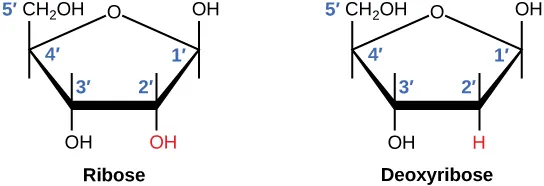
What is the key sugar difference between DNA and RNA?
DNA contains 2'-deoxyribose, which has H at the 2' carbon
RNA contains ribose, which has an OH at the 2' carbon.

What bases occur in DNA and RNA?
Both DNA and RNA contain adenine (A), guanine (G), and cytosine (C)
DNA uses thymine (T), while RNA uses uracil (U).

Which bases are purines and which are pyrimidines?
Purines are adenine and guanine and have two fused rings
Pyrimidines are cytosine, thymine, and uracil and have one ring.

What bond connects a base to the sugar in a nucleoside?
A beta-N-glycosidic bond connects the base to C1' of the pentose (sugar)
It joins N9 of a purine or N1 of a pyrimidine to the sugar

Where are phosphate groups most commonly attached in nucleotides?
They are most commonly esterified to the 5'-OH of the sugar, creating nucleoside 5'-phosphates such as AMP, ADP, and ATP
Phosphates can also occur at other sugar positions.

How do the names adenine, adenosine, and AMP differ?
Adenine is the base
Adenosine is adenine plus ribose, making a nucleoside
AMP is adenosine plus one phosphate, making a nucleotide.
What are NTPs and dNTPs?
NTPs are ribonucleoside triphosphates used in RNA synthesis, such as ATP and GTP
dNTPs are deoxyribonucleoside triphosphates used in DNA synthesis, such as dATP and dGTP.
Which bonds in ATP are phosphoanhydride bonds, and why do they matter?
The bonds between adjacent phosphate groups are phosphoanhydride bonds
Their hydrolysis can provide free energy for cellular processes, although the useful energy comes from the favorable overall reaction and stable products
What is a phosphoester bond?
Connects phosphate to an alcohol oxygen, such as the bond between a nucleotide phosphate and the 5'-OH of ribose
It differs from a phosphoanhydride bond between two phosphates
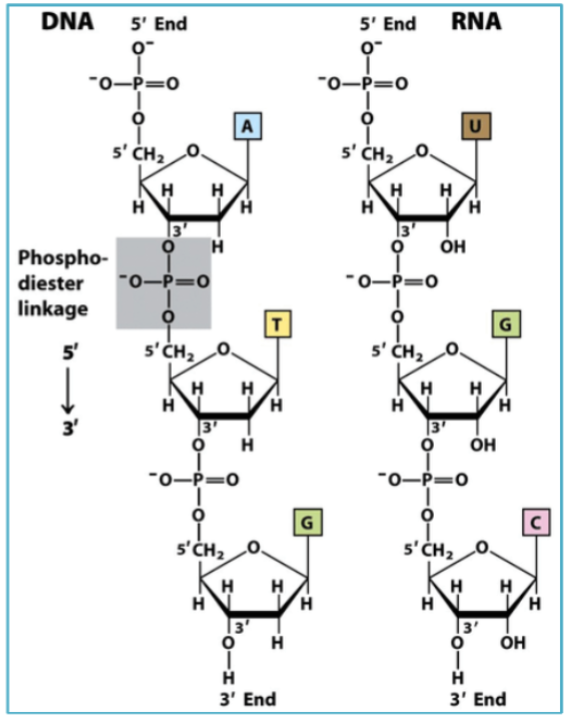
What bond links nucleotides within a DNA or RNA strand?
A 3'-5' phosphodiester bond links the 3'-OH of one sugar to the 5'-phosphate of the next nucleotide
This creates the repeating sugar-phosphate backbone
Why does each nucleic-acid strand have directionality?
One end has a free 5' phosphate or 5'-OH and the other has a free 3'-OH
Because the backbone is chemically asymmetric, sequences are conventionally written and read 5' to 3'
Which end of a newly synthesized DNA or RNA strand grows?
The 3' end grows
Polymerases add each incoming nucleotide to the free 3'-OH, so the new strand is synthesized 5' to 3'.
Why is the nucleic-acid backbone negatively charged?
Phosphate groups are negatively charged at physiological pH
This makes the backbone hydrophilic and allows interactions with cations and positively charged proteins
Why do bases stack in nucleic acids?
Bases are aromatic and relatively hydrophobic at neutral pH
Stacking interactions, including van der Waals and dipole interactions, reduce unfavorable exposure to water and help stabilize helices.
What is the Watson-Crick base-pairing rule?
In DNA, A pairs specifically with T and G pairs specifically with C
In RNA, A pairs with U and G pairs with C.

How many hydrogen bonds are in A-T and G-C base pairs?
A-T pairs have two hydrogen bonds
G-C pairs have three hydrogen bonds, though stacking interactions and sequence context also contribute strongly to duplex stability
Why must a normal DNA base pair contain one purine and one pyrimidine?
A purine-pyrimidine pair fits the constant width of the double helix
Two purines would be too wide and two pyrimidines too narrow, disrupting geometry and hydrogen bonding.
What does it mean that the two DNA strands are antiparallel?
The strands run in opposite chemical directions: one runs 5' to 3' while its complement runs 3' to 5'
This arrangement permits the Watson-Crick base-pair geometry.
What is a palindromic DNA sequence?
It is a double-stranded sequence whose 5' to 3' sequence is the same on both strands when each is read in its own 5' to 3' direction
Many restriction-enzyme recognition sites are palindromic.
What are Chargaff's rules for double-stranded DNA?
The amount of A equals T, and the amount of G equals C
Therefore total purines equal total pyrimidines: A + G = T + C
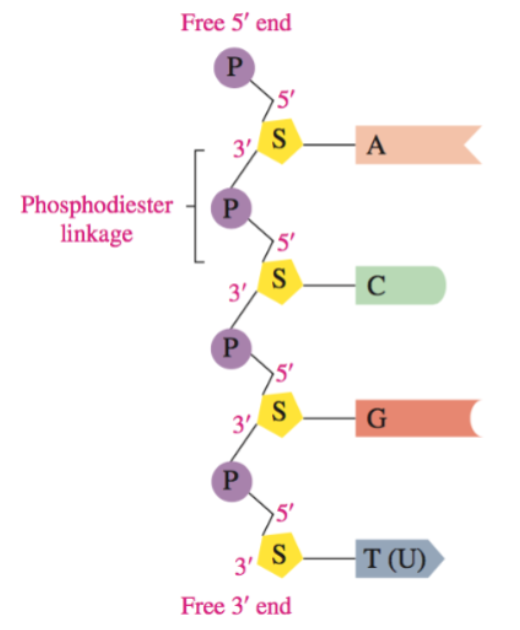
What does the primary structure of DNA mean?
Primary structure means the linear sequence of nucleotides, written 5' to 3’
It is the information-bearing level of structure
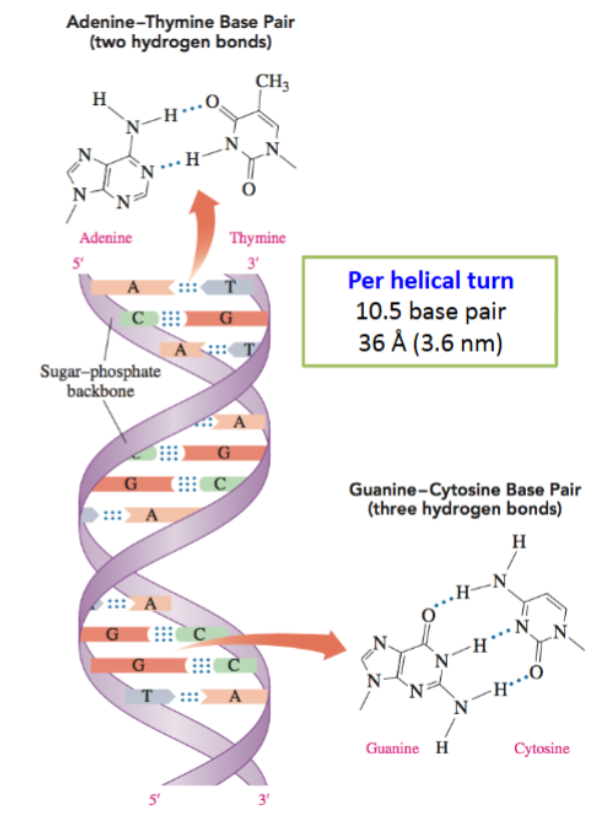
What does the secondary structure of DNA mean?
Secondary structure refers to the double helix formed by two complementary, antiparallel strands through base pairing and stacking.
What are key dimensions of B-form DNA emphasized in lecture?
A helical turn contains about 10.5 base pairs and extends about 36 angstroms, or 3.6 nm
Adjacent base pairs are separated by roughly 3.4 angstroms

What stabilizes the DNA double helix?
Base stacking between adjacent base pairs makes a major contribution
Hydrogen bonds provide pairing specificity between complementary bases on opposite strands
Generally, DNA duplexes with higher G≡C content are more stable than those with A=T
Metal cations such as Mg2+ or Na+ shield the repulsion between negatively charged phosphate groups.
Why does higher G≡C content usually increase DNA melting temperature?
G≡C base pairs have three hydrogen bonds rather than two, and GC-rich sequences often have favorable stacking
Duplex stability also depends on length, salt concentration, and the exact sequence

What is DNA denaturation or melting?
Separation of a double helix into single strands when heat, extreme pH, or other conditions disrupt hydrogen bonding and base stacking
It does not usually break the covalent backbone

What are the main factors affecting DNA denaturation?
Midpoint of melting depends on base composition
High G≡C will increase Tm (melting point)
Tm depends on DNA length
Longer DNA = higher Tm
Important for short DNA
Tm depends on pH and ionic strength
High salt increases Tm

Why is RNA chemically less stable than DNA under basic conditions?
RNA's 2'-OH can act as a nucleophile and attack a nearby phosphate, cleaving the backbone through a 2',3'-cyclic phosphate intermediate
This increases chemical reactivity and gives RNA extra hydrogen-bonding and structural possibilities
DNA lacks that 2'-OH and resists this spontaneous cleavage.

What is the central dogma in its basic form?
DNA is replicated into DNA
DNA is transcribed into mRNA (transcription)
mRNA is translated into protein (translation)

What does semiconservative DNA replication mean?
Each daughter DNA duplex contains one parental strand and one newly synthesized strand
The original strands serve as templates for complementary new strands

What does bidirectional DNA replication mean?
From an origin, replication proceeds outward in both directions
A replication bubble therefore contains two replication forks moving away from the origin

Why do eukaryotic chromosomes have many origins of replication?
Starting at many origins allows separate regions to copy simultaneously so the whole genome can be replicated within S phase since eukaryotic chromosomes are so long. This allows the chromosome to be copied more efficiently.
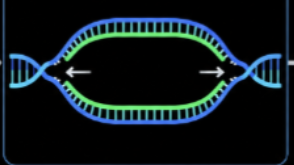
What is a replication fork?
The Y-shaped region where parental DNA strands separate and DNA polymerases synthesize the new complementary strands.
They move outward in both directions, synthesizing new DNA
Why must the leading and lagging strands be made differently?
DNA polymerase can synthesize only 5' to 3', but the two templates are antiparallel
At a moving fork, only one template has the correct orientation for continuous synthesis toward the fork

What does helicase do during DNA replication?
Helicase unwinds the parental DNA double helix by breaking the hydrogen bonds between nitrogenous bases.
Exposes the two template strands at the replication fork so that each can be copied
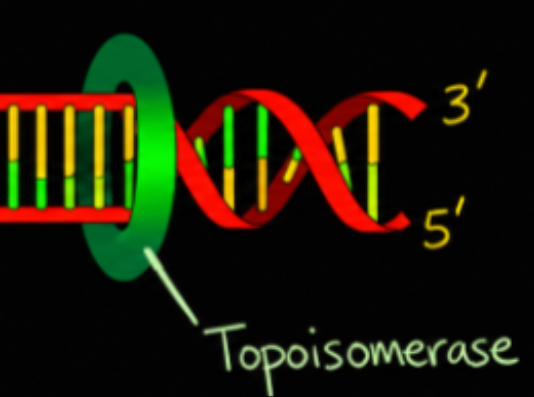
What problem does topoisomerase solve during replication?
Unwinding DNA creates torsional strain and overwinding ahead of the fork. Topoisomerase relieves this strain by transiently cutting, passing, and resealing DNA strands.

Why does DNA polymerase need a primer?
DNA polymerase can add a nucleotide only to an existing free 3'-OH; it cannot begin a strand from nothing
So, it needs the RNA primer to supply that OH
What does DNA primase do?
Synthesizes a short RNA primer that’s complementary to the DNA template in order to start synthesis
DNA polymerase then extends from the primer's 3'-OH.

What are Okazaki fragments?
Short DNA segments made discontinuously on the lagging strand
Each begins with an RNA primer, and after primers are removed and replaced with DNA, ligase joins the fragments.

What does DNA ligase do?
Seals remaining nicks in the sugar-phosphate backbone, creating a continuous phosphodiester backbone after Okazaki-fragment processing and replacement with DNA.

How does DNA polymerase achieve high fidelity?
It selects an incoming dNTP through complementary base pairing and active-site geometry
Proofreading and later repair pathways further reduce the number of permanent errors/increase fidelity

What is processivity of DNA polymerase?
The number of nucleotides a polymerase adds before it dissociates from DNA
Replicative polymerases are highly processive so they can copy long templates efficiently.
What is the difference between polymerization rate and processivity?
Polymerization rate measures how fast a polymerase adds nucleotides
Processivity measures how long it stays attached and continues synthesis before falling off
How does the 2'-OH explain a major biological difference between DNA and RNA?
DNA's lack of a 2'-OH makes it chemically durable enough for long-term information storage
RNA's 2'-OH makes it more readily hydrolyzed, fitting many RNA roles as temporary messages or dynamic functional molecules.
What is transcription?
Synthesis of an RNA molecule from a DNA template
RNA polymerase reads the template strand and makes RNA 5' to 3'
Which DNA strand does RNA polymerase read?
RNA polymerase reads the template strand in the 3' to 5' direction
It synthesizes the RNA strand 5' to 3'.
How does an RNA sequence relate to the template and coding DNA strands?
RNA is complementary and antiparallel to the DNA template strand
Its sequence matches the coding, or non-template, DNA strand except RNA has U where DNA has T.
If the coding DNA strand is 5'-ATGCCA-3', what is the RNA transcript?
The RNA is 5'-AUGCCA-3'
It has the same 5' to 3' sequence as the coding strand except U replaces T.

What is a promoter?
A regulatory DNA sequence near a gene where transcription machinery assembles
It helps determine where transcription starts and contributes to when, where, and how frequently a gene is transcribed
What are transcription factors?
Proteins that bind specific DNA regulatory sequences or other transcription machinery
They help recruit, position, activate, or repress RNA polymerase
What is a transcription bubble?
It is a short locally unwound region of DNA inside RNA polymerase
Opening it exposes the template bases so RNA can base-pair with the template during synthesis
Why can RNA polymerase initiate RNA synthesis without a primer?
RNA polymerase can form the first phosphodiester bond de novo from ribonucleoside triphosphates
In contrast, DNA polymerases used for replication require a preexisting 3'-OH primer.
What type of substrate does RNA polymerase use?
RNA polymerase uses ribonucleoside triphosphates: ATP, GTP, CTP, and UTP
The incoming NTP's alpha phosphate becomes part of the RNA backbone
What is RNA polymerase II responsible for in eukaryotes?
RNA polymerase II synthesizes pre-mRNA, the precursor to most mRNA, and some small nuclear RNAs
It is the polymerase emphasized for protein-coding gene transcription
Why must eukaryotic mRNA leave the nucleus before translation?
Eukaryotic transcription and RNA processing occur in the nucleus, while ribosomes translate mRNA in the cytosol
The transcript must be processed and exported before cytosolic ribosomes can use it
How do eukaryotes and prokaryotes differ in coupling transcription and translation?
In prokaryotes, no nuclear membrane separates the processes, so ribosomes can translate an mRNA while it is still being transcribed
Eukaryotes separate them by location and time.

What happens during transcription initiation?
Transcription factors recognize promoter elements and recruit RNA polymerase
DNA opens locally to make a transcription bubble, allowing the enzyme to begin RNA synthesis at the start site.
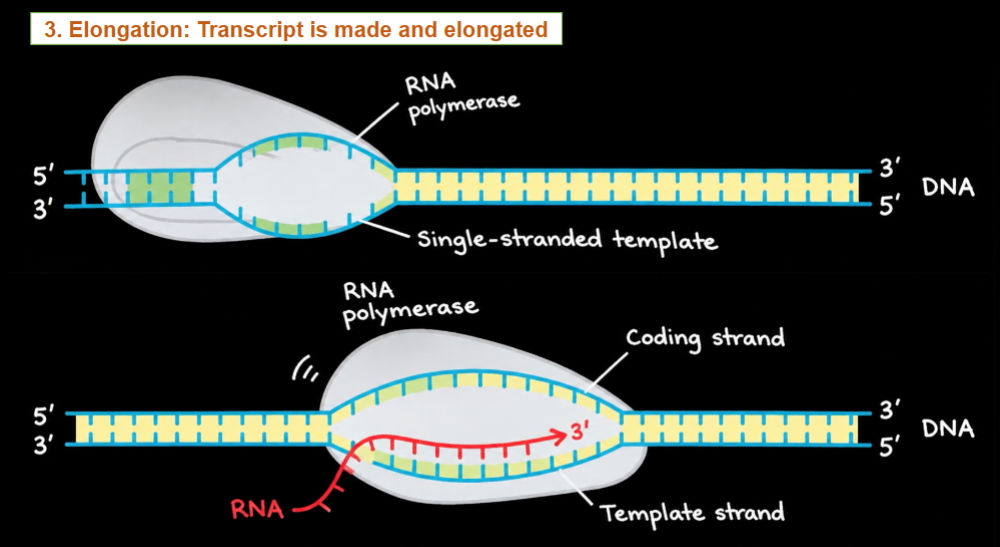
What happens during transcription elongation?
RNA polymerase moves along the DNA template, maintaining a small transcription bubble
It adds ribonucleotides to the RNA 3' end, so RNA lengthens 5' to 3'.

What is the difference between the coding and template strands?
The template strand is physically read by RNA polymerase and is complementary to RNA
The coding strand has the same sequence as RNA, except it contains T instead of U.

What is a pre-mRNA?
The initial RNA polymerase II product for a protein-coding gene
In eukaryotes it is usually processed by 5' capping, splicing, and 3' polyadenylation before becoming mature mRNA.

What is a 5' cap and what does it do?
A modified guanine attached by an unusual 5'-5' triphosphate linkage to the RNA's 5' end
It protects the RNA from degradation and promotes efficient translation and processing.
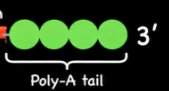
What is a poly(A) tail?
A run of adenine residues added to the 3' end of most eukaryotic mRNAs after cleavage
The DNA template does not directly encode the tail
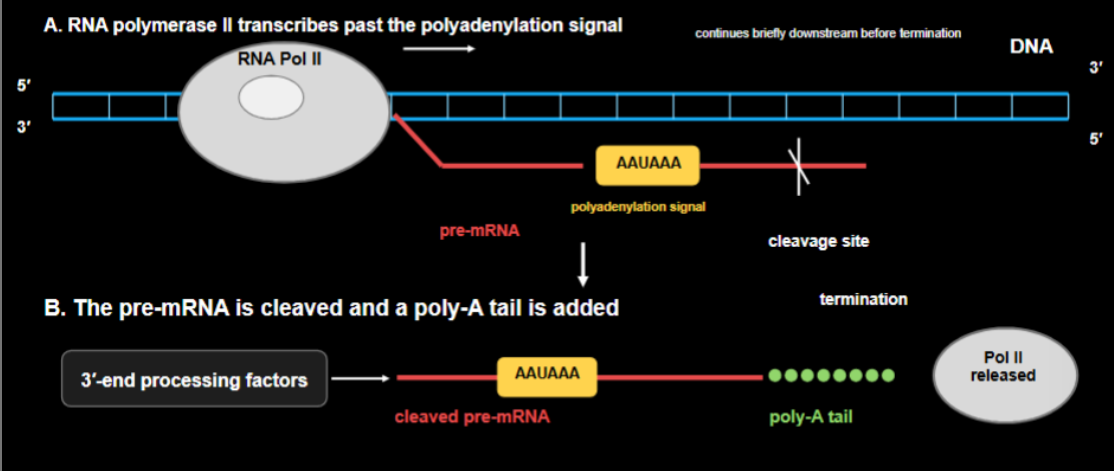
What sequence signals cleavage and polyadenylation?
The pre-mRNA contains the polyadenylation signal AAUAAA
Processing factors cleave the RNA downstream of this signal, and poly(A) polymerase adds the tail.

What are introns and exons?
Introns are sequences transcribed into pre-mRNA but removed during splicing
Exons are sequences retained and joined together in mature RNA

What is RNA splicing?
Removes introns from pre-mRNA and joins exons to make a continuous coding message
It is a crucial eukaryotic processing step before many mRNAs are translated
What is a spliceosome?
A large RNA-protein complex made from small nuclear ribonucleoproteins, or snRNPs, and other proteins
It recognizes splice sites and catalyzes pre-mRNA splicing