social psych III
 Call Kai
 Learn
 Practice Test
 Spaced Repetition
 Match
 Flashcards
 Knowt Play
1/53

There's no tags or description
Looks like no tags are added yet.
54 Terms
Performance Before a Group: Group Behavior
Social impact: where does the arousal come from when you have to do something in front of other people. There will be some adrenaline. Ex. Lecturing people for the first time.
Social impact Theory
source of arousal
Arousal = f (strength x immediacy x number)
Strength: When we care about others’ evaluation of us, strength is increased. The status of the audience.
Immediacy: how much do you feel their presence/their eyes on you. We may feel more nervous when we can see people’s eyes on us and their responses.
Tip: don’t look at the people in the front, talk to the people in the back because it’s harder to see their response.
Number: notion that more audience members give more arousal. More anxiety potentially. Rule of going from 9 to 10 adds more potential anxiety than 99 to 100.
Example: The researchers tested how zoo visitors would react to a rule prohibiting them from leaning on the metal railings near the bird exhibits. A confederate approached visitors and instructed them not to lean on the railings, manipulating the three core variables of the theory. When the confederate was dressed in the official, authoritative uniform of a zookeeper, obedience was higher than when dressed causally (Strength). When the confederate gave the instruction while standing right in the same room near the visitors, compliance was higher than when instructions were in a separate room (Immediacy). When the rule was targeted at smaller groups of visitors, obedience was higher than in large groups (Number).
Social Facilitation
Arousal Enhances the dominant response: if we are good at the task, the arousal you feel will improve the performance. The excitement of being good and wanting to show others. If you are bad at the task, the arousal will cause your performance to be worse/undermined.
Maze study: independent variable: level of the maze. Experimental group got a difficult maze. Another IV: amount of people watching DV: how long it took you to do the maze.
Different variations with anagrams, sports (basketball, have people be watched doing 100 free throws or 100 free throws alone. People who were already bad worsened their performance when being watched), lacing up shoes vs. tying them. When people watched you tie the shoes, they did it faster. When people watched you lace up the shoes, went slower.
Measures were developed for indicators of autonomic nervous system like heart rate, blood flow, etc. A researcher used these measures and found different types of arousal based on level of skill. People who were bad and being watched -> arousal was like a threat. People who were good and being watched -> displayed itself in a different way, “challenged”.
Yerkes Dodson
how arousal affects performance. For any one person in any one task, there will be some sort of curve on how arousal affects our performance. There will be a point of optimal arousal. Being somewhat aroused is optimal, but too high or low arousal is problematic for performance. If you are really good at something, arousal may not affect your performance. Overall, your skill level may change how the curve looks. There will be different curves for different individuals depending on what the task is. Within individuals, there will be different curves for different tasks that you do.
Intragroup Behavior
Categorized; how we are affected by being embedded in a group in terms of our performance.
Social Loafing
Intragroup Behavior: when embedded within a group, we tend to not work as hard as we do when doing a task alone. How we behave in small group vs. alone
One of the first studies on this was a task that wasn’t skill relevant: the task of shouting. The researcher had people set up to shout into a microphone. Had them shouting by themselves, or with a group of 2, 3, 4, 5, 6. Measured the decibels of the shouting. People shouted louder when they were alone. People shouting in group 3 > Shouting in group 6. Perhaps a social comparison effect of everyone noticing people weren’t working hard.
Another study was when people were in different cubicles. The subjects couldn’t see or hear how much effort people put into it. The researcher asked certain cubicle combinations to shout. Same result, people were more likely to shout louder on their own.
Study at cheerleading camp: Clapping alone or in groups. With/without social comparison accounted for. Either way, social loafing occurred.
Why Social Loafing Happens
Intragroup Behavior - Why:
Deindividuation: as a psych concept, deindividuation is the notion that when my behavior isn’t tied to my identity, we are freed to behave in a way that is not normal. Could be negative or positive. Example: halloween study with the kids and the candy vs. quarters. Mirror in front of them, self-discrepancy theory. Kids in a more disguised costume were more deindividuated.
Positive deindividuation: sign up for study on group interactions. Put into a common room and have subjects just have a conversation. They manipulated whether the room was lit or was really dimly lit so you couldn’t see anyone. Wore a blindfold going to the room, take it off in the room, put the blindfold when you leave. No visual identification in the dark room. People who had an interaction in the dark room had a more positive experience, they talked more about aspirations and personal history (without distinctive details). Being deindividuated freed them up from doing impression management.
Weird deindividuation study: had a police scanner in a mid size study. Whenever there was a call about someone threatening to jump off to commit suicide. People were more likely to do negative behavior in a large group, such as telling the person to jump. Other factors of negative behavior were darkness, and the higher up the person was. If people can’t tie my identity to my behavior, I can put less effort. To reduce social loafing, you can make people have more individual
Swim study: having a timer the entire time. For 4x100 teams, the individual times for some groups were all posted, while for other groups, only the total time was posted. If you compared the individual vs total team without ind. teams, there was social loafing. When times were individually shown, there was less social loafing.
Why: diffusion of responsibility, the responsibility is distributed among the group members. In a group, your individual effort may be hidden. In helping behavior, people feel less responsible to help.
Free riding, the notion that there might be some benefit from social loafing. If I can not work as hard because others are doing the work, that is a good thing. There is a temptation to social loaf to conserve energy and free ride on the backs of other people. Problem: if everyone in the group feels that way, then the group will suffer since no one is doing the work.
Group Task types
Maximizing (as much as possible) vs. Optimizing (most well done). Social loafing is more likely to happen when people want to maximize. People are doing the same task over and over again, leading to automatic processing. Controlled processing is more involved with optimizing. Automatic processing is more likely to lead to social loafing.
Additive (as much as the group can, have the group total at the end, prone to social loafing especially if the individual outputs aren’t tied to the individual/deindividuation) (Ex. Paper planes with individual count vs group total). paper planes competition in groups, adding or seeing individually vs. compensatory (the goal is accuracy). Example estimating the temperature in the group by group members. More with controlled processing, less social loafing.
Disjunctive (the group is as good as its best member as their ability shines through, ex. Trivia and someone who is really good at history. Issue: sometimes, because of other issues about the group like whoever is the leader, the person who might be the best may be of a lower status in the group so they won’t be the forefront of the group and help them get success) vs. conjunctive (the group is only as good as its worse member. Ex. four people playing card towers; 3 people are good but 1 is bad, that person will heavily impact the outcome. Ex. Crew, having one person who is out of time will slow the group down as a whole)
Groupthink
Intragroup Behavior: we may think that having more people be involved in the evaluation of something would be better because you can get more ideas from multiple people because they can build on people’s ideas. However, there is deterioration of decision making that results from structural flaws and ingroup pressures, often leading to a disastrous decision.
Ex. JFK presidency bay of pigs invasion. The US lost a lot, and wanted to get it back. Bay of Pigs invasion was developed by JFK’s people, training ex Cubans to roam through the country and sweep up the pro-democracy to Havana to make a big protest/revolution. This was disastrous.
Groupthink variables
Intragroup behavior: Central leader: person with the final say. Important because:
Gatekeeper: Plays the biggest role. Plays the important role of (1) controls access to the central leader or channel the message of the central leader is receiving, filtering out any alternative opinions/information and changes the slant (2) has an effect on other people in the group to reward people they agree with and punish people they disagree with.
Pressure to uniformity: there is pressure in the group to be on the same page and come to a decision that everyone agrees with, facilitated by the other people in the group or gatekeeper
Pluralistic ignorance: people who have doubts about the outcome may think that others know more than they do, so they should just defer the responsibility to them
Self-censorship: people who have the greatest doubts restrain themselves from bringing it up because they may get punished by the gatekeeper, or pluralistic ignorance
In archival research, there’s evidence many people in the group had their doubts but did not bring them up because of the pressures.
Ex. Challenger space shuttle launcher. Rocket launch carrying people to the National Space Station. Really hyped up. They chose a school teacher, not an astronaut, to go up with them. They broadcasted the rocket launch live. Every school gathered to watch. The space shuttle went up and blew up. Groupthink situation: the flight commander was the central leader. A lot of people in terms of the engineers had doubts of the temperature and the structural making of the rocket. Some people voiced their doubts, but got punished by the gatekeeper, or self-restrained.
It’s difficult to do groupthink in the lab
Combatting groupthink: brainstorming.
A researcher looks into creativity. He did research on individuals making as many creative ideas vs. in groups. In groups, people would evaluate the ideas as they are going so they would stifle people who were created by coming up with more ideas. The researcher said that there needs to be 2 phases: idea generation WITHOUT evaluation. Stating the ideas without commenting on the value of the idea. Then, once you’ve exhausted all your ideas, then you can evaluate the ideas. Many more creative solutions are able to be formed from this brainstorming. Speculation that doing the phase of many ideas without evaluation prevents groupthink.
Minority influence
Intragroup behavior: Johnny Rocco study. If the subject, 85% moved closer to majority because the majority would bombard the person in the minority with normative and informative social influence. A french researcher researched about a minority able to convince the majority.
Minority influence
A person has to be consistent and stick to their idea. They cannot give a little bit towards the majority because they will double-down after you agree.
Confidence. Minority influence is important to the extent that they exude confidence that they are correct.
Independence/objectivity: you don’t have any stake in the game. It’s just from an entirely objective stance that is consistent and confident. In this way, the minority can influence the majority. Ex. civil rights in the US
Leadership
Intragroup Behavior: Contingency Model: There isn’t a systematic personality characteristic of a leader. Leadership effectiveness depends on an appropriate match between a leader's style and the demands of a specific situation. Ex. A software startup has a hard deadline in 48 hours to fix a critical system crash. The team members know their technical roles, respect the manager's expertise, and the manager has formal authority to assign tasks. A lot of leadership research comes from military funding.
Leadership styles:
Socio-emotional leadership: good at listening, situational awareness, improving morale, team-building
Task leadership: delegate tasks, don’t care much about social emotional leaders, drills everyone to be on task
Within groups, oftentimes it’s important to have both kinds of leadership. The most effective leaders are both (Self-monitoring as a skill)
Large Intragroup Behavior
Many people in the group
Social dilemmas
Large Intragroup Behavior: the conflict between wanting to maximize self-interest versus the interest of the group as a whole
Types:
Commons dilemma: people are taking from a resource. Issue: if too many people take from the resource too quickly, the resource will be depleted too quickly. Ex. natural resource issues, like grazing livestock in ancient times. If someone’s livestock grazes too much, they deplete it for the others. Sometimes, people want to show restraint, but feel like they will get taken advantage of/get left behind. Ex. whaling industry in the 1900s. If people act selfishly, they can ruin the resources for everyone else. Ex. rainforest deforestation Ex. Maine lobster fishing. Self interest vs. the good of the group
Public goods dilemma: you have to contribute to the resource to keep it alive. If too many people act selfishly, the resource will be depleted and gone for everyone. Ex. NPR; most stations rely on contributions from the community to survive. As the listener, if you never give anything, then it will be depleted. Ex. Recycling may be a process that is inconvenient, but when people don’t recycle, there are big environmental impacts.
General social dilemmas: large group situation where acting selfishly may benefit you, but if too many people do this, there will be a problem. Ex. cities in the northeast in terms of beltways or commuter traffic areas, they have high occupancy vehicle lanes. Those are in place to encourage carpool, if you have more than one person in a car for less pollution and traffic. But sometimes, when traffic is too much in the main lanes, a car with only just one person will go in the HOV lanes. Sometimes many people do this and increase traffic. Ex. people walk over the grass to get somewhere quickly like the Hodson grass area. It’s fine if only a couple of people do that, but when many people do this, a muddy path appears.
Ways to reduce selfish behavior
Large Intragroup behavior: Normative issues
Normative and informative social influence descriptive and injunctive norms: if you can establish a norm that you don’t act selfishly in a situation, people are strong norm followers and don’t act selfishly. Ex. in Texas, a basketball player was called out for using water. Later he wrote a letter saying there was a waterbreak under the house. He felt the need to say something because of the pressure of normative social influence. Informative: when people bombard others with information about why something shouldn’t happen. Ex. Oil embargo: reducing gas usage during oil embargo. In some buildings on campus, there would be stickers that had messages saying “turning out the lights saves electricity” giving people information to build the norm, why they should show restraint.
Smaller groups: when you have to publicly show your selfishness, there may be repercussions. Johnny Rocco Study, people got kicked out.
Descriptive and injunctive norms: descriptive norms are information about what most people do. Ex. encouraging recycling in one dorm saying 85% of Hopkins students recycle. Descriptive information convinces others to follow. Injunctive norms is how ought one behaves, with a bit more judgment. There is an element of subjective norms from the Reasoned Action Model. Most powerful when it's people in our friend group or people we care about. Ex. recycling in a neighborhood.
Smaller groups: 13% people wrote 10. The class came closer to solving it because there was a smaller group. When you are in a smaller group, you feel that your selfish behavior may have a greater impact on fellow members. Your selfish behavior could ruin things.
Deindividuation - identifiability. If choices were tied to us individually, this would change the rates people answered. People would be less likely to act in a selfish manner. People may believe they can get away with things if they are not being identified.
Operant conditioning: the use of rewards and costs. When people are rewarded for not being selfish, an effective change is made. Ex. recycling, if a benchmark is made; experimental group: a reward. Then people are more likely to recycle than without the reward. Punishments: fined for not recycling.
Legal measures: people weigh the odds of getting caught. Ex. lobsters in Maine: you could only take lobsters that reached reproductive maturity. At the beginning, it didn’t have enough of an effect since there were not enough police boats and it was worth it to risk the fine. When the state put a lot more patrol boats out, their behavior changed because the odds of getting caught increased. Ex. Red light cameras. If you are caught, you will be sent a $40 fine. The odds of getting caught are very high. Within 6 months of the camera installments, selfish acts and accidents reduced. While those accidents go down, rates of accidents in intersections without cameras increased because people who act selfishly decide to do the behavior in those intersections.
Large Intragroup Issues
Crowd Behavior: Destructive Events
Destructive events: purposeful negative behavior (ex. Property destruction, violence, looting, rioting)
Ex. 2026 Champions League in Paris, people were burning things in celebration. 2011 Vancouver Riot after NHL Game 7 Loss (Facebook riot: people used facebook to track the destructive behavior;
Social Rage Approach: There will be systemic issues (ex. Institutional racism, police misconduct, etc.) and dramatic events (ex. Unpopular verdicts, assassinations, sports defeats, etc) that crystallize frustration/outrage leading to collective protests that can turn into large scale destructive behavior
However,
majority of large gatherings/protests are peaceful
Many system issues are continuous but destructive events are often episodic, happen here and there
Destructive behavior can occur in the aftermath of good news (ex. 2026 Champions League Final Paris)
However for Destructive Large Intragroup Behavior
majority of large gatherings/protests are peaceful
Many system issues are continuous but destructive events are often episodic, happen here and there
Destructive behavior can occur in the aftermath of good news (ex. 2026 Champions League Final Paris)
How destructive events develop
Unifying event: mass of people together that can be spontaneous or planned (protest march Freddie Gray 2015), “open”, “closed”, or “mixed”
Has to be a convergent norm: there has to be a substantial enough number of like-minded people who would favor destructive behavior and join in; oftentimes, there is an instigator
Instigator: just having people in the same mood doesn’t start destructive behavior. Most people make the calculation that if they start it they might get caught. Need someone willing to risk it anyway; somebody who is willing to do the first dramatic/destructive behavior in the hopes that others join in
Weigh risk of getting caught (ratio of crowd/police ex. people at UMD celebrated off campus after the final four game, turning to a destructive event, burning things. The aftermath was a special commission about what went wrong. They said there wasn’t enough police. Next year, they had tons of policemen on horses), probability everyone will join in, is there a convergent norm.
Spike Lee’s “Do the Right Thing” movie about white pizza maker in a black neighborhood. Police incident, and Spike Lee's character throws a trashcan through the pizzeria’s window. That incident, the act of violence, led to a large, destructive crowd coming in.
Once Destructive (Large Intragroup) Events Occur
Contagion (Le Bon’s 1895 “Psychology of Crowds” something happens in these large gatherings of people that activate the autonomic nervous system arousal and contagion of being in a high energy crowd/state, people get swept up in this crown mentality of adrenaline and excitement) People do things they usually wouldn’t do. In the facebook riot, most people weren’t there to riot, but they got caught up in it.
Emergent norm: what becomes allowable behavior starts to change when people start the destructive behavior. The norms against destructive behavior change, that behavior becomes the norm. The emergent norm of destruction
Deindividuation: embedded in a group with a bunch of activity, people wouldn’t be able to tie their behavior to them. People feel freed up to act destructive.
Intergroup Behavior
examine how people in one social group perceive, feel about, and behave toward members of another social group. Discontinuity effect: intergroup behavior is much more competitive than inter-individual behavior
Research done from a reductionist approach; Often represented by the Prisoner’s Dilemma Game: 6 people report to the lab, randomly split up into groups of 3, going through a matrix game, then have them elect someone to talk about the game. The other trial has only 2 people.
PDG Matrix
Intergroup Behavior: In individual interactions, 90% of subjects both choose X to be mutually benefitted, and also alternate to help each other. They put their trust in the other individual. In groups, they found that they behave 50% cooperative and 50% competitive. Half the time, they try to maximize themselves. Subjects should not know when the last trial will be. In groups, there is a temptation to beat the other group. It is unclear if the Y response is driven by greed (getting 5 points) or fear (the other group will be competitive).
Alternative: if you choose Z, a third column, you will get 2 no matter what. The Z response represents fear, and Y remains a greed drive. In this PDG alt, individuals chose X 90% of the time. In groups, X is 50%, and Z and Y are 25% chosen.
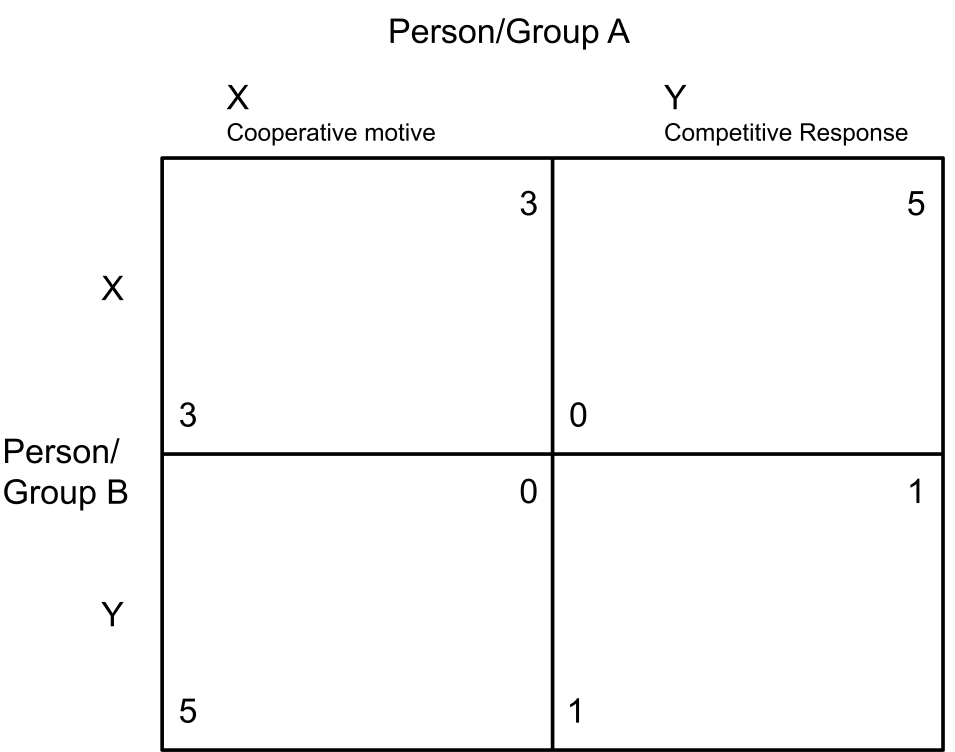
Reasons for intergroup competition
Schemas for Fear & Greed: somewhere along the line, we develop a schema that says competitiveness/greed is ok. Developmental research shows kindergarteners don’t have this schema, but as school goes on, they develop this schema. But not the same schema for 1-on-1. The greed schema comes first, but the fear comes from the notion that the other group will be greedy.
Within groups, there can be social support for that greedy behavior, which can’t happen by yourself. Having a confederate giving support for greed increased the Y competitiveness by 70%.
Diffusion of responsibility: when by yourself, you are 100% responsible for your choice. When embedded within a group, the responsibility for the group’s behavior is distributed across the members. Oftentimes, when the spokesperson comes to the other group, they may say that the responsibility belonged to the other group members
Deindividuation: your behavior is not tied up to you individually, freeing you up to be competitive. When they individuated behavior in groups in PDG, group competitiveness decreased.
Reciprocity effects: Individuals choose X about 90% of the time. Individuals are pretty quick to regret screwing the other person over. After choosing Y and tricking the other person to choose X, they feel apologetic and will tell them they will choose X and they can choose Y. In groups, the group that got screwed over will try to screw the other group over, reciprocating the behavior. Oftentimes, there is a tit-for-tat behavior in aggressive responses. If someone does a level 3 of aggressiveness, the opponent will respond with a level 4. Many times, groups that were screwed over choose Z out of fear to control the situation
Intergroup-outgroup bias: tendency to have positive attributions to one’s own group, and negative attributions about the other group. This contributes to competitive behavior, and fosters the belief that each group deserves to win more.
Social identity theory: part of our self esteem comes from group membership. It is important for us to be a member of a group. This contributes to aggressive/competitive responses. Ex. 100 subjects put randomly into the blue group vs green group. Had blue vs. blue and blue vs. green in PDG. Blue vs. Blue was far less competitive. Some subjects were taken out, given $100 and told to give it to other subjects (all strangers). Most likely to give it to the color group they were assigned to. Minimal groups still were favored in their decision.
Reduction of intergroup competition
Simple contacts. If you get people together, people will be able to see the similarities and see less differences. Ex. Brown vs Board of Education. However, it is not that effective of a strategy.
Robber’s Cave Study: social psychologist ran the study at this summer camp. The campers were from a small midwestern city, 10 year old boys that all had the same backgrounds. One of the first things they did was put them into groups, allowing them to name themselves: rattlers vs eagles. Each lived in their own cabins. Had activities that increased competition, like a soccer game or trivia. They also tried to reduce the behavior. Ingroup-outgroup bias was established. The names of the groups ramped up the competitiveness. After a few days, they displayed a trophy to increase competitiveness. Competitiveness increased wildly, and became very hostile. To reduce the competition, they tried simple contact: mandated that they needed to mingle with people from the other groups. This did not diminish the competition, and made the hostile behavior worse. What worked was Higher Level Goals. They created situations where the two groups would need to solve a problem that would benefit both of them. One day, they had the water truck go into a ditch so water wasn’t delivered. Rattlers had one tool that would have one tool to get the truck out of the ditch, and the eagles had another tool. They had to work together to solve the higher/bigger problem, which diminished their competitiveness by a lot. Another thing that reduced the competitiveness a lot was to have a competition against another camp (Robbers Cave vs. Another camp).
Positive intergroup examples: to reduce intergroup competitiveness, if you have an example of an interaction that goes well between the two groups. A study put groups into minimal groups blue vs green. They quickly ramped up the competition. Afterwards, they pulled out one person from each group and had them go to a separate room where they would solve a creative problem together. It had the effect of the groups, and trickled down the positive interaction. Ingroup-outgroup bias was reduced.
Interpersonal Relationship Research
Early research on interpersonal attraction had to do with experiments, so lots of experiments on first impressions. Later, they decide to do more correlational studies on established relationships.
Interpersonal Attraction
Early research on interpersonal attraction had to do with experiments, so lots of experiments on first impressions. Later, they decide to do more correlational studies.
The power of First Impressions: have an enormous impact, either on the person perceiving or the person being perceived, on the schema formation
Primacy effect: first things we learn about a person has a greater impact than subsequent information
Confirmation bias: once we have a schema sorted about what we think about a person, we use that as a guide and look for things that are schema consistent, ignoring things that are inconsistent; lingering effect
Overconfidence: people tend to be more confident that their first impression of somebody is correct than they actually should be, because we want to categorize/label people; we are overconfident that we know someone even in ongoing relationships; ex. Impressions people have in their marriage: people tend to be overconfident on how much they know their romantic partner
Physiological approaches
Interpersonal Attraction: Pheromones: as mammalian species, they may play a role in interpersonal attraction between humans ex. Have guys wear a cotton shirt without washing it, getting their pheromones on it. Women would be assigned to a tshirt person, exposed to that smell for an amount of time. Then they had a speed dating situation, to see if they would be more attracted to the person they had been exposed to. Didn’t work. Either we aren’t doing the science well, or it doesn’t have that much of an effect on humans. One ex. A high school student did a study on the pheromones from women menstruating vs. women not, the pheromones tended to make the women on the same cycle because of the pheromones.
Physiological autonomic nervous system arousal as a cue: when we feel excitement in the presence of someone, we will label this as attraction. This is a sign we must like them with the signs of increasing heart rate, etc. Research on the misattribution of arousal: we may feel arousal for another reason, but we label is as arousal
Physiological approaches: Misattribution
Interpersonal Attraction: Misattribution of Arousal: Bridge study field/quasi experiment: a park on both sides of the river, across a deep gorge was a rope and plank bridge going across (a bit scary). The other end of the park had a shallow gorge with a concrete bridge (not scary). They took a female research assistant in a park uniform, had her in the middle of each bridge. Randomly selected men to ask a man about experience in the park; innocuous questions. Then another research assistant would come up to the man and ask them to rate the female research assistant’s performance. The questions pertained to the RA’s attractiveness, even giving “her number”. The guys going across the rickety bridge were more likely to rate her as more attractive and take her phone number. The bridge swaying and sparking autonomous nervous system arousal that is labeled as attraction. They also did a laboratory version. Subjects sign up to be in a study about learning theory. Men as subjects and women as subjects. There would be a confederate of the experiment, said to be a subject. The actual subject would be taken to a shock machine, and answer memory questions. Control: minor shocks. Experimental: harsh shocks. Before, they talk to the confederate. Afterwards, asked to talk about the interaction and the person, rating their attraction. People who were getting minor shocks didn’t show attraction to that person. Increase in adrenaline and fear leads to arousal mislabeled as attraction
Doing something exciting with someone may lead to attraction
Study on couples with marital problems: have them write down 10 things that would be pleasing, 10 things that would be exciting. Randomly assigned couples to do the pleasing thing once a week, or do exciting things. At the end of the 6 week period, the couples that did exciting things together had a rekindling in the relationship, more than the other couples.
“Secrets”: when a relationship has to be a secret, there is increased attraction towards the person because secrets can be inherently exciting. When you have to keep it a secret, you are thinking about the person more often because you are trying to not let it get out. However, there can be some level of stress of fear of what will happen. Ex. study on men and women heterosexual and not currently in a relationship. Told it’s a study about ESP. it’s rigged so that they are randomly put with the opposite gender. Control: they do a memory task. One experiment condition: effect of touch, lightly touch your feet under the table and everyone knows it happens. Second experiment condition: has to be a secret that you are touching them. Then they ask them about the enjoyment of the task, and how attractive they find the partner. When no one knew about the touch, there may have been autonomous nervous system arousal that they label as attraction, so they rated their person higher in terms of attractiveness.
Some people believe it is Classical conditioning: pairing something neutral with something that causes an automatic response many times. So the misattribution may come from the association of the previously neutral person with arousal.
Learning theory
Interpersonal Attraction: Operant conditioning: we are going to be attracted to people who spending time with them is rewarding, versus people who we get a cost from. Matters a great deal. People who make us feel pleasant or good are the people we are attracted to. Very strong phenomenon
Reciprocity effects: you do something for me, I feel an obligation to do something back. Works in interpersonal attraction; when we find someone likes us, we may feel obligated or inclined to like them back. Reciprocate the attraction.
Flattery effects: flattery tends to work; giving them compliments and saying nice things can increase their attraction for you.
Social exchange theory
Interpersonal Attraction: variation on operant conditioning. The rewards and costs that we might get out of interaction with each other affect attraction. It’s not merely the rewards themselves; we weigh in the odds of obtaining those rewards. The notion that it is the odds of getting a reward or punishment.
Probability of outcomes: ex. Whether or not someone would go out with you if you asked. Thinking about the probability of having a reward or a cost. Ex. male subjects who wanted to be in a romantic relationship. Signed up to be in a study about motor coordination. Confederate of the experiment, a woman. Subjects are told she’s a transfer to the university. Half of them are told she’s in a relationship, the other half are told she’s interested in a relationship. The task is to sort notecards. Each sort their own notecards. 10 mins in, the woman’s cards go everywhere. She starts picking them up. The dependent variable: what does the male subject do. If she was not dating anyone, those guys were more likely to get up and go get help. If they knew she was in a relationship, they were less likely to help. The odds of getting anything from helping were low.
Communal vs. Exchange: in communal relationships, there is some level of closeness/intimacy. We expect to have relationships in the future. Exchange relationships will be more business-like and short term, more transactional. In communal relationships we are more likely to give them social support. In exchange relationships, we are less likely to help them or support them. We are more likely to be attracted to communal people than exchange theory. More invested in them.
Interpersonal Attraction Orientations
Contact effects
Proximity: We form relationships with people we have interactions with, showing whether you mesh or how much you fit with them. plays a role in who we form relationships with. We only form relationships with people we have interactions with. Proximal relationships create more relationships, found in much research. In the past, people ended up marrying someone within 5 miles of where they were living because people tended to live their lives where they were born, due to proximity effects. Famous study: post wwii MIT study: dramatic influx of enrollments in universities. They had to figure out how to accommodate all the students. They had them live in a motel-type situation. Social psychologists wanted to find out who they interacted with and liked the most. They had students rate who they liked across the dorms. People tended to like and have more interactions with people in the same dorm. People who lived at the bottom of the staircase, who were more likely to be passed by a lot of people, were more powerful because people were more likely to be around them and have good interactions with.
Proximity: mere exposure. If we see someone a lot, the salience is heightened. If we like them a lot in first impressions, we like them more. If our first impression is bad, we tend to like them less. Study: non chinese speaking people were projected with chinese symbols. Shown 100 slides. One slide was seen a lot, others were seen less. They bring them back to see the slides and rate them. The more they were exposed to the symbol, the more they liked it. This is an explanation to the proximity mere exposure phenomenon.
Black bag study: study in upper level psychology seminar class. He paid somebody (an actor) to come to class in a leather black bag. Only his feet exposed, told to sit in the back. He wanted to see what happened with mere exposure. People were troubled with the guy, but what they found was that at the end of the semester, everyone loved the guy in the black bag. He was there consistently, so they came to like him.
Familiarity: We are predisposed to like somebody if they remind us of someone who we had a positive interaction with in the past. If they remind us of someone we didn’t like in the past, we tend to not like that person (bimodal). Ex. moving and seeing similar people in different schools that remind you of people that you like/have a good relationship, increases attraction or inclination
Familiarity: seeing someone who reminds you of someone you like reduces the stress and makes you feel more comfortable ex. In knock job interview studies, using people's social media accounts, they would get someone on the interview to look like someone in their social network/someone who is physically familiar, report on what they thought of the board and self reports on how comfortable they felt.
Interpersonal Attraction Orientations II a.
Trait approaches I
Physical appearance (halo effect): attraction through central node
Computer dance study: study done in early sixties when people were doing lab first impression research, one of the first to be out of a lab. IN midwestern uni, the incoming freshman that would come for orientation were sent surveys before about demographic things (gender, race, status, siblings), attitudes (political, sports, food), and personality (introversion, extroversion). In the study, they invited the freshmen to come to a gathering. Told them they wanted them to get to know someone from their class, so they will be paired and spend 45 mins with someone, getting to know them. Before they do it, they get a headshot taken of them. Photos are sent to another university where freshmen rate the attractiveness of these freshmen (people tend to have commonalities on what faces they consider attractive; people’s rates of themselves tend to be different) opposite sex pairs. At the end of the 45 minutes, the lights go on and they are told to rate the event in a survey by themselves. They got the measures of how much they were enjoying themselves, the food, how much they liked the person they were interacting with, and whether they would want to interact with them in the future. They looked at different variables from the initial surveys. The only thing that predicted whether or not they would want to interact with them in the future was their level of attractiveness. Superficial, but since it was only 45 mins of interactions, it was difficult to establish similar attitudes or personality traits.
First impressions: hiring (even if they have the same background, the more attractive person may get hired more easily. Tends to be more prominent when a job is very public-facing), juries (physically attractive people tend to be found less guilty than those who are not attractive, unless they used their attractiveness to commit the crime), teacher ratings (attractive professors tend to get higher ratings than unattractive professors)
Social interactions: experience sampling, diary record study about who initiated an interaction, how many people were there, all about their interactions. Then students from another university rate their attractiveness. For men, attractiveness played a big factor. For women, there wasn’t much change in the quality of interactions. The difference was who started the interaction. Attractive women were more likely to have others start the interaction.
Little kids: in newborn infants, mothers rate how much they love their kid, and ask outside adults how attractive the newborns were. Tracked how much interactions the mothers had with their newborns, they found that physically attractive newborns had more interactions. Kids are more likely to look at more attractive faces than not, even newborns. Attractive kids tend to get called on more. Persuasion techniques: little kids try to get kids to eat healthy. Physically attractive little girls would use techniques like “please” and batting their eyes, but less attractive girls used actual persuasion techniques and arguments. Attractive kids were more successful in persuading other kids. Kids pick up on how their teachers interact with them.
Interpersonal Attraction Orientations II b.
Trait Approaches II
Matching hypothesis: we tend to end up in a relationship with a partner who is the same level of physical attractiveness as us. There is a level of comfort in matching attractiveness. If not, the more attractive person in the relationship may lead the other person to feel jealous, or the attractive person has more people trying to be with them. One theory is that everyone seeks out the most attractive people first, the most attractive people pair off most, and so on, timing and social marketplace. Another theory is that we know our level of physical attractiveness, so we seek out someone who is the same level to reduce any discrepancy. Prof speculation: when we are first starting to date, we want the most attractive people. As we get into more relationships,we learn there is less tension and insecurity when you pair with someone at the same attractiveness level. No timing mechanism
Similarity effects: we tend to be attracted to people that have similar attitudes and demographics, less so personality. Whether we will be mutually rewarded or it would be taxing. We value people who like the same things we do or have the same attitude perspective, so our interactions go well. When there is dissimilarity, there may be points of conflict. In demographics, we tend to be more attracted to people who have the same status, race, etc. research on personality is much less clear about what we seek out. The research on complimentary relationships (opposites attract) the thing that is exciting about the person at first becomes the thing that causes tension and problems in the end. Big 5 personality: people who are high in neuroticism (more negative, complain more, smile less, tend to be self focused, not good listeners) tend to be disliked in first impressions and are found off-putting, found to divorce more.
Positivity effects: people prefer people who are more positive, easy-going, and are happier. Better first impression if you are positive in nature.
Small imperfection: when someone seems very perfect, we like them to have a small imperfection. Study: 2 classes of a course. A guest lecturer came in (actor). The professor made the guest lecturer perfectly or in an outstanding way. Control: had actor do the lecture. Experimental: 25 mins in, the actor knocks over his water glass and gets flustered/embarrassed, then gets back into the lecture. In terms of the ratings that the students gave of the lecture, even though the lecture was the exact same, they tended to like the guy who spilled his water more; it was endearing or relatable. We don’t want people to be perfect, we want them to have small quirks (that don’t dominate the interaction
Evolutionary approach
Interperson attraction orientations:
Survival and reproduction, there is an inherent drive for reproduction. Humans want to have offspring. Set up different motivations in terms of behavior. In the history of humanity, we have survived due to adaptations that have been successful.
Differential parental investment: men and women play different roles in -. Women are sure of their maternity. Men are less sure of their paternity, wider window of fertility. Women are more likely to be invested in their offspring. As a result, there are differential parental investments that influence mate preferences. Study from different cultures across the world, range of ages of subjects. Rated what matters to them most in terms of an ideal romantic partner. Things at the top were similar like someone who is nice and loves us. They also found that there were systematic differences between what men and women wanted. Men valued physical attractiveness more than women, and women valued resources.
Mate preferences: Men value physical attractiveness because, from an evolutionary perspective, shows that they are healthy and are able to successfully carry their child. Women value resources across cultures; women are more invested in any one offspring, so the resources of their partner will provide for the offspring. Other things emerge in terms of age at marriage: for men, 28, for women, 26. Someone who is older for women may have more time to gather resources. For men, they value a younger partner more and more as they age. Somewhat of a sexist theory, and sexual stereotypes.
Close relationships: theoretical orientations I
Interpersonal attraction orientations: Evolutionary approach
Gender differences
Mate preferences
Jealousy: physical vs. emotional jealousy. Couples in a study, said to be a cognitive study. Asked them to think about certain imaginary scenarios. They measured physiological measures/signs of autonomic nervous system arousal. First scenarios were standard. Later, they told them to imagine their romantic partner falling in love with someone, romantically. They then told them to imagine them having sex with another person. They then asked them how they felt, and physiological responses. Men were more upset imagining the sex (the offspring will be with someone else), and women were more upset imagining they would fall in love with someone else (their resources will be taken somewhere else)
Male sexual jealousy: in terms of homicide of women vs men. Researchers found that women were murdered mostly because of male sexual jealousy or control issues (she’s cheating on me or going to leave me).
Child abuse: research for genetically related kids vs step/adopted kids. Step adopted kids tend to be abused more since they do not have the genes of their parents. Ex. lions in a pride, when a lion kills the leader, they also kill their offspring.
Macrotheories; cannot predict individual relationships.
Close relationships: theoretical orientations II
nterpersonal attraction orientations
Attachment theory (early socio-emotional bonding has later implications for schemas regarding self and others. Styles:
Secure kids develop the schema that they are worthy of love, value, and resources. They also believe/trust that others will be there for them, and want to be close to other people
Anxious/ambivalent: inconsistent care when they are an infant. Either giving love or not giving love. They develop weird schemas questioning whether people actually want to be close to them. Anxious about this. They have distrust whether the person will be close to them, but desire the want for bonding. Have a lot of anxiety but doubts.
Avoidant: consistent care in the first 2 years of life, but the care is cold and business-like/mechanical. Those kids developed schemas that they don’t know if others want to be close to them, but also don’t want to be close to others.