Art History Exam 2
 Call Kai
 Learn
 Practice Test
 Spaced Repetition
 Match
 Flashcards
 Knowt Play
1/42

There's no tags or description
Looks like no tags are added yet.
43 Terms
Byzantine Iconoclasm
c. 726-843 CE. Byzantine controversy over religious images. Iconoclasts opposed sacred images because of concern that their use could become idolatry.
Byzantine Orthodox beliefs about images
Orthodox Christians defended sacred images (icons) and their devotional use. The restoration of icons in 843 CE marked the final end of Byzantine Iconoclasm.
Leon Battista Alberti
1404-1472. Renaissance humanist, architect, and theorist. The review emphasizes his perspective instructions, writings that elevated the artist as an individual achiever, realism, Classical subject matter, and monumental neo-Roman architecture.
Alberti - perspective instructions
1435-1436: Alberti's On Painting (De pictura) described a systematic method of linear perspective for representing convincing three-dimensional space on a flat surface.
Tempio Malatestiano, Rimini
Alberti's redesign begun c. 1450. A Renaissance church exterior using monumental Roman/Classical architectural forms.
Bay
A repeating spatial section of a building, usually defined by structural supports such as columns, piers, arches, or vaults. One of the review sheet's Gothic architectural 'ingredients.'
Rib
A projecting masonry element forming the structural/visual framework of a rib vault. One of the review sheet's Gothic architectural 'ingredients.’
Buttress
An exterior support that helps resist the outward thrust of walls and vaults. Gothic buildings often use flying buttresses. One of the review sheet's Gothic architectural 'ingredients.'
Masaccio
1401-1428. Early Renaissance Florentine painter; one of the review sheet's 'Big Three' at the beginnings of the Renaissance in Florence.
Donatello
c. 1386-1466. Early Renaissance Florentine sculptor; one of the review sheet's 'Big Three.'
Filippo Brunelleschi
1377-1446. Early Renaissance Florentine architect associated with Classical architectural forms and perspective; one of the review sheet's 'Big Three.'
Notre-Dame
French for "Our Lady," referring to the Virgin Mary. It is a common dedication/name for churches and does not mean only Notre-Dame de Paris.
Jan van Eyck
c. 1390-1441. Major 15th-century Netherlandish painter associated with large panel paintings and highly detailed naturalistic art.
Campin
Early 15th-century Netherlandish master associated with large panel paintings and the new naturalistic art of Northwest Europe. The review sheet spells the name 'Roger de Campin.'
Limbourg Brothers
Active in the early 15th century; died 1416. Manuscript illuminators/book illustrators associated with the new naturalistic art of Northwest Europe.
Abbot Suger
c. 1081-1151. Major art/architecture patron and abbot of Saint-Denis; associated with rebuilding at Saint-Denis and the beginnings of Gothic architecture.
Dukes of Burgundy
Important late-medieval/15th-century court patrons who supported major artistic production.
Dukes of Mantua and Urbino
Italian Renaissance rulers and art patrons whose courts supported artists, architects, and humanists.
Medici
Powerful Florentine banking/political family and major Renaissance patrons, especially during the 15th century.
St Gall
Major medieval monastery. The Plan of St. Gall dates to c. 820 and represents an ideal monastic complex.
Cluny
Major Benedictine monastery founded 910 in Burgundy; an important center of medieval monastic culture and patronage.
Chartres Cathedral
Main Gothic rebuilding c. 1194-1220. Known for unusually intact stained glass. The review emphasizes how its glass and restored visual richness show the desired Gothic aesthetic and faith-reinforcing storytelling.
S-Curve
A pose in which the body follows an S-shaped line, producing a graceful shift in hips and shoulders and a greater sense of natural movement.
Giotto
c. 1267-1337. Italian painter emphasized on the review, especially for his works in the Arena Chapel, also called the Scrovegni Chapel.
Arena / Scrovegni Chapel
Padua; Giotto's fresco cycle generally dated c. 1303-1305. Important for more substantial figures, emotion, narrative, and spatial presence.

Beardless Christ - Sarcophagus of Junius Bassus
359 CE. Early Christian Roman sarcophagus. Recognize the youthful, beardless Christ and the combination of Christian subject matter with Classical/Roman-looking forms.

Great Mosque, Cordoba - interior
Mosque begun 785-786 and expanded later. Recognize the repeated two-tiered arches and alternating red/light voussoirs creating a rhythmic interior.

Book of Kells - Incarnation page
c. 800 CE. Insular illuminated manuscript. Recognize extremely dense ornament, interlace, spirals, animals, and elaborate sacred lettering.
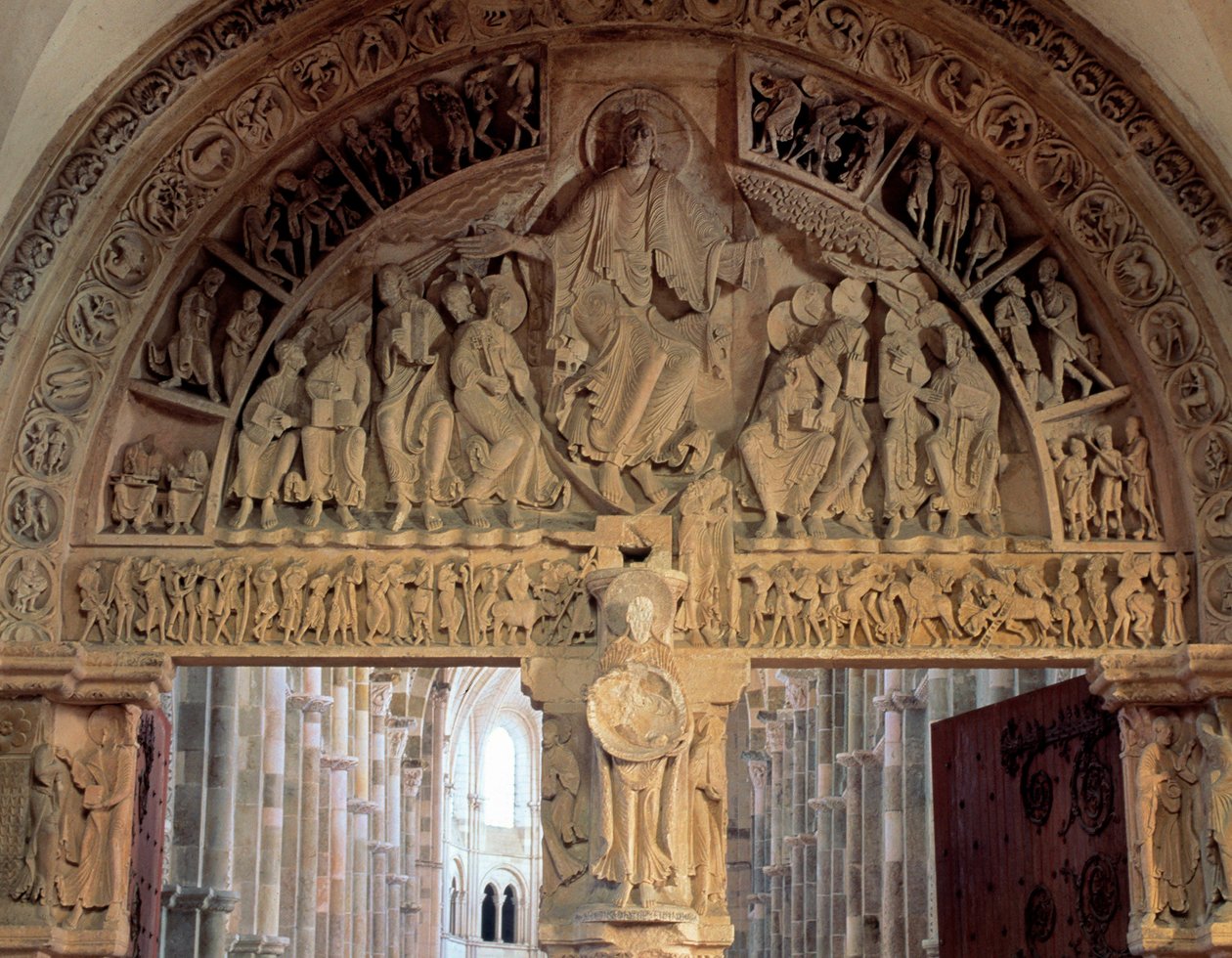
Vezelay tympanum
c. 1120-1130. Romanesque portal sculpture at Vezelay. Recognize the large central Christ, apostles, and peoples of the world connected with Christian mission.
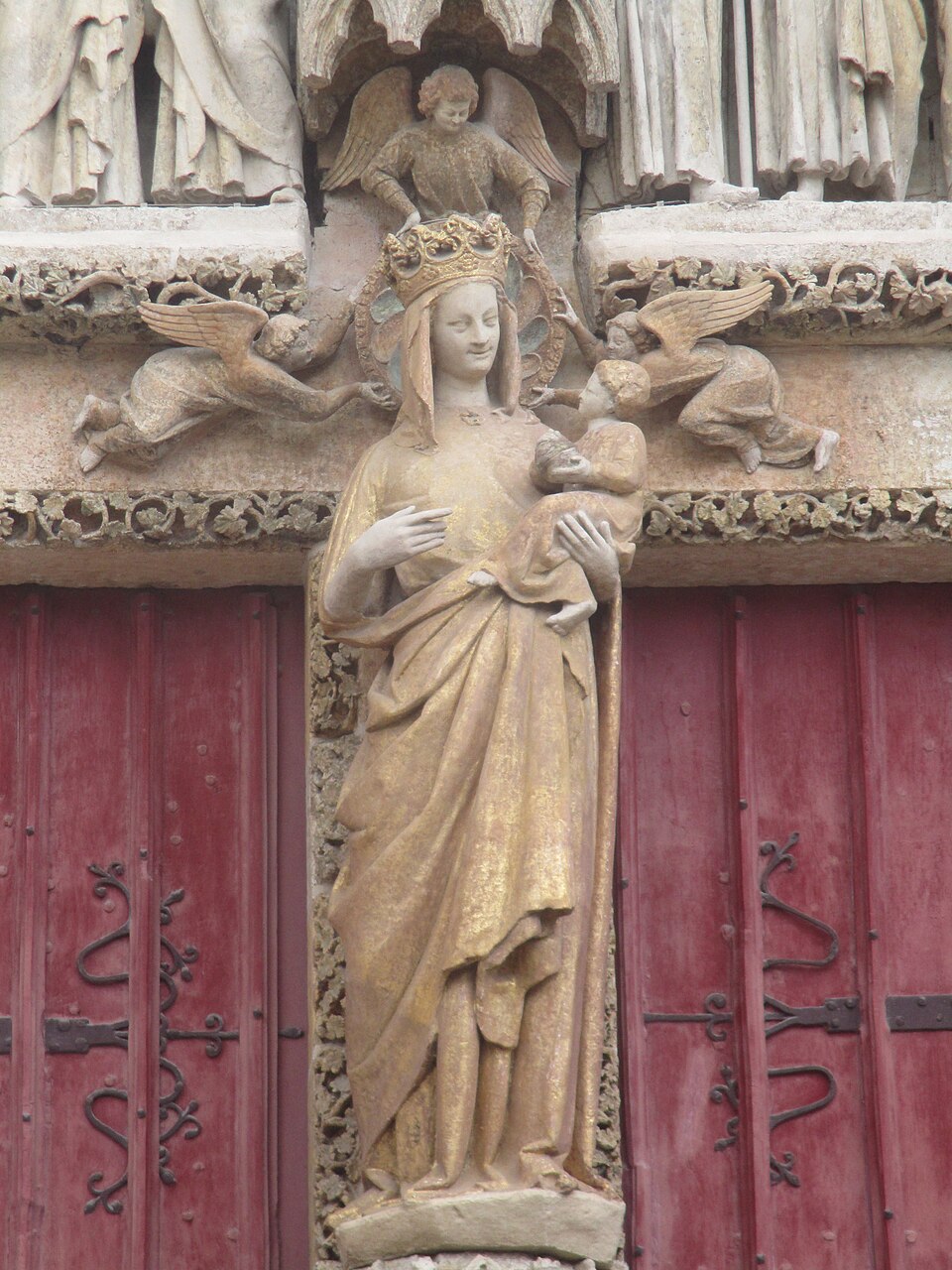
Amiens Cathedral - "Vierge Doree"
c. 1250s. Gothic portal sculpture. Recognize the Virgin and Child, increased naturalism and interaction, graceful posture, and S-curve.

Chartres north transept rose window
c. 1230-1235. Gothic stained glass. Recognize Mary/Virgin and Child at the center with kings of Israel and other figures around them; the review highlights royal patronage.

Saint-Denis ambulatory
Consecrated 1144 under Abbot Suger. Early Gothic architecture associated with large windows, light, pointed arches, and rib vaulting.
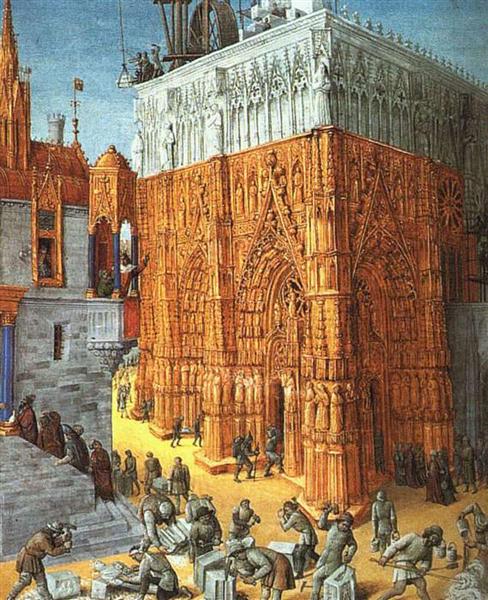
Fouquet - Building of the Temple of Jerusalem
15th century. Recognize the biblical Temple represented as if it were a Gothic cathedral - an ancient subject translated into contemporary medieval architectural language.

Giotto - Lamentation
c. 1303-1305, Arena/Scrovegni Chapel. Recognize the mourning around Christ, strong emotion and gestures, weighty figures, and diagonal composition.

Masaccio - Trinity
c. 1425-1428, Santa Maria Novella, Florence. Recognize the convincing illusion of architectural space created through linear perspective.

Jan van Eyck - Adam and Eve, Ghent Altarpiece
Ghent Altarpiece completed 1432. Recognize highly naturalistic nude figures and meticulous surface detail.

Jan van Eyck - Adoration of the Lamb, Ghent Altarpiece
Ghent Altarpiece completed 1432. Recognize groups converging on the sacrificial Lamb in a detailed sacred landscape.

Piero della Francesca - Baptism of Christ
c. 1440s-1450. Early Renaissance painting. Recognize calm geometry, clear light, carefully organized space, and balanced figures.
"The relation of art, as an artificial pattern suggesting ideal order, to the world as humans experience it with the senses...was complex and troubling after the collapse of the Classical world."
Main idea: After the Classical world, Christian artists had to balance art that looked like the visible human world with art meant to express spiritual or ideal truths. Classical art often emphasized natural-looking bodies and physical space, while medieval Christian art could favor symbolic or spiritual meaning over realism. Byzantine Iconoclasm shows how controversial physical images of sacred figures could become. Later, Giotto moved religious art toward figures with more bodily weight, emotion, and believable space. Examples to remember: Byzantine Iconoclasm + Giotto/Arena Chapel.
"Changing religious beliefs, and changing attitudes toward religious teachings' relation to our earthly life, are illustrated in changes to religious art's 'avatars'..."
Main idea: Sacred figures changed as attitudes toward religion and earthly human experience changed. Earlier figures could appear flatter, more symbolic, or less physically connected to a believable environment. Later medieval and Renaissance artists increasingly gave Christ and other figures bodily weight, emotion, interaction, and convincing surroundings. This matches the review sheet's contrast between weightless-looking figures and figures with 'heft,' and between figures placed on a flat ground and people occupying real-world space. Examples to remember: Giotto's Lamentation + Masaccio's Trinity.
"When references to the Classical world and Classical art appeared in art and architecture after the fall of Rome, they were hardly ever exactly like their Classical prototypes, and often conveyed different messages..."
Main idea: Later artists borrowed Classical forms but adapted them to new Christian, civic, and Renaissance purposes instead of simply copying ancient works. Renaissance artists revived interests such as naturalism, perspective, the human figure, and Roman architecture, but used them in their own cultural setting. Alberti is a strong example: his architecture deliberately recalls monumental Rome while serving Renaissance patrons and buildings. Examples to remember: Alberti + Tempio Malatestiano; Masaccio/Brunelleschi for perspective and Classical spatial ideas.
"The Western world after the Dark Ages gradually saw the artist himself (rarely, herself) developing new relationships with her/his client base and vocational self-image..."
Main idea: The artist's social and professional identity changed. Art production moved beyond artists being viewed mainly as craftspeople working within established religious/workshop systems toward named individuals with recognizable reputations, patrons, styles, and intellectual ambitions. Alberti's writings especially helped promote the artist as an educated individual achiever who mastered perspective, realism, and Classical knowledge. Examples to remember: Alberti + the Florentine 'Big Three' (Masaccio, Donatello, Brunelleschi).
"The locus of European art production from the Dark Ages to the Renaissance era went from the monastery...to the cathedral...to the citizens of the cities, to the new ruling powers..."
Main idea: The major centers and patrons of European art changed over time. Earlier medieval monasteries such as St. Gall and Cluny were major centers of art and architecture. Gothic cathedrals such as Chartres then became major artistic and religious centers. With the growth of cities and Renaissance courts, wealthy citizens, merchants, politicians, dukes, families such as the Medici, and the revived Papacy became increasingly important patrons. Sequence to remember: Monastery (St. Gall/Cluny) -> Cathedral (Chartres) -> Urban citizens -> Medici/Italian dukes/Papacy.