L07/08 speech perception II
 Call Kai
 Learn
 Practice Test
 Spaced Repetition
 Match
 Flashcards
 Knowt Play
1/31

There's no tags or description
Looks like no tags are added yet.
32 Terms
2 solutions of pbs of speech perception mechanism
1/ motor theory
2/ general acoustic theory
motor theory general gist
Speech perception involves identifying the articulatory gestures that produced the acoustic signal, rather than perceiving speech solely from acoustic patterns.
Articulatory gesture, rather than sound. as fundamental unit of speech perceptiom
strong connection b/w perception and production !
motor theory process
Register acoustic signal
Determine gestures that produced it
Deduce syllables/words from gestures
What is the advantage of motor theory?
Problem: the same phoneme can have different acoustic realisations because of co-articulation.
Motor theory's solution: speech perception identifies the underlying articulatory gesture, which is more stable than the acoustic signal
=> e.g. The core gesture for /d/ remains similar (tongue contact at the alveolar ridge), despite acoustic differences caused by co-articulation with different vowels.
motor theory Liberman vs Fowler?
Liberman: perceiving the speaker's intended gestures.
Fowler: perceiving the speaker's actual gestures.
Fodor’s modularity theory general gist
Some cognitive processes operate through specialised, relatively independent modules that process specific types of input automatically and rapidly.
principle of pre-emption
speech module pre-empts output of regular acoustic analysis
=> interpret cues linguistically when signal contains complex characteristics of speech
=> “whistles/squeaks” of transition formants are contextualized linguistically
duplex perception
same acoustic signal can be perceived simultaneously as a non-speech sound “squeaks” and as a speech cue.
categorical perception (CP)
‘blind’ to many physical differences (e.g., male/female/child)
many signals => few phonemes (categories)
gradual physical change but abrupt perceptual change
voice onset timing
timing of burst + vocal fold vibrations
e.g.
b/p = labial plosives (closed lips, burst of air)
≤ 20 msec short voice onset times /b/ (voiced); ≥ 20 msecs long voice onset times /p/
research on speech perception for VOTs
The difference between ba-1 & ba-3 is 20 ms
The difference between ba-3 & pa-1 is also 20 ms
no difference in (1), but two different sounds in (2)
even if same diff, better if 2 sounds from diff category
=> solv pb of lack of invariance by collapsing continuous into categorical

canonical model of categorical vs continuous perception
perceptual narrowing:
Infants become increasingly sensitive to speech distinctions relevant to their native language and less sensitive to distinctions not used in it.
via distributional learning
distributional learning def
Learning speech categories by detecting patterns or clusters in the distribution of acoustic input.
challenge/nuance to canonical categorical perception & who
2018, McMurray
Speech categories are gradient; children retain sensitivity to within-category acoustic detail, and phonetic development continues over an extended period.
McGurk fx
non-acoustic information affected speech perception:
visual:
that one video
aka when an auditory stimulus (e.g., /ba/) was presented with the face of a talker articulating a different syllable (e.g., /ga/), listeners often experienced an illusory percept distinct from both sources (e.g., /da/)
challenges of McGurk tasks
not ideal to study real-life multisensory speech perception
individual diff in degree of susceptibility to fx
incongruence does not occur naturally
susceptibility NOT correlated w performance during natural audiovisual speech perception
=> to study it we need tasks more like everyday/natural
motor theory & mirror neurons, macaque experience
mirror neurons: Neurons in macaque frontal/parietal cortex that activate when an action is performed, observed or heard (e.g. peanut-crushing).
=> Showed motor areas are involved in perception, challenging the separation between action and perception. Area F5 is broadly comparable to human Broca's area
Gallese & Goldman simulation theory
Observing another's action activates similar motor representations as performing it; this internal simulation may help understand their actions and infer intentions
bridge b/w prod & perception?
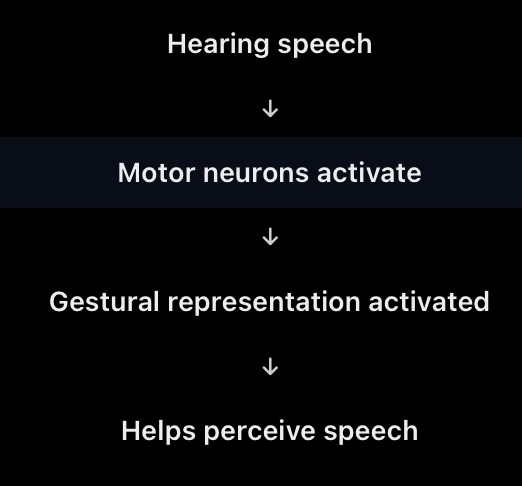
When speech prod, neurons involved in the relevant articulatory movements fire.
When you hear someone else produce that speech sound, some of those same neurons also fire.
=> the motor system might help you perceive speech by activating representations of the gestures used to produce it.
how do mirror neurons develop?
through repeated associations between performing an action and seeing that same action performed. => develop mirror neurons
aka sensorimotor associative learning.
roles of mirror neurons
imitation: helping us reproduce another person's body movements.
gesture recognition: helping us distinguish and understand basic actions or gestures.
mentalizing: potentially contributing to early understanding of other people's intentions and mental states.
neuroimaging evidence of motor theory; fMRI
fmri:
listening to speech activates speech motor cortex
location of activity depends on what articulators participate in speech sound
listening to speech & imaging speaking => similar patterns of neural activity
neuroimaging evidence of motor theory; TMS
TMS to motor cortex => decrease phoneme discrimination
TMS applied to part of motor cortex controlling tongue => ++MEPs at tongue muscles when listening to tongue-related phonemes
=> motor cortex generates neural activity in response to speech
neuroimaging evidence of motor theory: BUT / NUANCE
TMS producing MEPs in tongue —> MEPs in leg too
results may reflect widespread activity in motor cortex
may be bigger than speed perception but response-preparation or extended lg-action network?
general PBs with motor theory
Infants perceive speech sounds that they cannot produce.
Japanese quail & chinchillas perceive speech sounds that they cannot produce.
Duplex & categorical perception occur in non-speech stimuli.
Aphasia: Provides evidence for double-dissociations between speech production & perception abilities (even in bilateral brain-damaged patients).
Different gestures è same phoneme (e.g., bite-block vowels)
solution 2: general acoustic theory:
Massaro
perceiving speech not perceiving gestures
motor system not invovled
speech perception = follows Fuzzy Logic Model
speech is not special: speech perception follows general principles of human pattern recognition; does not require a unique speech-specific mechanism.
cue-based approach: identify which available acoustic cues listeners actually use
major assumptions of FLM
multiple sources of information influence speech perception
perceivers have continuous information, not just categorical information, about each source
the multiple sources are used together in an optimal manner
experience is critical
prototypes in FLM
ideal/prototype speech sounds
exemplars are compared to prototypes —> closest prototype wins
EXPERIENCE alter prototypes
FLM 3 processes
evaluation = multi sources of info transformed into psych values → how strongly that information supports a particular speech interpretation.
e.g. top-down/bottom-up influences
K / context…
integration = of each interpretation
decision = maps outputs of integration into some response
Discrete decision: choosing one alternative (e.g. hearing bat rather than pat).
Rating: indicating how confident you are (e.g. 70% likely to be bat).
top down influences
“leam bacon” —> “lean bacon”
Because “top-down” information favors the real word over the non-word
bottom up influences
phonetic restoration
“legi(cough)latures —> “legislatures”
Stronger for longer words
Stronger for grammatical, meaningful expressions
Changes depending on context
recap Motor vs FLMP
Motor Theory (Lieberman)
Close link between perception & production of speech • Use motor information to compensate for lack of invariants in speech signal •
Determine which articulatory gesture was made, infer phoneme –
Human speech perception is an innate, species-specific skill • Because only humans can produce speech, only humans can perceive it as a sequence of phonemes • Speech is special •
FLMP (Massaro)
Derives from general properties of the auditory /perceptual system
Speech perception is not species-specific – cue based system