BSC2010: Chapter 9 Vocabulary Words
 Call Kai
 Learn
Learn Practice Test
 Spaced Repetition
 Match
Match Flashcards
 Knowt Play
1/29

There's no tags or description
Looks like no tags are added yet.
Name | Mastery | Learn | Test | Matching | Spaced | Call with Kai | Chat |
|---|
No analytics yet
Send a link to your students to track their progress
30 Terms
cell communication
the process through which cells can detect and respond to signals in their environment

signal
an agent that can influence the properties of cells
receptor
protein that detects a signal molecule and performs an action in response

cellular response
adaptation at the cellular level that involves a cell responding to signals in its environment
cell-to-cell communication
a form of cell communication that occurs between two different cells
direct intercellular signaling
signals pass through a cell junction from the cytosol of one cell to adjacent cells

contact-dependent signaling
membrane-bound signals bind to receptors on adjacent cells

autocrine signaling
cells respond to signaling substances that they themselves secrete

paracrine signaling
Signal released from a cell has an effect on neighboring cells.

endocrine signaling
Specialized cells release hormone molecules into vessels of the circulatory system, by which they travel to target cells in other parts of the body.

hormones
chemical messengers that are manufactured by the endocrine glands, travel through the bloodstream, and affect other tissues

receptor activation
The "turning on" of a receptor, which often occurs when a signaling molecule binds to a receptor on a responding cell.

signal transduction
the transmission of molecular signals from a cell's exterior to its interior
signal transduction pathway
A series of steps linking a mechanical, chemical, or electrical stimulus to a specific cellular response.

cell surface receptors
receptors found in the plasma membrane

enzyme-linked receptors
transmembrane proteins that bind a signal and directly catalyze a reaction inside the cell
protein kinases
transfer phosphates from ATP to protein, a process called phosphorylation

G-protein coupled receptors
A signal receptor protein in the plasma membrane that responds to the binding of a signaling molecule by activating a G protein. Also called a G protein-linked receptor.

G proteins
Proteins that are activated by exchanging bound GDP for bound GTP (and thus also known as GTP-binding proteins).

ligand-gated ion channel
A transmembrane protein containing a pore that opens or closes as it changes shape in response to a signaling molecule (ligand), allowing or blocking the flow of specific ions.

intracellular receptors
receptors located inside the cell rather than on its cell membrane

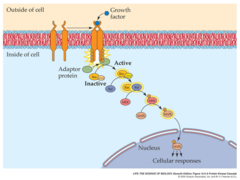
Receptor Tyrosine Kinases (RTKs)
Best known group of enzyme-linked receptors
-Steps:
1) Hormone binds to RTK
2) RTK forms a dimer and is phosphorylated by ATP
3) Proteins build a bridge between Ras and RTK
4) Ras triggers phosphorylation of another protein
5) Phosphorylation cascade amplifies

growth factor
broad group of proteins that stimulate cell division

protein kinase cascade
a pathway in which one protein kinase activates the next, and so on
second messenger
A small, nonprotein, water-soluble molecule or ion, such as calcium ion or cyclic AMP, that relays a signal to a cell's interior in response to a signal received by a signal receptor protein.

adenylyl cyclase
An enzyme that converts ATP to cyclic AMP in response to a chemical signal.
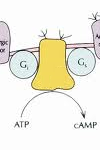
cyclic AMP (cAMP)
Cyclic adenosine monophosphate, a ring-shaped molecule made from ATP that is a common intracellular signaling molecule (second messenger) in eukaryotic cells. It is also a regulator of some bacterial operons.

Protein Kinase A (PKA)
a protein kinase activated by the second messenger cAMP

phosphodiesterase
enzyme that degrades cAMP, producing AMP, to terminate signaling
protein phosphatases
An enzyme that removes phosphate groups from proteins, often functioning to reverse the effect of a protein kinase.
