2.2 Representing Hydrocarbons and Simple Organic Compounds
 Call Kai
 Learn
 Practice Test
 Spaced Repetition
 Match
 Flashcards
 Knowt Play
1/65

There's no tags or description
Looks like no tags are added yet.
66 Terms
What is Tamoxifen used for? What is it?
Breast cancer (Estrogen Receptor positive cancer)
An organic molecule
Where are the carbon atoms in a skeletal formula drawing?
At the jagged angle
What is interesting of Hydrogen atoms in a skeletal formula drawing?
Each carbon (each angle) is assumed to have the maximum possible number of Hydrogen atoms bonded to it
Hydrocarbons are a specific class of organic compounds that contain only two elements:
Carbon and Hydrogen
What are some everyday examples of where we can find hydrocarbons?
Natural gas in homes
Gas for cars
Propane in BBQs
Butane in lighters
Asphalt
Candle wax
Tar
Plastics
Hydrocarbons are divided in how many categories? Based on what?
3 main categories
Whether their Carbon atoms have single, double, or triple bonds with each other
What are the names of the 3 categories of Hydrocarbons?
Alkanes
Alkenes
Alkynes
Alkanes contain only-
Single carbon-to-carbon bonds
Alkenes contain at least-
One carbon-to-carbon double bond
Alkynes contain at least-
One carbon-to-carbon triple bond
Define aliphatic hydrocarbons
Organic compound made of Carbon and Hydrogen that does not have rings; has open chains
Define aromatic hydrocarbons
Organic molecules composed of Carbon and Hydrogen that contain one or more cyclical rings

This is an example of what type of hydrocarbon?
Alkene

This is an example of what type of hydrocarbon?
Alkyne
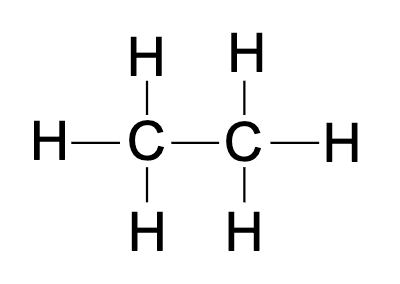
This is an example of what type of hydrocarbon?
Alkane

This is an _____ hydrocarbon
Aromatic

These are examples of _____ hydrocarbons
Aliphatic
The longest of the long-chain hydrocarbons tend to be _____ at room temperature
Solid
What is an interesting trend of Hydrocarbons? Why?
Molecules with more Carbons have higher melting and boiling points
Because of the strong intermolecular forces in the long structures which makes the molecules attract
Many short-chain Hydrocarbons are _____ or _____ at room temperature. Why?
Gases or liquids
Because they have weaker intermolecular forces
Alkanes all end in _____ which immediately tells you what?
-ane
The compound will only have single carbon-to-carbon bonds
The prefixes of Alkanes tell you what?
The number of Carbon atoms in the compound
Name the first 10 prefixes of Alkanes
Meth-
Eth-
Prop-
But-
Pent-
Hex-
Hept-
Oct-
Non-
Dec-
What is a phrase that will help you remember the names of Alkane prefixes?
Monkeys Eat Peeled Bananas. Please Hand Him One. Nicely Done!
Do Alkanes only come in lines? Can they have chains branching off the main chains?
Yes, they can have branches
A branch off an Alkane is called what?
An Alkyl group
Branches must be named in-
Alphabetical order
When considering large molecules, is it possible to have more than one possibility for connecting their atoms?
Yes
Can you have two different compounds with the same molecular formula?
Yes
Molecules that have the same molecular formula but different structures are called what?
Structural isomers
How can you tell if two structures are isomers?
If they have the same molecular formula but are named differently
Describe physical and chemical properties between isomers
Physical: different
Chemical: sometimes similar
The number of structural isomers _____ as the number of carbon atoms in the molecular formula _____
Increases
Increases
Alkenes are the class of Hydrocarbons that contain at least one-
Carbon-to-Carbon double bond
C=C
The presence of a double bond (or a triple bond) increases what?
The reactivity of the compound compared to an Alkane with a similar number of Carbons
Why is C2H4 more reactive than C2H6?
Because C2H4 has a double bond between the carbons
What is the smallest member of the Alkene family? What is its formula?
Ethene
C2H4
Ethene is a _____ at room temperature
“gas”
What is the everyday use of Ethene?
Manufacture of polyethylene/polythene- a plastic used in home insulation and water bottles
The Alkyne family of Hydrocarbons contain at least one-
Carbon-to-Carbon triple bond
What does the suffix become for Alkynes?
-yne
What is the simplest Alkyne? What is its formula?
Ethyne
C2H2
What is the common name of the Alkyne Ethyne? What is its everyday use?
Acetylene
Used primarily as a fuel in welding torches
Name the 3 types of reactions involving these compounds
Combustion
Addition
Substitution
Can all Hydrocarbon compounds undergo combustion reactions? What about all organic molecules?
Yes
Yes
A combustion reaction occurs when a Hydrocarbon is _____ in the presence of _____
Heated
Oxygen
When a Hydrocarbon undergoes combustion, what 2 things could occur?
It can combust quickly (explode)
It can combust slowly (burn, smoulder)
Describe a car’s combustion engine
Engine has several chambers shaped like cylinders
Pistons are metal plungers that slide in and out of the cylinders
Gas is mainly octane. When it’s ignited by a spark inside a piston chamber it explodes in the presence of oxygen. Explosion causes energy to be released
This energy causes the pistons to move outward. This motion, translated through gears, is the forward motion of the car
Energy from a nearby cylinder pushes the first piston back into the cylinder so that the process is continuous
Which are more chemically reactive- Alkenes + Alkynes or Alkanes?
Alkenes and Alkynes
What is an addition reaction in Alkenes and Alkynes?
One of the double or triple bonds is broken and the Carbon atoms involved are allowed to form bonds with other elements
What is a saturated Hydrocarbon? Which type of Hydrocarbon are they?
When a Hydrocarbon is saturated with Hydrogen
Each Carbon atom has the maximum possible number of Hydrogen atoms and no more Hydrogen atoms can be added to the compound
Alkane
Why are Alkenes and Alkynes unsaturated Hydrocarbons?
Because they contain less than the maximum possible number of Hydrogen atoms due to the presence of the double/triple bonds
What does “in excess” mean?
A way to completely saturate an Alkyne
Add Hydrogen, for example by bubbling Hydrogen gas through it
The reaction would have H2 (in excess) written on the left side of the equation
Can all Hydrocarbons undergo substitution reactions?
Yes
What is required for a substitution reaction to occur?
A catalyst
Define catalyst
A compound that helps promote a reaction but does not get used up in the process
In a substitution reaction, a _____ atom is replaced by a different atom/group of atoms
Hydrogen
Covalent compounds share electrons. Is this sharing equal?
No
_____ is a physical property of compounds that results from the uneven distribution of electrons among adjacent atoms
Polarity
What does the unequal sharing of electrons (-) mean for covalent compounds?
Polar compounds have a slightly negative side and a slightly positive side
When looking at a compound, how could you know which element will attract the electrons more?
By their electronegativity value
The higher an element’s electronegativity value, the more the element pulls the electron pair close to it
Electronegativity (EN) is defined as what?
The ability of an atom to attract electrons
On the periodic table- the trends of electronegativity show that electronegativity _____ as you go down and _____ as you move from left to right
Decreases
Increases
In regards to electronegativity, what is special about the noble gases?
Since they do not react, they are rarely assigned EN values

What does this picture mean?
You can use the difference in the electronegativity value between two atoms to classify it
Besides EN values, polarity can also be determined by looking at-
The overall symmetry of the compound
More symmetric means non-polar