Human Physiology 225 IU Exam 1
 Call Kai
 Learn
 Practice Test
 Spaced Repetition
 Match
 Flashcards
 Knowt Play
1/163

There's no tags or description
Looks like no tags are added yet.
164 Terms
Physiology
Normal functioning of a living organism and its component part, including all its chemical and physical processes
Pathophysiology
Study of how normal physiological processes are altered by disease/injury
Homeostasis
Internal and external fluid exchange, steady state, constant internal conditions but with movement of materials, no net movement, disequilibrium
Equilibrium
Maintain constant conditions but with movement of materials, no net movement, concentrations are equal between compartments
Homeostasis control systems
stimulus/sensor: regulated variable is monitored. Integrating center: responds to sensory signal. Output signal: directions for response. Effector/target: produces response
Local control: Paracrine & autocrine agents
cells in the vicinity of the change initiate the response
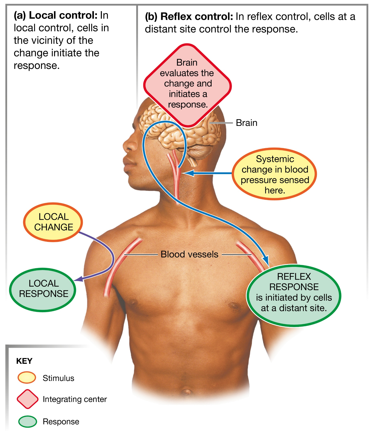
Reflex control
cells at a distant site control the response, integration in both nervous and endocrine systems,

Negative feedback loop
on then off, response counteracts the stimulus, shutting off the response loop

Positive feedback loop
reinforces stimulus, changes to completion, sends variable further from the setpoint

Feedforward control
actions due to anticipation of a change in a regulated variable, ex: salivation
Lipids
triglycerides, 3 fatty acids + glycerol, fatty acid: monomer, saturated vs unsaturated

Carbohydrates
5 or 6 carbon ring: monomer, mono/di/tri/oligo/polysaccharide, glycogen > 50,000

Protein
amino acid: monomer, 20 types different by R-group, peptide bond

Proteins: primary structure
where each amino acid is put

Proteins: secondary structure
beta sheets and alpha helix

Proteins: tertiary structure
3D structure

Proteins: quaternary structure
only some proteins, hemoglobin

Nucleic acids
Nucleotide: monomer, phosphate, sugar, 5 different bases, DNA, RNA
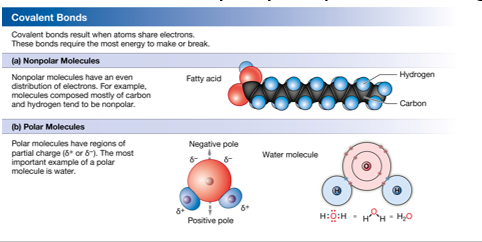
Covalent Bonds
share electrons, requires the most energy to make or break, polar/nonpolar

Polar
water

nonpolar
fatty acids and carbon dioxide - shares electrons equally, no positive or negative sides
Noncovalent Bonds
Charges attract, ionic, hydrogen, vander waals forces
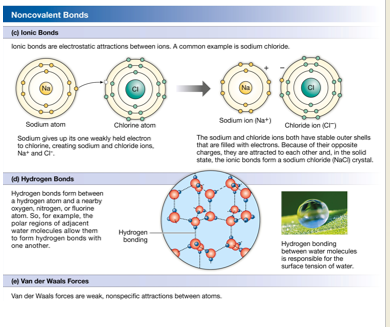
Ionic bonds
transfer of electrons to form ions, cation: + charge, anion: - charge, opposite ions attract: Na+ + Cl- → NaCl
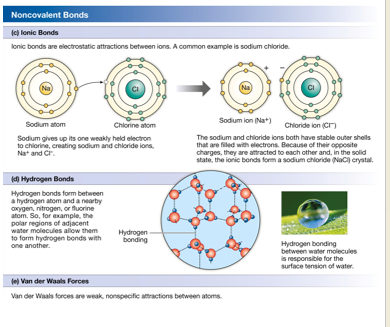
Hydrogen bonds
slightly positive H attracted to a slightly negative atom, polar molecules or regions of molecules

Vander Waals forces
weak electrical attraction, usually within a molecule

Aqueous solutions
solvent, solute, solution, hydrophilic, lipophobic, hydrophobic, lipophilic, amphipathic
solvent
water, dissolves solute
solute
salt, what dissolves
solution
saltwater, whole thing
hydrophilic
water loving
lipophobic
fat hating
hydrophobic
water hating
lipophilic
fat loving
Amphipathic
both, areas that are polar and nonpolar, ex: phospholipids, hydrophilic head, hydrophobic tails
pH
concentration of H+, log10 scale, higher → basic, neutral = 7, lower → acidic, blood = 7.35-7.45 (basic)
Acids release:
H+ ions
Bases release
OH- ions
Buffers
moderate pH
Protein functions: Enzymes
biological catalysts
Protein functions: Membrane transport
channels, transporters
Protein functions: Signal molecules
hormones or other signal molecules
Protein functions: Receptors
bind signal molecules
Protein functions: Binding
bind non-soluble molecules for transport in blood
Protein functions: Immunoglobins
antibodies
Protein functions: Motor proteins
transport inside cells
Protein functions: Structural proteins
cytoskeleton, cell action
Protein functions: Regulatory
regulate cell functions
Binding site
Ligand or substrate
Specificity for binding
molecular complementarity, shape and charge
Reversible binding
affinity: high attraction to specific ligand, equilibrium
competition for binding sites
agonists - helps with enzyme activity, antagonists - inhibit enzyme activity
Isoforms
slightly different form of enzyme, ex: Fetal Hb vs Adult Hb
Activation
cofactors or coenzymes: assist by attaching to non-binding site, allosteric modulators: change shape of protein for activation
Inhibition
competitive inhibitor, allosteric inhibitor: functional to non-functional
Intracellular Fluid (ICF)
fluid inside the cell

Extracellular Fluid (ECF)
fluid surrounds the cell
Cell membrane
isolates cell, regulates exchange, communication, structure and support
Fluid mosiac model
phospholipids, polar and hydrophilic phosphate group (head), nonpolar and hydrophobic fatty acid tails

Fluid mosiac model: Cholesterol
a steroid, positioned among phospholipid fatty acid tails, nonpolar, hydrophobic
Fluid mosaic model: proteins
peripheral: polar, hydrophilic. Integral: transmembrane, lipid anchored, nonpolar, hydrophobic,
Extracellular matrix
proteins, carbohydrates, inorganics, cell junctions connect this space to cells
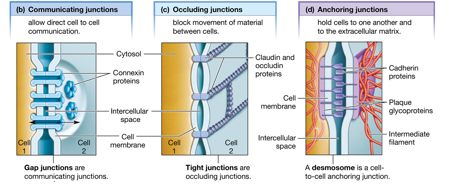
Cell junction: communicating
gap junction: connexin, cell to cell communication - faster

Cell junction: Occluding
tight junction, blocks material movement between cells

Cell junction: anchoring
desmosome, holds cells to one another and to the ECM
Epithelial tissue
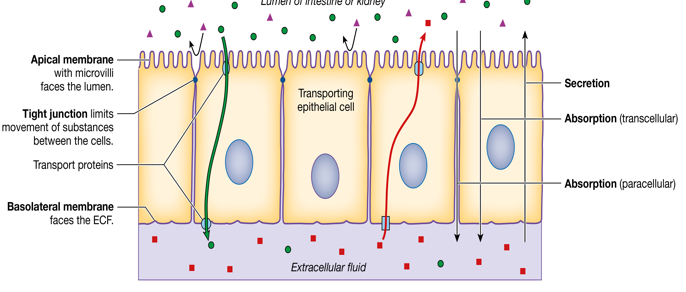
lines all free body surfaces, outside of skin, endothelium: internal - ex: inner lining of blood vessels
Epithelial structure and function
basement membrane, one cell layer, apical membrane, basolateral membrane, tight junctions. Exchange, transport, ciliated, protection, secretion
Chemical work
metabolism, any reaction in the body
transport work
channels, transporters, concentration gradients, movement in or out of the cell
mechanical work
cellular level - actin, myosin. Tissue level. Organismal level - body movement
Kinetic energy
energy being used (in motion)
Potential energy
stored energy (potential to have motion)
Exergonic reaction
start with high energy and ends with low energy, reactants have the energy

Endergonic reaction
start with low energy and end with high energy, products have the energy

Biological catalysts
usually proteins, lower activation energy to start a reaction, increase rate of reaction

Metabolism: Catabolic reactions
making bigger molecules smaller
Metabolism: anabolic reactions
making smaller molecules bigger
Feedback inhibition
stopping feedback - enough end product is produced, from competitive inhibition, antagonist, or inhibitory modulator
ATP energy cycle
ATP ←→ ADP + P, cycling between ATP and ADP, removing phosphate releases energy, adding phosphate absorbs energy
ATP → ADP
Potential energy, exergonic reaction
ADP → ATP
Kinetic energy, endergonic reaction
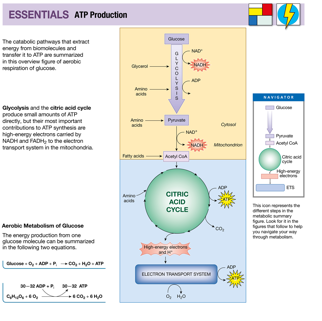
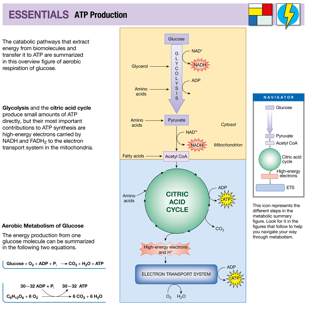
Aerobic cellular respiration
glucose + water + oxygen → carbon dioxide + water + ATP. Glycolysis, Oxidation of pyruvate, Citric acid cycle, Oxidative phosphorylation, produces 30 ATP, takes longer
Aerobic: Glycolysis
Glucose → 2 pyruvate, located in cytosol, produces 2 ATP and 2 NADH

Aerobic: Oxidation of pyruvate
2 pyruvate → 2 acetyl CoA + 2 CO2, located in mitochondrion, produces 2 NADH

Aerobic: Citric acid cycle
Acetyl CoA → 4 CO2, located in mitochondrion, produces 2 ATP, 6 NADH, 2 FADH

Aerobic: Oxidative phosphorylation
ATP production, located in mitochondrion, produces 10 NADH → 10 NAD + 25 ATP, 2 FADH → 2 FAD + 3 ATP
Anaerobic cellular respiration
glycolysis: same without O2, fermentation. Cycles ATP much faster, but only produces 2 ATP,
Anaerobic: Fermentation
2 pyruvate → 2 lactate (lactic acid), located in cytosol, energy used: 2 NADH

selectively permeable
penetrating (permeable) vs non-penetrating solutes (impermeable)
chemical disequilibrium
imbalance of chemicals
electrical disequilibrium
imbalance of charges
Relative concentrations of ions in/out of the cell
K+ high inside the cell, low outside the cell. Na+, Cl-, Ca2+ are low inside the cell, but high outside the cell
Osmosis
water follows its gradient
tonicity
non-penetrating solutes only, will impact volume of a cell
Hypertonic solution
cell will shrink, more solutes outside the cell → water will leave the cell to balance solution
hypotonic solution
cell will swell, fewer solutes outside the cell → water enters the cell.
Isotonic solution
cell doesn’t change size, solute and water concentration are the same in the solution and cell
Bulk flow
follow pressure gradients
passive transport processes
utilize concentration gradient of a solute
active transport processes
require ATP