Meat Bible-Exam 2
 Call Kai
 Learn
 Practice Test
 Spaced Repetition
 Match
 Flashcards
 Knowt Play
1/243

There's no tags or description
Looks like no tags are added yet.
244 Terms
T/F
High temp, post rigot chilling is where meat is stored at 20 degrees Celsius for 24hrs, which has the same effect on tenderness as 2 degree Celsius for 14 days
true
T/F
Gelatin is made from skins or hides, connective tissues, cartilage, and bones of cattle and calves.
true
T/F
The addition of salt, sugar, and nitrite/nitrate in meat curing contributes to flavor
true
T/F
Fermented sausage means that it has lactic acid in it
true
T/F
Bos taurus breeds have higher capastatin levels than bos indicus breeds
false
T/F
A steak with a sarcomere length of 2.2 micrometer would be more tender than a steak with 2.9 micrometer
false
T/F
Tray-Ready packaging means that the meat is ready to go into the case for immediate selling.
false
T/F
The shearlings 4 pelt is the most valuable lamb pelt
false
T/F
The sarcomere is the most basic contractile unit of muscle
true
T/F
The maximum amount of sodium nitrite that can go into regular bacon is 200ppm.
false
T/F
The Hydrodyne process of tenderizes beef by putting it in a sealed water-filled chamber and setting off an explosion to destroy z-lines
true
T/F
The higher the degree of doneness that steaks are cooked, the more tender the steak
false
T/F
The Background Effect for tenderness is related to the amount and distribution of marbling.
false
T/F
Swift’s Pro-Ten process works by injecting the live animal with panpain, which stays behind in the muscle after bleeding and is activated by heat during the cooking process.
true
T/F
Salt-soluble, heat-coagulable proteins (SSHCP) are collage, elastin, and reticulin
false
T/F
Muscle is a contractile unit that is made up of connective tissue, muscle fibers, and intramuscular fat.
true
T/F
Meat is made more tender by: (1) causing the sarcomeres to be longer, (2) disrupting the integrity of the myofibrils, and (3) disrupting the integrity of the connective tissue.
true
T/F
Lungs can be used for human food in the US
false
T/F
A steak with 32% collagen solubility would be tougher than a steak with 16%.
false
T/F
A 1200 pound live animal yields 1200 pounds of T-bone steaks.
false
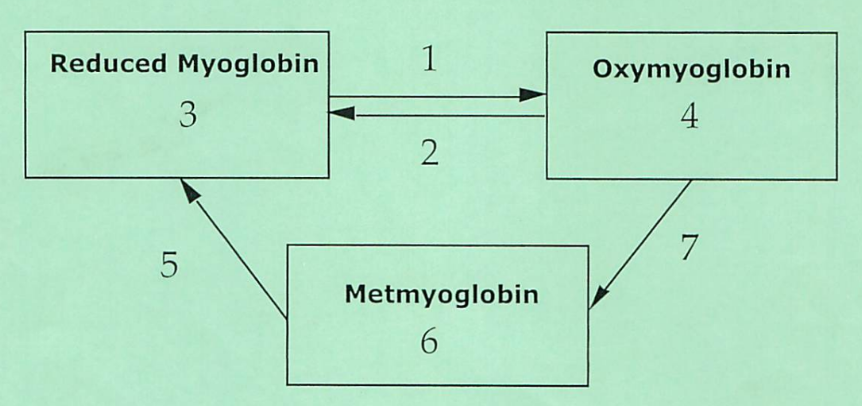
Which form of myoglobin has O2 at the free binding site?
4
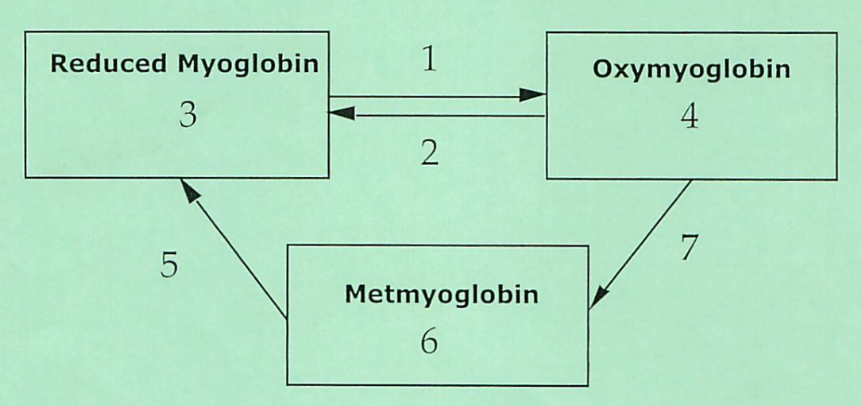
Which form of myoglobin has OH at the free binding site?
6

Which step is the oxygenation step
1

Which step is where reduction (electron gain) takes place?
5

Which step is where vacuum packaging (removal of oxygen) changes the color of meat?
2
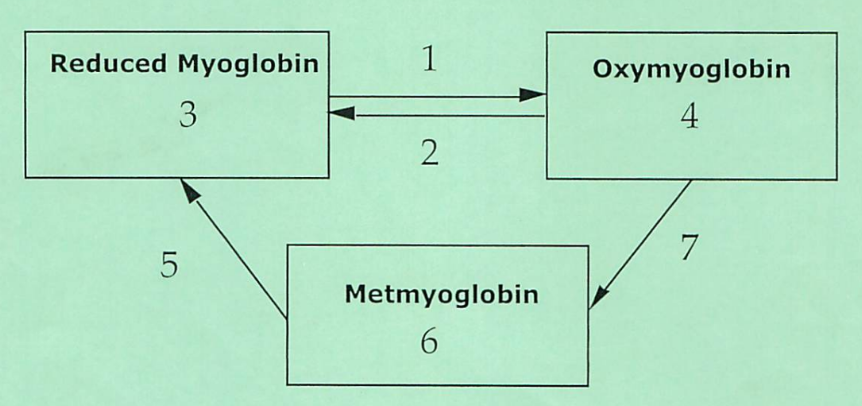
Color of meat in oxymyoglobin
red

Color of meat in number 1 above
purple

Vitamin fed to cattle to reduce oxidation of meat
Vitamin E

Type of iron present in number 5 above

Term used to describe the chart above where some muscles are high in this and some are low.
Tenderization process whereby carcasses are hung by the obturator foramen.
TAMU Tenderstretch
Sold as aphrodisiacs in the Far East
gall stones
Other than tropomyosin and troponin, which other protein is found in thin myofilaments?
actin
Name of most valuable cattle hide due to presence or absence of branding.
native
Name for the youngest classification of bovine.
veal
Minimum amount of fat on beef carcasses to prevent cold shortening.
.25 inches
In the living animal, serves to store reserve energy.
fat
In the living animal, serves to produce energy and convert is to work.
muscle
In the living animal, connects muscle to bone.
connective tissue
Fat depot that is located in the perimysium and endomysium.
intramuscular
Exogenous enzyme from the papaya.
papain
Example of a cooked, smoked emulsion-type sausage.
frankfurter
Endogenous enzymes that work on the z-lines
calpains
Edible portion of domestic mammals used for food.
meat
Compound that can be added to meat to increase activity of calpains.
calcium chloride
Which has more myoglobin, a locomotive or support muscle?
locomotive
Uses electricity to tenderize beef.
electrical stimulation
Which cut is likely to be more tender, a cut from a locomotive or support muscle?
support
Type of cookery that converts collagen to gelatin.
moist-heat
Thick myofilaments primarily are made up of this protein.
myosin
5 principles of meat cutting
separation of fat from lean portions
thick from thin
valuable from less valuable
tough from tender
separation of retail cuts by cutting across the grain
Which of the pork “bony” cuts is considered a wholesale cut?
spareribs
Quality in pork carcasses is based upon firmness of fat and lean, color of the lean, amount of feathering and __________ thickness
muscle
Method of pelt removal over the sirloin, rump, and legs used in lamb slaughter, which leaves the membrane intact
fisting
Determine the carcass cost basis (per cwt.) for a lamb with a live price of $140/cwt, live weight of 150 lbs., and carcass weight of 75 lbs.
$280/cwt
The oldest ovine maturity group.
mutton
Calculate, to the nearest tenth, the USDA yield grade for the following lamb carcass: 2.8 inch² REA, 85 lb HCW, and .22 inch in 12th rib fat thickness
2.6
The USDA quality grades for lamb carcasses, in order are: prime, choice, _______, and utility and cull.
good
The ideal color.=, texture, and exudation group that has desirable color, firmness, and water holding capacity
RFN
The lamb carcass section found in the foresaddle that consists of the rack and breast.
bracelet
The four types of lamb legs that were discussed in the fabrication of lab are Safeway, Frenched, Shank-off, and ________.
American
Employs the principle of impact energy to extract the proteins for boneless ham manufacturing.
tumbling
Employs the principle of frictional energy to extract proteins for boneless ham manufacturing.
massaging
Ingredients used during curing to increase water-holding capacity
alkaline phosphate
T/F
Lean finely textured beef is a reclaimed product from bone.
false-its from fat
T/F
The muscle cell is the smallest completely functional unit in the muscle.
true
T/F
The Longissimus dorsi is more tender than the Deep pectoral and the Deep pectoral is more tender than the Rectus femoris.
false
T/F
Locomotive muscles tend to be tougher than support muscles primarily because of differences in bulk density/lubrication effects
false
T/F
The National Beef Tenderness Survey found that roasts were more tender than their steak counterparts.
true
T/F
A steak with a sarcomere length of 3.2 micrometer likely would be more tender than a steak with a sarcomere length of 2.1 micrometer.
true
T/F
high temp, pre-rigor chilling involves chilling the carcass at 16 degree celsius for 16 hrs after slaughter
true
T/F
Support muscles have more myoglobin than locomotive muscles
false- they have less
T/F
The three reasons for the differences in tenderness among muscles are actomyosin effect, background effect, and bulk density/lubrication effect.
true
T/F
The background effect deals with sarcomere length, muscle fiber diameter, and sarcomere/fragment
false
T/F
Meat from bos indicus breeds such as brahman tend to be more tender than meat from bos taurus breeds such as angus.
false- they are less tender
T/F
in general, the higher the grade of beef, the more tender it will be
true
T/F
teh greatest contribution to USDA’s Estimated Hide and Offal Value is the hide.
true
T/F
You would expect that a 120 lb live lamb will yield 120 pounds of lamb chops
false- you dont expect this
T/F
The rank order in age class from youngest to oldest is veal, beef, and calf
false
compound in postmortem muscle that lowers pH and in fermented sausages that gives tangy flavor
lactic acid
Process that converts nitric oxide myoglobin to nitrosyl hemochromogen
heat
in vacuum packaging and in pre-rigor pork sausage manufacturing, serves as a barrier to oxygen
saran
myoglobin when oxygen is present
oxymyoglobin
Myoglobin form when OH is present
metmyoglobin
Byproduct used to make industrial oils, lubricant, soap, and glycerin
inedible tallow
Contractile organ comprised of connective tissue, muscle fibers, and intramuscular fat.
muscle
Primarily comprised of myosin
thick myofibrils
Primarily comprised of actin, tropomyosin, and troponin
thin myofibrils
Process wereby sarcomeres shorten die to cold-induced nervous response
cold shortening
IN packaging, helps bag conform to teh surface of meat to reduce flex cracks
heat shrink packaging
In meat curing, serves as an antimicrobial
salt
Oldest and slowest way of curing meats.
dry curing
Most valuable bacon slices
premium
Dispersion of fat particles in water held by the action of salt soluble, meat coagulable proteins
meat emulsion
Frankfurter defect caused by overchopping
fatting-out
In sausage, manufacturing, term used to describe the relative amount of SSHCP in a meat
binding index
Used to replace defective human heart valves
aorta valves
In living animals, harnesses and collects activity of muscle fibers
connective tissue
In living animals, provides support and rigidity
skeleton
Basic contractile unit in muscle
sarcomere