Human Muscular Anatomy Practical Review
 Call Kai
 Learn
 Practice Test
 Spaced Repetition
 Match
 Flashcards
 Knowt Play
1/39

Earn XP
Description and Tags
Vocabulary flashcards covering the major superficial and deep skeletal muscles of the head, neck, trunk, upper limbs, and lower limbs tested on the anatomy practical examination.
40 Terms

1
Temporalis
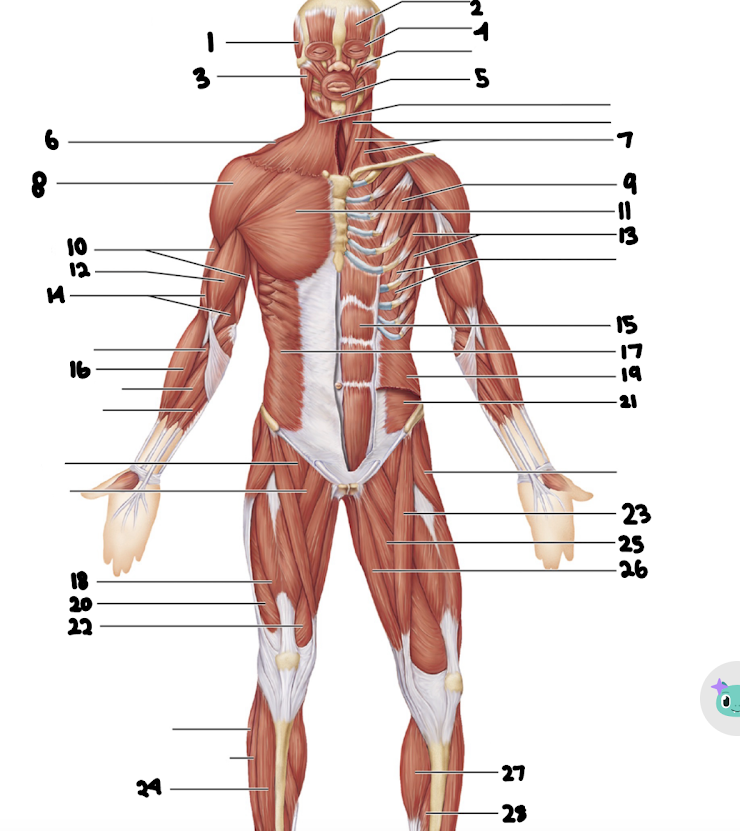
2
Epicranius

3
Masseter

4
Orbicularis oculi

5
Orbicularis oris
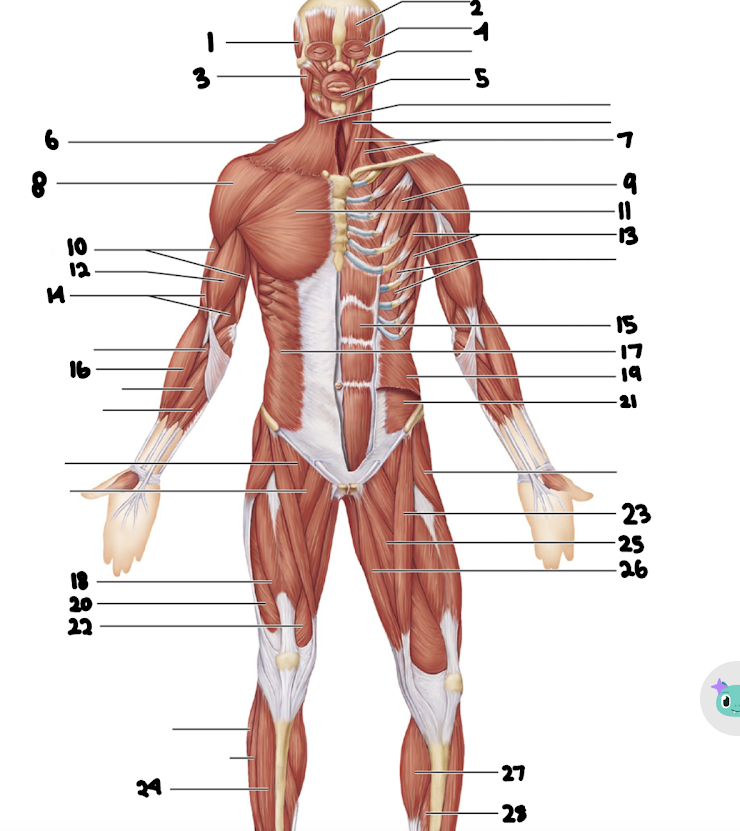
6
Trapezius

A major two-headed neck muscle originating on the sternum and clavicle and inserting on the mastoid process; flexes the neck and rotates the head to the opposite side.
Sternocleidomastoid
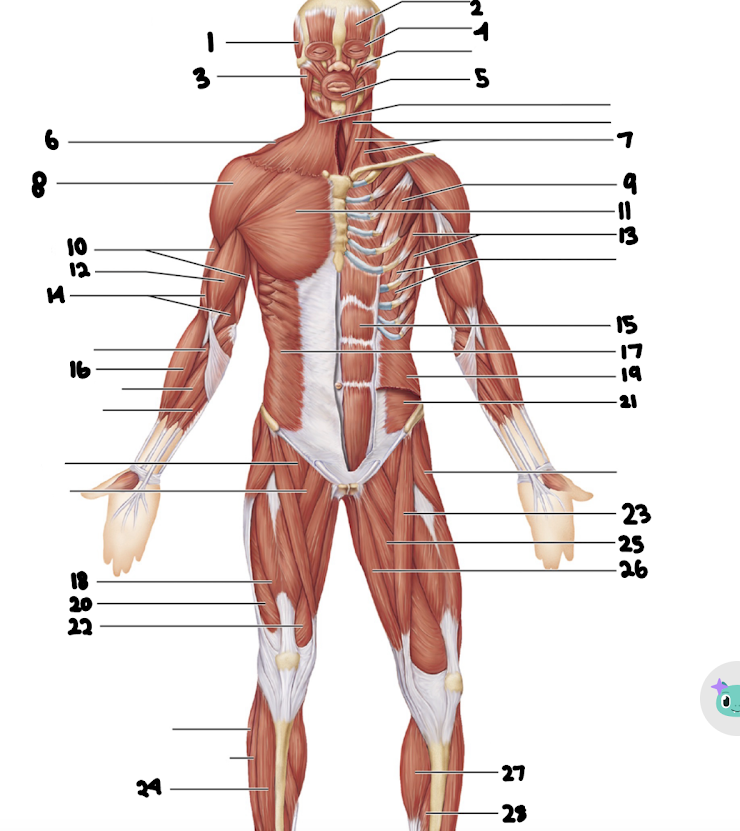
8
Deltoid
A thin, flat triangular muscle located deep to the pectoralis major on the anterior thoracic wall that draws the scapula anteriorly and downward.
Pectoralis minor
A thick, fan-shaped muscle covering the superior anterior chest wall that adducts, flexes, and medially rotates the humerus.
Pectoralis major
A three-headed muscle located on the posterior compartment of the arm that serves as the principal extensor of the forearm at the elbow.
Triceps brachii
A two-headed muscle situated on the anterior compartment of the arm that flexes and supinates the forearm at the elbow.
Biceps brachii
A strong anterior arm muscle located deep to the biceps brachii that serves as a major flexor of the forearm at the elbow joint.
Brachialis
A superficial muscle on the lateral aspect of the forearm that flexes the forearm at the elbow, especially in a semi-pronated position.
Brachioradialis
A fan-shaped muscle with a serrated anterior border on the lateral thoracic wall that protracts and stabilizes the scapula against the ribcage.
Serratus anterior
A long, paired vertical muscle running longitudinally along the anterior abdominal wall that flexes the vertebral column and compresses abdominal contents.
Rectus abdominus
The largest and outermost flat muscle of the anterolateral abdominal wall whose downward-sloping fibers compress the abdomen, flex the trunk, and rotate it laterally.
External oblique
The intermediate flat muscle layer of the anterolateral abdominal wall lying deep to the external oblique that assists in trunk flexion, lateral rotation, and abdominal compression.
Internal oblique
The innermost flat muscle layer of the anterolateral abdominal wall with horizontal fibers that functions to compress the abdominal viscera and stabilize the core.
Transversus abdominus
An anterior thigh muscle and superficial member of the quadriceps femoris group that extends the leg at the knee and flexes the thigh at the hip.
Rectus femoris
The largest and most laterally situated muscle of the quadriceps femoris group on the anterolateral thigh that extends the leg at the knee joint.
Vastus lateralis
The medial, teardrop-shaped component of the quadriceps femoris group that extends the leg at the knee and stabilizes patellar tracking.
Vastus medialis
A long, slender strap muscle that crosses obliquely over the anterior thigh; flexes, abducts, and laterally rotates the thigh at the hip, and flexes the knee.
Sartorius
A superficial muscle lying on the anterior lateral surface of the tibia that acts as the primary dorsiflexor and inverter of the foot.
Tibialis anterior
A triangular skeletal muscle located in the medial compartment of the thigh that adducts, flexes, and medially rotates the thigh at the hip.
Adductor longus
A large triangular muscle forming the bulk of the medial thigh adductor group that strongly adducts and extends the thigh at the hip.
Adductor magnus
A long, thin superficial strap muscle on the medial side of the thigh that adducts the thigh at the hip and flexes the leg at the knee.
Gracilis
A prominent, superficial two-headed muscle in the posterior compartment of the calf that plantarflexes the foot at the ankle and flexes the leg at the knee.
Gastrocnemius
A broad, flat muscle located deep to the gastrocnemius in the posterior calf that powerfully plantarflexes the foot at the ankle.
Soleus
A rotator cuff muscle occupying the infraspinous fossa of the scapula that laterally rotates the humerus at the shoulder joint.
Infraspinatus
A thick muscle situated on the inferior posterior aspect of the scapula that adducts and medially rotates the humerus at the shoulder.
Teres major
A broad, expansive superficial muscle of the lower posterior trunk that extends, adducts, and medially rotates the humerus.
Latissimus dorsi
A fan-shaped pelvic muscle lying largely deep to the gluteus maximus that functions as a primary abductor and medial rotator of the thigh at the hip.
Gluteus medius
The largest and heaviest superficial muscle of the buttocks that powerfully extends and laterally rotates the thigh at the hip joint.
Gluteus maximus
A two-headed muscle in the posterior lateral thigh (part of the hamstring group) that flexes the knee and extends the thigh at the hip.
Biceps femoris
A medial hamstring muscle of the posterior thigh characterized by a long, cord-like tendon; extends the thigh at the hip and flexes the knee.
Semitendinosus
A deep medial hamstring muscle of the posterior thigh with a broad membranous tendon; extends the thigh at the hip and flexes the knee.
Semimembranosus
A thin, quadrilateral facial muscle of the cheek that compresses the cheeks against the teeth during chewing and whistling.
Buccinator
A two-headed deep muscle of mastication that protracts the mandible and produces lateral side-to-side excursion for grinding.
Lateral pterygoid
A thick, quadrilateral muscle of mastication located on the medial surface of the mandibular ramus that elevates and protracts the mandible to aid in jaw closure.
Medial pterygoid