Econ Unit #2
 Call Kai
 Learn
 Practice Test
 Spaced Repetition
 Match
 Flashcards
 Knowt Play
1/39

There's no tags or description
Looks like no tags are added yet.
40 Terms
Income effect
The change in the quantity demanded of a good that results from a change in the consumer's purchasing power caused by a change in the good's price
Substitution effect
the change in the quantity demanded of a good that occurs when the price of the good changes relative to the price of other goods, leading consumers to substitute one for another
Diminishing marginal utility
is the principle that as a consumer consumes more units of a good or service, the additional satisfaction (Marginal utility) gained from each additional unit decreases, even though total satisfaction (total utility) continues to rise
Utility
Satisfaction or pleasure gained from consuming a good or service
Total Utility
The cumulative satisfaction from all units consumed
Marginal Utility
The extra satisfaction from consuming one more unit
Price Ceiling
Maximum price, must be low (below equilibrium), Meant to help consumers, Problem: leads to shortage, Possible examples: health care, gasoline, rent control
Price Floor
Minimum price, Must be high (above equilibrium), Meant to help suppliers (such as workers), Problem: leads to surplus, Examples: minimum wage, agricultural price supports
Determinants of Demand - Consumer Income
For normal goods, an increase in income causes an increase in demand. For inferior goods, an increase in income causes a decrease in demand. AKA, a change in income that causes a change in demand.
Determinants of Demand - Consumer Tastes
When consumers in general desire a product more (or less) (due to factors other than money), demand increases or decreases. Consumer tastes change due to trends, Changes in product quality, and seasons.
Determinants of Demand - Price of a Substitute
When a substitute (margarine) becomes more or less expensive, it increases or decreases demand for the original product (butter)
Determinants of Demand - Price of a Complement
When a complement (gasoline) becomes more or less expensive, it decreases or increases demand for the original product (automobiles)
Determinants of Demand - Number of Buyers
When there are more or less potential consumers, demand for a product increases or decreases
Determinants of Demand - Future Prices Expected by Consumers
When consumers expect higher or lower prices in the future, the demand for the product now increases or decreases
Normal Good
Demand goes up as income goes up, and goes down as income goes down. Ex: Clothing, restaurant meals, fresh produce, and standard household appliances.
Inferior Good
Demand goes down as income goes up (because people can afford to trade up for a better alternative) and goes up when income falls. Ex: Ramen, public transportation
Substitute
a product that may be used in place of another
Complement
a product which increases use of another
Determinants of Supply - Production Costs
Any increase or decrease in the cost of land, labor, or capital causes the supply of the product to decrease or increase
Determinants of Supply - Productivity/Technology
When workers’ productivity increases or decreases, supply increases or decreases
Determinants of Supply - Number of Sellers
When the number of sellers in a market increases or decreases, supply increases or decreases
Determinants of Supply - Producer Expectations
When producers expect higher or lower prices in the future, the supply for the product now decreases or increases
Determinants of Supply - Price of Other Goods
If producers of a good are faced with the higher or lower prices of a good they could produce alternatively, supply for the good in question decreases or increases
Elasticity
Responsiveness, How much one thing will change due to a change in another thing, Elastic = changes significantly, Inelastic = changes very little
Price elasticity of demand
How much quantity demanded changes due to a change in price
Price elasticity of supply
How much quantity supplied changes due to a change in price
Cross elasticity of demand
How much demand changes due to a change in the price of a substitute or complement
Income elasticity of demand
How much demand changes due to a change in income
Total Revenue Equation
TR=Price x Quantity (P x Q)
Math Elasticity of Demand and Supply Equation
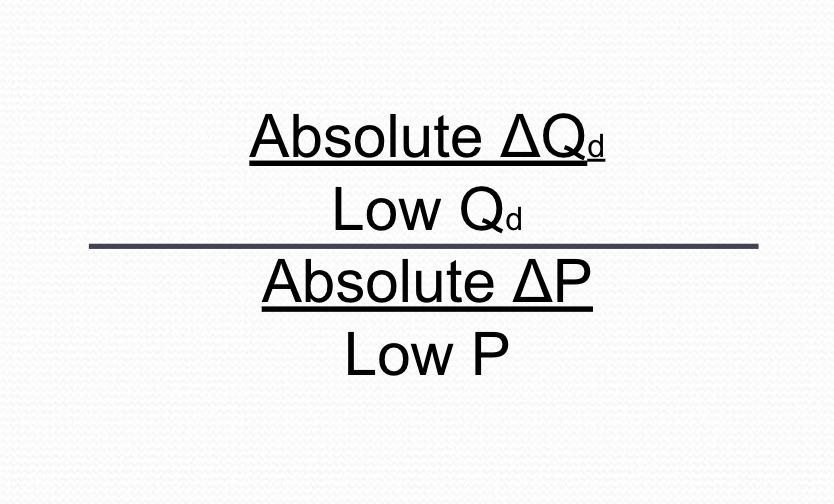
Elasticity Coefficients for supply and Demand
Elastic: Ed(s) >1
Inelastic : Ed(s)<1
Unit elastic : Ed(s)=1
Price elasticity of supply
How much quantity supplied changes due to a change in price
Elastic Supply
Resources can easily be shifted between alternative uses. It is relatively easy to supply more when price increases. Example: Hamburgers
Inelastic Supply
Resources cannot easily be shifted between alternative uses. It is relatively difficult to supply more when price increases. Example: Parking spaces in downtown Denver
Cross Elasticity Equation
If Exy is zero (or very close to it), the products are UNRELATED.
If Exy is positive, product Y is a SUBSTITUTE for X
If Exy is negative, product Y is a COMPLEMENT for X.

Income Elasticity Equation
If Ei is positive, the good in question is a normal good
If Ei is negative, the good in question is an inferior good

Equation for Consumer and Producer Surplus
½ base x height
Land
The natural elements not created by human effort (Natural Resources)
Capital
Includes manufactured goods, tools, equipment, and structures used to produce other goods and services (Man-Made Resources)
Opportunity cost
the value of the single next-best alternative given up when making a choice