Biological Functioning & Affective States
 Call Kai
 Learn
 Practice Test
 Spaced Repetition
 Match
 Flashcards
 Knowt Play
1/26

There's no tags or description
Looks like no tags are added yet.
27 Terms
⭐ 1. What biological functioning indicators can be used to assess animal welfare?
A: Biological functioning can be assessed using growth, survival, reproduction, nutrition, and health-status indicators. 🔎 What this means: Growth can include body-weight gain and feed conversion; survival can be assessed with mortality rates; reproduction can include fertility and litter size; nutrition can include body-condition scores and nutrient inputs; and health status can include vaccination, morbidity, lesions, and lameness. Problems with disease, injury, nutrition, or other basic functions can indicate welfare problems. 💡 Think: Is the animal growing, surviving, reproducing, nourished, and healthy?

- What is pathology, and what are its strengths and limitations for assessing animal welfare?
A: Pathology is the study of disease or the causes of disease, and it can identify abnormalities and help direct treatment or suggest potential causes, but the animal is already sick or dead and the findings may not reveal the original cause. 🔎 What this means: Veterinary pathology can tell you what abnormal changes are present, while forensic pathology may investigate why disease occurred. It provides useful evidence about current biological functioning, but it can be reactive rather than preventive.
- What is epidemiology, and what are its strengths and limitations for assessing animal welfare?
A: Epidemiology is the study of patterns, causes, risk factors, and effects of disease in defined populations; it can identify multiple risk factors and remain useful when disease incidence is low, but it may require many subjects and substantial time. 🔎 What this means: Rather than focusing on one sick animal, epidemiology looks for patterns across populations. This can reveal associations between management conditions and welfare problems that are difficult to recognize from individual cases.
- What is a controlled experiment, and what are its strengths and limitations for animal-welfare research?
A: A controlled experiment systematically applies treatment conditions to one or more groups and compares them with control groups to determine causality. 🔎 What this means: Controlled experiments generate strong causal inference and can be useful when the condition or treatment is widely available or prevalent. Limitations include reduced external validity if the study does not reflect real-world conditions, ethical concerns about deliberately causing harm, and practical or logistical constraints. 💡 Think: Change one condition deliberately and compare the outcome.
- What are independent and dependent variables in a controlled animal-welfare experiment?
A: Independent variables are the conditions manipulated by researchers, whereas dependent variables are the outcomes that may change because of the independent variables. 🔎 What this means: If researchers change the amount of human interaction given to shelter cats, that treatment is the independent variable; an outcome such as whether the cats develop respiratory disease would be a dependent variable. 💡 Think: Independent = what I change; dependent = what I measure afterward.
- What is a meta-analysis, and what are its strengths and limitations for animal-welfare research?
A: A meta-analysis uses data from previous studies with similar designs and aims to identify patterns, similarities, and differences across their results. 🔎 What this means: Advantages are that it uses studies already completed, minimizes additional animal use, and can create a large sample for analysis. Its conclusions are only as good as the studies and measures included, and combining studies across long periods can be problematic if older methods are no longer relevant.
⭐ 7. How do pathology, epidemiology, controlled experiments, and meta-analysis differ?
A: Pathology examines signs, causes, and effects of disease; epidemiology examines disease incidence and distribution in populations; controlled experiments test possible causes under controlled conditions; and meta-analysis combines results from comparable studies to assess the strength and generality of findings. 🔎 What this means: This is the lecture's knowledge-check distinction. Ask what type of evidence is being used: an affected animal, a population pattern, a deliberately manipulated treatment, or a combination of previous studies. 💡 Think: Pathology = disease itself; epidemiology = population patterns; experiment = manipulate; meta-analysis = combine studies.
⭐ 8. What are the benefits and limitations of using performance or productivity measures as animal-welfare indicators?
A: Performance and productivity measures can provide evidence about biological functioning when their relationship to welfare is clear, but productivity is not automatically a welfare indicator. 🔎 What this means: Measures such as growth, reproduction, survival, and feed conversion may reveal problems with health or basic functioning. However, the lecture specifically warns that not all aspects of production indicate welfare, so the link between a productivity measure and the animal's welfare must be made explicit. 💡 Think: Production can be evidence of welfare, but production is not the same thing as welfare.
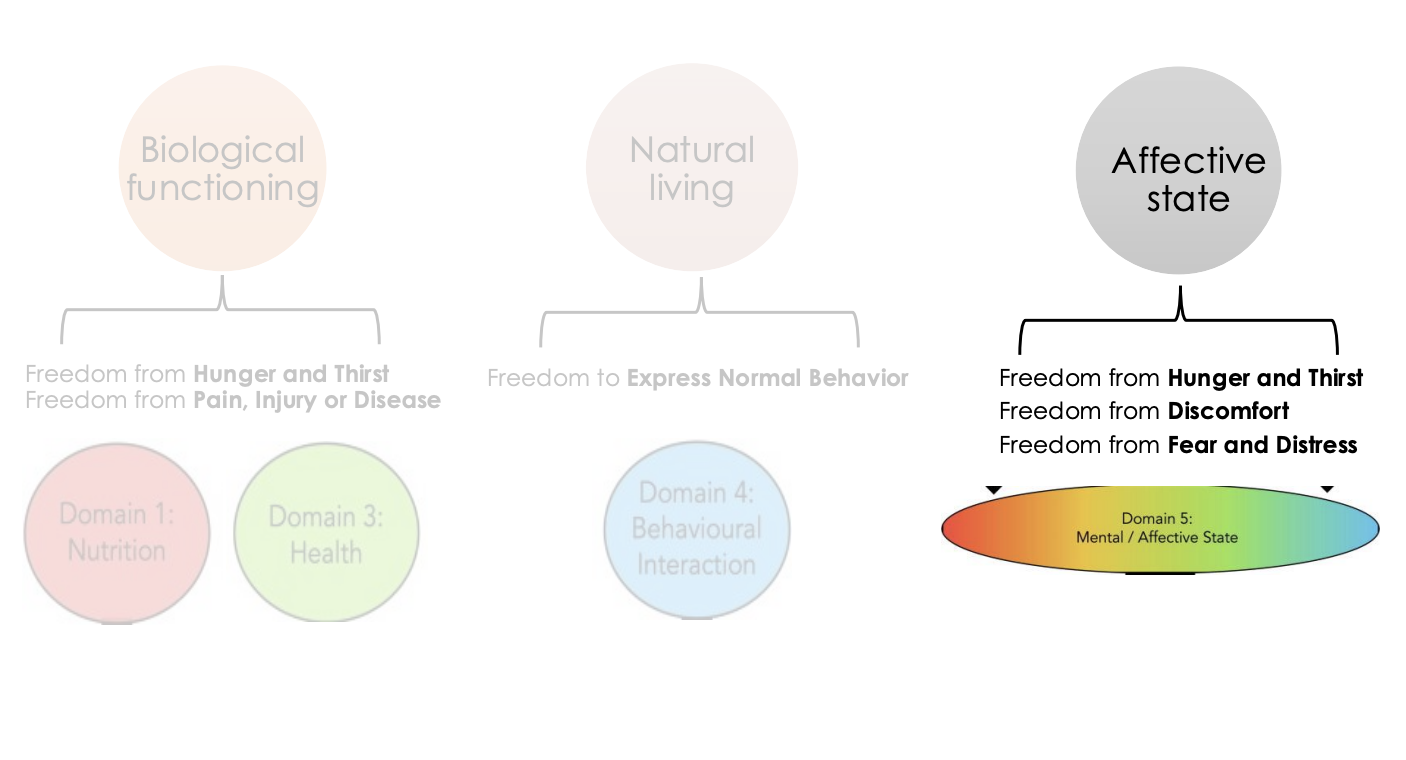
Why is biological functioning alone insufficient for a complete assessment of animal welfare?
A: Biological functioning identifies important welfare problems such as disease, injury, and impaired basic functioning, but it does not capture every aspect of how an animal feels or whether important behavioral and natural-living needs are met. 🔎 What this means: This lecture focuses on the biological-functioning sphere, but the Foundations framework treats welfare more broadly. An animal may appear physically functional while still experiencing frustration or other negative affective states.

⭐ 10. How does Mendl et al.'s framework describe animal emotions using valence and arousal?
A: Mendl et al.'s framework describes emotions using valence, which ranges from negative to positive, and arousal, which ranges from low to high. 🔎 What this means: High-arousal negative states can include fear, anger, and anxiety, while high-arousal positive states can include excitement, happiness, and delight. Low-arousal negative states can include depression, boredom, and sadness, while low-arousal positive states can include calmness, relaxation, and contentment. Emotions are proposed to help animals avoid harm or punishment and seek resources or rewards. 💡 Think: Valence asks good or bad; arousal asks activated or calm.

⭐ 11. How can affective states or emotions be assessed in non-human animals?
A: Affective states cannot simply be asked about directly in non-human animals, so they are assessed indirectly using behavior, physiology, communication, preference or motivation, and cognitive bias. 🔎 What this means: Human subjects can directly describe their feelings, but animals cannot verbally report a subjective experience. Researchers therefore collect observable evidence that may allow reasonable inferences about how an animal feels.
- What does it mean to infer an animal's affective state by analogy?
A: Inference by analogy means using similarities between animals and other beings whose subjective experiences are better understood to make evidence-based inferences about what an animal may be experiencing. 🔎 What this means: The lecture lists evidence from neuroanatomy and physiology, neuropharmacology, and behavior. Behavioral evidence can include posture, movement, facial changes, communication, preferences, motivation, and cognitive bias. No single observation directly gives access to the animal's conscious experience.
⭐ 13. How is pain defined in the Affective States lecture?
A: Pain is “an unpleasant sensory and emotional experience associated with, or resembling that associated with, actual or potential tissue damage.” 🔎 What this means: Pain contains both a sensory component, meaning how the physical stimulus feels, and an emotional or affective component, meaning how that experience makes the animal feel. Pain is therefore not simply detection of tissue damage. 💡 Think: Pain has both an “ouch” and an emotional experience.
- What is behavior, and how can behavior provide evidence of pain?
A: Behavior is what animals do to interact with, respond to, and control their environment, and pain may be reflected both in pain-specific behaviors and in reduced performance of normal motivated behaviors. 🔎 What this means: Looking only for an obvious new pain behavior can miss important evidence. An animal may also stop eating, moving normally, interacting, or performing other behaviors it is normally motivated to perform.
⭐ 15. What factors should be considered when interpreting signs of pain in an animal?
A: Pain assessment should consider species, whether the species is prey or predator, the reason for the pain, the environmental context and location, and individual variation such as personality and pain tolerance. 🔎 What this means: The same painful condition may not look identical in every animal. Injury, illness, or a procedure can produce different responses, and animals may alter how visibly they express pain depending on species, setting, and individual characteristics.
⭐ 16. What main approaches can be used to obtain objective behavioral evidence of pain in animals?
A: Pain can be assessed using pre-versus-post comparisons, functional responses, responses to analgesics or anesthetics, and preference or motivational tests and learned associations. 🔎 What this means: Pre-post comparisons ask what behaviors increase after a painful event. Functional-response measures ask which normal behaviors decrease. Analgesic or anesthetic studies ask whether blocking pain reverses the suspected indicator. Preference and learned-association approaches examine what animals choose or learn to seek or avoid. 💡 Think: Increase, decrease, reverse with pain relief, or choose/avoid.
- How can pre-versus-post behavioral comparisons provide evidence of pain?
A: Pre-versus-post comparisons support a pain inference when a behavior changes after a potentially painful event compared with the animal's baseline. 🔎 What this means: The lecture shows piglets during castration producing a large increase specifically in vocalizations above 1000 Hz and sea lions showing increased back-arching after a painful marking procedure. Comparing with the animal's behavior before the event helps distinguish a procedure-related change from normal individual behavior.
- How can decreases in normal behavior provide evidence of pain?
A: A reduction in normal motivated behavior can serve as a functional indicator of pain when the decrease occurs after a painful treatment and is reversed by pain relief. 🔎 What this means: Rainbow trout injected with acetic acid into the lips showed abnormal rubbing and rocking but also greatly reduced feeding. The feeding reduction disappeared after morphine was administered, strengthening the inference that pain was responsible. 💡 Think: Pain can add abnormal behaviors and subtract normal ones.
- What are grimace scales, and how do they provide evidence of pain?
A: Grimace scales assess pain using facial action units, which are specific muscular changes in facial features associated with pain. 🔎 What this means: The lecture describes changes such as altered ear and whisker position, tightening of the eyes, and opening of the nostrils. A structured scale allows facial expressions to be scored more systematically rather than relying only on a general impression that an animal “looks painful.”
⭐ 20. How can analgesics or anesthetics help validate a proposed measure of pain?
A: A proposed pain measure is strengthened when it is high during a painful condition without effective pain relief but decreases toward control levels when effective analgesia or anesthesia blocks the pain. 🔎 What this means: The lecture compares animals with or without a painful procedure and with or without effective pain relief. If the suspected indicator appears mainly when pain is present and untreated, then disappears when pain is blocked, that pattern supports the interpretation that the measure actually reflects pain rather than an unrelated effect. 💡 Think: If blocking pain blocks the sign, the sign is stronger evidence of pain.
- How is the lecture's pain-validation notation Pa, PA, pA, and pa interpreted?
A: In the lecture's notation, P means the painful condition is present, p means it is absent, A means effective analgesia or anesthesia is present, and a means pain relief is absent. 🔎 What this means: A valid pain measure should be much greater in Pa, where pain is present and untreated, than in PA, pA, or pa. Ideally, PA, pA, and pa should be similar because either the painful condition is absent or effective pain relief has prevented the pain response. The calf ear-flick example after dehorning illustrates this validation logic.
⭐ 22. What is the main limitation when scientifically assessing affective states such as pain?
A: We cannot directly observe another animal's subjective affective state, so conclusions about pain and emotion are inferences supported by converging evidence rather than direct measurements of the conscious experience itself. 🔎 What this means: The lecture therefore emphasizes analogy and multiple types of evidence. Validated behavioral measures can still be used to compare procedures and provide a scientific basis for veterinary recommendations that reduce or eliminate pain, but the evidence should not be overstated as direct access to the animal's feelings.
⭐ 🔄 UPDATED/REPLACEMENT 23. How does Fraser et al. describe animal welfare as a “bridging concept”?
A: Fraser et al. describe animal welfare as a bridging concept that connects scientific research about animals with ethical concerns about animals' quality of life. 🔎 What this means: Animal-welfare science arose because society had ethical concerns and wanted scientific guidance. A useful scientific conception of welfare therefore must be measurable enough for scientific study while still addressing the ethical questions that motivated the research. The concept is inherently value-laden because deciding what is better or worse for animals involves values.
⭐ 🔄 UPDATED/REPLACEMENT 24. What three overlapping quality-of-life concerns does Fraser et al. identify in animal welfare?
A: Fraser et al. identify natural-living concerns, feelings-based concerns, and functioning-based concerns. 🔎 What this means: Natural-living concerns emphasize allowing animals to develop and use their natural adaptations and capabilities. Feelings-based concerns emphasize avoiding prolonged or intense pain, fear, hunger, and other negative states while allowing positive experiences such as comfort and pleasure. Functioning-based concerns emphasize satisfactory health, growth, and normal physiological and behavioral functioning. These correspond closely to the natural living, affective state, and biological functioning spheres from the Foundations lecture.
- Why does Fraser et al. argue against defining animal welfare using only one of the three welfare concerns?
A: Fraser et al. argue that natural living, subjective feelings, or biological functioning alone cannot fully capture the major ethical concerns about animal quality of life. 🔎 What this means: Natural behavior can sometimes occur under harmful conditions, good biological functioning can coexist with frustration or other negative feelings, and focusing only on subjective experience can overlook important health or natural-living concerns that science cannot fully reduce to feelings. A comprehensive welfare conception therefore needs to recognize overlap and possible disagreement among these dimensions.
⭐ 26. How does Fraser et al.'s integrative model explain welfare problems as a mismatch between an animal's adaptations and its environment?
A: Fraser et al. propose that welfare problems arise when the adaptations an animal possesses do not adequately match the challenges of its current environment, and this mismatch can affect feelings, biological functioning, or both. 🔎 What this means: One type occurs when an animal retains a strongly motivated adaptation that is no longer functionally necessary, producing negative feelings without obvious biological impairment. A second occurs when the environment presents a challenge for which the animal lacks an adaptation, producing biological harm without obvious negative feelings. A third occurs when the animal has the relevant adaptation but it is inadequate for the severity of the challenge, causing both poor feelings and poor functioning.
- What examples illustrate the three mismatch problems in Fraser et al.'s integrative model?
A: A bucket-fed calf frustrated by an unfulfilled urge to suck illustrates negative feelings without major functional impairment; a pig developing lung damage from polluted air illustrates functional harm without obvious subjective distress; and an animal whose thermoregulatory responses cannot cope with severe cold illustrates both negative feelings and impaired functioning. 🔎 What this means: These examples show why feelings and biological functioning do not always move together. Welfare assessment therefore cannot assume that a physically functioning animal feels well or that the absence of obvious distress means the animal is biologically unharmed. 💡 Think: Calf = feels bad; polluted pig = functions badly; severe cold = both.