AP Stats Formulas for exam
 Call Kai
 Learn
 Practice Test
 Spaced Repetition
 Match
 Flashcards
 Knowt Play
1/35

There's no tags or description
Looks like no tags are added yet.
36 Terms
Probability of A or B
P(AuB)=P(a)+P(B)-P(AnB)
P(AnB)
P(AnB)=P(B)*P(AlB)
STDV of random variable
typical deviation of a random variable from the mean in long run √np(p-1)
Mean of Random Variable
E(x)=Σxi*P(xi)
Random Variable vs. Binimial random variable
random doesn’t have to be discreet or have only pass/fail or 2 outcomes
Probability of Binomial Random Variable
P(makes 2/8)=binimialist (8, .5)

Combination stuff
tells you the total number of ways a certain outcome can happen.
STDV of binomial Random Variable
√np(1-p)
Mean of BRV
Σxi(P)
STDV of sampling populations
√p(1-p)/n, aka the spread
The Shape
more than 10 successes and failures to be big enough
Confidence interval
p̂±1.96√P(1-p)/n ex, I'm 90% (use z score there) confidence the percentage of teens in band is between x and x (ur interval, round to hundreds)
Critical value z
the z score that corresponds to the confidence interval

Margin of error
By how much the sample value will vary, use .5 if no p hat
“Conduct hyp at 5% significance level
the limit for which you decide to reject null hypothesis if p<5%, reject H0 and have evidence for HA, if p>5% fail to reject H!
P-Value
the probability of getting a certain sample size given H0 is true.
Small P-value
samle highly unlikely to happen by chance, reject H0
Big P value
low surprise, fail to reject H0
Type 1 error
you rejected the null hyp when it was actually true. A company claims that its new medication cures 80% of patients (H₀: p = 0.80). A consumer group suspects the cure rate is actually lower (\(H_a: p < 0.80\)).
The Type I Error: The consumer group concludes that the cure rate is lower than 80%, when in reality, the medication actually does cure 80% of patients.
The Consequence: The group might damage the company's reputation or stop people from taking a perfectly effective medicine.
Type 2 error
fail to reject null hypothesis, when HA is actually true.
A company claims that its new fuel additive increases a car's gas mileage (\(H_0: \mu = 30\) mpg vs. \(H_a: \mu > 30\) mpg).
The Type II Error: The researchers conclude that the additive does not increase gas mileage, when in reality, it actually does increase it.
The Consequence: The company misses out on marketing a profitable, fuel-saving product, and consumers miss out on better gas mileage.
Power
the probability of correctly rejecting a false null hypothesis P=1-P(type 2 error)
How to find out you made type 2/type 1 error
theres no way to know, problem will tell you
P(type 1 error)
defined as significance level alpha, 1% sig level=1% chance of type 1 error
P(type 2 error)
1-power
How to get more power
increase significance level aplha
increase sample size
out of our control but more power if true parameter further from Ho
regular variable
any characteristic of an individual or object, but no probability attached
discrete random variable
countable numerical valies tied to a probability distrubutioun
Binomaial random variable
the number of heads in 10 coin flips

Confidence interval for difference between proportions
means 95% confident proportions for x is x percent less to 2.07% greater than proportion of all x in KY.
differnce between sampling proportions
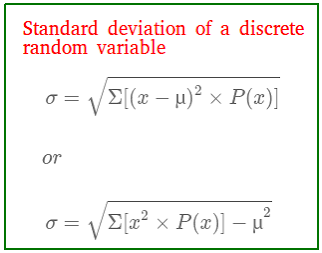
standard deviation of discreet random variable
like when ur given a table of something and probability values, how far its countable outcomes tend to vary from the expected value when weighted by how likely each outcome is to happen.
mean of x packs in table, where its discreet random variable
sum of xi*p
Expected value
the long-run average of a random variable's outcomes over many repetitions
Conditions for binomial Random Variable
The outcome of each trial can be classified as either success or failure.
Each trial is independent of the others.
There is a fixed number of trials.
The probability \[p\] of success on each trial remains constant.

z score for empirical rule stuff:
z=individual value-mean/stdv, use if you know mean and standard deviation