11d — Skills, Priming + Conditioning
 Call Kai
 Learn
 Practice Test
 Spaced Repetition
 Match
 Flashcards
 Knowt Play
1/16

There's no tags or description
Looks like no tags are added yet.
17 Terms
What was the first task to show the conscious/non-conscious dissociation in H.M.?
Mirror tracing (Milner, 1962).
What is the mirror tracing task?
Tracing a star between two lines while looking only at your hand in a mirror, so left and right are reversed.

How did H.M. do on mirror tracing over three days? [Figure: mirror-tracing-hm.jpeg]
He improved within each day and retained it across days, becoming nearly errorless by day 3, while insisting each day that he had never done the task before.

What is mirror-reversed reading, and what did Cohen and Squire (1980) find? [Figure: mirror-reading-cohen-squire.jpeg]
Reading mirror-reversed words (e.g., bedraggle, capricious, grandiose) as a perceptual skill; amnesics improved at the same rate as controls and retained the skill 3 months later, with no memory of doing it.

What is the Tower of Hanoi, and what is the minimum number of moves for 5 disks? [Figure: tower-of-hanoi-diagram.jpeg]
Moving the tower one disk at a time, never placing a larger disk on a smaller one; the minimum is 31 moves.

How did amnesics do on the Tower of Hanoi (Cohen, 1984)? [Figure: tower-of-hanoi-table.jpeg]
They started at about 48 moves like controls and improved at the same rate, reaching near the minimum by session 4, with no memory of the task.
What is priming?
Facilitation of processing a stimulus due to prior presentation of the same or related stimuli — faster or more accurate.
What is the word-fragment priming demo?
After studying words like PENDULUM, FLAMINGO, and AGNOSTIC, fragments like L_MI_G and _G_O_T_C pop out easily, while unstudied ones stay hard.
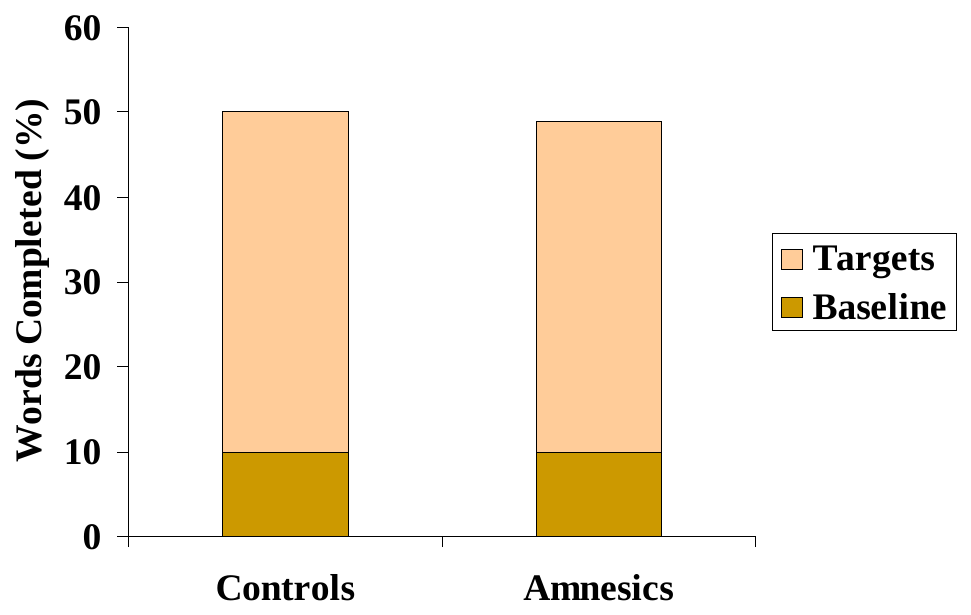
How did amnesics do on word-fragment priming? [Figure: priming-word-completion.png]
Just as well as controls — about 50% completion of studied words vs 10% baseline — despite no memory of seeing the words.
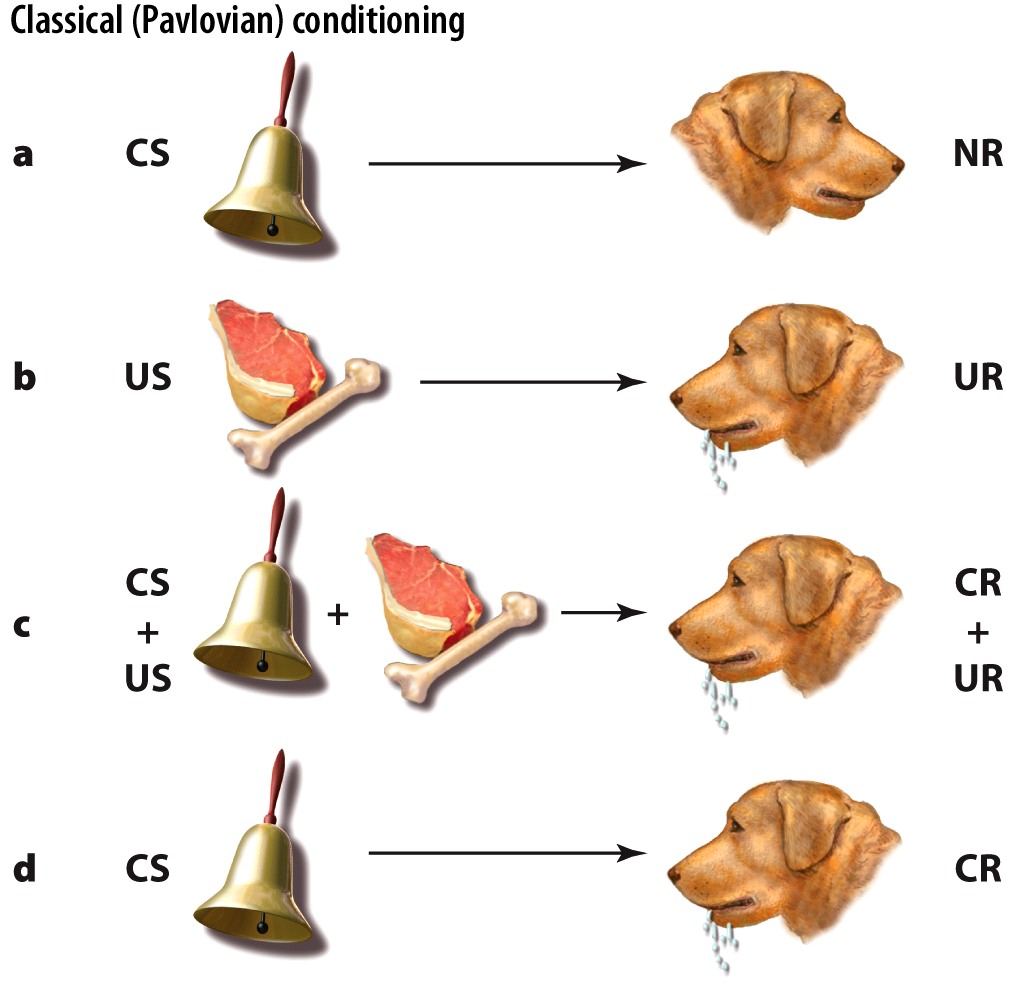
What is classical conditioning? [Figure: classical-conditioning-diagram.jpeg]
Pairing a neutral conditioned stimulus (e.g., a tone) with an unconditioned stimulus (e.g., an air puff) so the CS alone comes to elicit the response (an eyeblink).
What is delay conditioning?
The tone plays continuously for 1250 ms and the 100 ms air puff comes at the end of the tone, so the CS and US overlap and terminate together.
What is trace conditioning?
The tone plays briefly (250 ms) and stops, leaving a 1000 ms gap before the air puff, so the CS and US do not overlap.
What did Clark & Squire (1998) find for delay eyeblink conditioning?
Everyone conditioned: amnesics and both aware and unaware controls reached about 25–35% differential CRs by block 6.

What did they find for trace eyeblink conditioning? [Figure: eyeblink-conditioning-results.png]
Only controls who were aware of the CS–US relationship conditioned; unaware controls and amnesics did not.

What does the delay/trace difference show? [Figure: delay-trace-timing.png]
Whether conditioning occurs depends on conscious awareness of the CS–US relationship in trace conditioning, but not in delay conditioning.
How were controls classified as aware or unaware in Clark & Squire (1998)?
By a questionnaire after conditioning asking about the relationship between the tone and the air puff.
What is the standard model of what the hippocampus does?
The medial temporal lobe system binds declarative memories into unified representations, while nondeclarative memories just reflect changes within the processing systems themselv