NMJ & Excitation
 Call Kai
 Learn
Learn Practice Test
 Spaced Repetition
 Match
Match Flashcards
 Knowt Play
1/38

There's no tags or description
Looks like no tags are added yet.
Name | Mastery | Learn | Test | Matching | Spaced | Call with Kai | Chat |
|---|
No analytics yet
Send a link to your students to track their progress
39 Terms
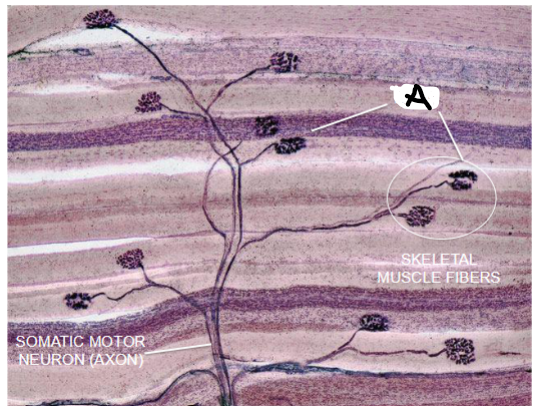
What is A
Neuromuscular junction
How many motor neurons does a muscle fibre receive input from
1
Where do muscle fibres receive input from motor neurons
At a single synapse (neuromuscular junction)
Near the centre of the muscle fibre, roughly equidistant from the two tendons
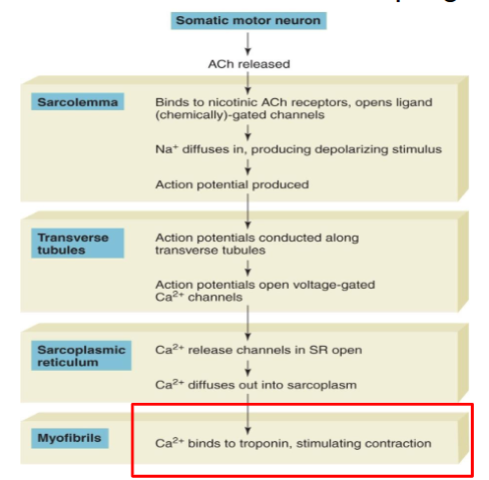
*Excitation Contraction Coupling*
Represents physiologic mechanism whereby an electrical discharge at muscle initiates chemical events at cell surface to release intracellular Ca2+ and produce muscle action
(Associated with myosin actin interaction)
What is released from the somatic motor neuron
ACh
Role of ACh in excitation contraction coupling
Open ligand (chemical) gated channels
What runs through the ligand gated channels
Na+ diffuses in, producing depolarising stimulus (action potential produced)
Where are a high density of receptors found
In folds of sarcolemma
Neuromuscular junction
site where a motor neuron stimulates a muscle fibre
Motor end plate
area of the muscle fibre sarcolemma where a motor neuron stimulates it
What happens at the neuromuscular junction
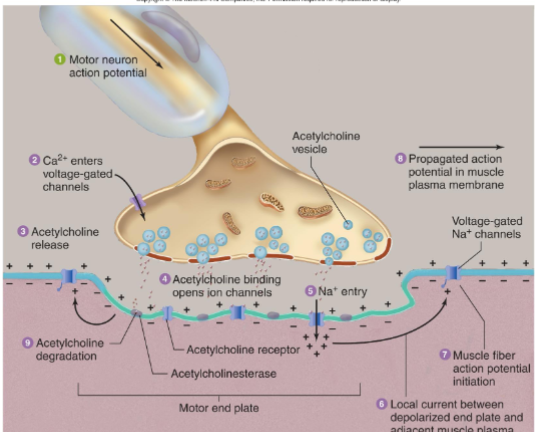
How do vesicles bind with the presynaptic membrane
They are both lipid based
Role of Acetylcholinesterase
Acetylcholinesterase is responsible for breaking down acetylcholine in the receptors and the cleft. It breaks down acetylcholine into acetate and choline.
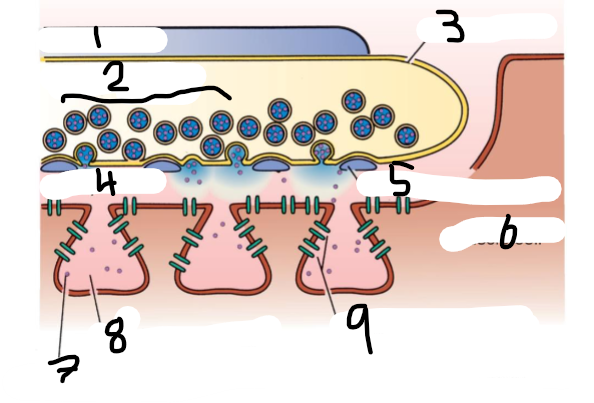
Label
Schwann cell
Synaptic vesicles
Axon terminal
Synaptic cleft
Schwann cell process
Muscle cell
Acetylcholine molecule
Postjunctional fold
Nicotinic acetylcholine receptors in postjunctional membrane
ESPS
Excitatory Postsynaptic Potential
(What is the electrical activity at the neuromuscular junction when there is a change in motor axon action potential) Picture
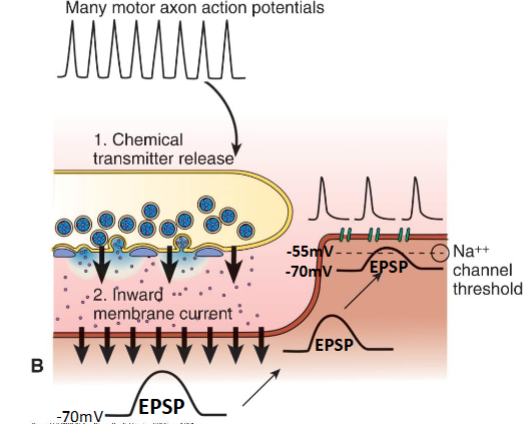
Any substance that affects Acetycholine transmission will affect __________
Muscle contraction
How does botulism toxin (BOTOX) work and what is it used for
Inhibits acetylcholine release from nerve terminal
Used for:
Focal Dystonias,
Spasticity in cerebal palsy
Cosmetic surgery
How does curare work and what is it used for
Blocks AChR receptor
Used on poison arrows in South America
Acetycholinesterase inhibitors (e.g. neostigmine) are used to treat myasthenia gravis which is …..
Grave muscle weakness
What else treats myasthenia gravis other than Acetycholinesterase inhibitors (e.g. neostigmine)
Plasmapheresis (plasma exchange
Cause of myasthenia gravis
Autoimmune disease - Immune system does not recognise the ACh Receptors as self and so attacks and diminishes the density of these receptors at the NMJ.
Symptoms of myasthenia gravis
Patients have flaccid & loose muscles - find it difficult to find muscle fibres to contract
Prevalence of myasthenia gravis
1:5000
Botox capital of the world
Westport (in bacteria)
Result of inhibition of Acetycholinesterase in the synaptic cleft
Inhibition of Acetycholinesterase -> less degradation of ACh.
ACh increases in the synaptic cleft and compensates for the low numbers of Ach Receptors
Process of excitation contraction coupling
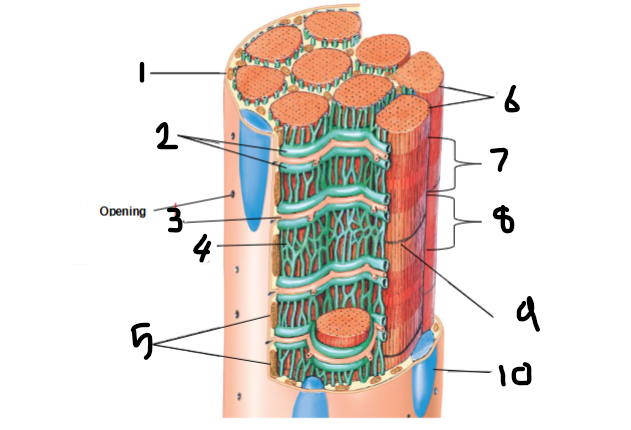
Sarcolemma
Terminal cisternae
Transverse tubule
Sarcoplasmic reticulum
Mitochondria
Myofibrils
A band
I band
Z line
Nucleus
Transverse Tubules
Narrow membranous tunnels formed from the sarcolemma
Transverse Tubules role
Open to the extracellular environment
Able to conduct action potentials
Sarcoplasmic Reticulum (SR) vs Endoplasmic reticulum
SR is modified endoplasmic reticulum that stores Ca2+ when muscle is at rest
How does Ca2+ diffuse out of the SR when a muscle fibre is stimulated
via calcium release channels
(Ryanodine receptor; RyR)
How does the Ca2+ supply in the SR get replenished
At the end of a contraction, Ca2+ is actively pumped back into the SR by the Ca2+- ATPase pump.
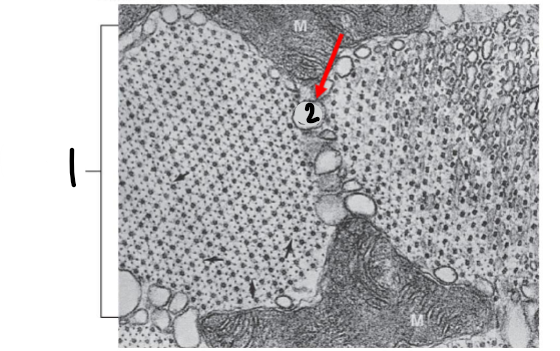
Myofibril
Sarcoplasmic reticulum
When is the Ca-ATPase pup active
Constantly - tightly regulates calcium levels
What percentage of ATP is used by the Ca-ATPase pump and the Cross bridges
30% Ca-ATPase pump
70% cross bridges
Process of Stimulating a Muscle Contraction
-Acetylcholine is released from the motor neuron.
• End plate potentials are produced.
• Action potentials are generated.
• Voltage-gated calcium channels (DHPR) in transverse tubules change shape and cause calcium channels in SR to open.
• Calcium is released and can bind to troponin C
• Cross-bridges bind, rotate and generate force (70% ATP)
Process of Muscle Relaxation
-Action potentials cease.
• Ca2+-ATPase pumps Ca2+ back into SR (30% ATP).
• No more Ca2+ is available to bind to troponin C, so no more cross bridges are formed.
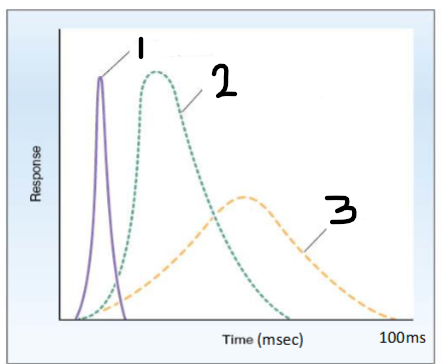
Temporal sequence of events in excitation-contraction coupling
Action Potential
Intracellular (Ca2+)
Tension
(An Action Potential precedes the rise in Ca2+, which precedes cross-bridge cycling resulting in
force development)