GEOL 316: Environmental Geochemistry Final
 Call Kai
 Learn
 Practice Test
 Spaced Repetition
 Match
 Flashcards
 Knowt Play
1/100

There's no tags or description
Looks like no tags are added yet.
101 Terms
Causes and Trends of Eastern U.S. Acid Rain
Increased coal combustion at power plants in the Rust/Coal Belt (released lots of CO2 and SO2) → carried by dominant winds eastward (and into Canada) → international pressures on policymakers (impacted forestry in Canada).
Resulted in rainfall with pH of 4 (10x as acidic as 5) rather than 5.6 (unpolluted rainfall). Negatively impacts forests (flushing/leaching of nutrient ions from soils).
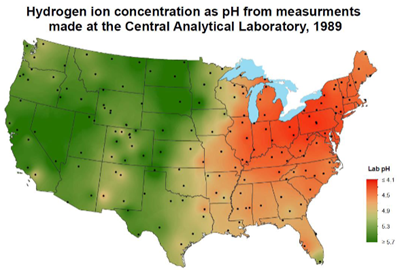
Bear Brook Watershed
Yearly water monitoring research site in Maine. East watershed = control. West watershed = experimental (soils treated with sulfuric acid and compared to East).
Through time… increase in concentration of divalent cations (Mg, Ca) in stream with acid treatment due to CATION EXCHANGE. Cations in soils balance negative charge of edge effects, organics, and clays. Acids flood soils with H+, flushing out divalent cations from these exchange sites (and accumulate in waterways).
Acid Strength
How readily the acid breaks up/dissociates and donates an H+ and thus how stable the conjugate base is (stable base = strong acid). This all depends on the K of the reaction (larger K = more products = stronger tendency to dissociate).
pKa
-log (Kacid)… strong acids almost fully dissociate in aqueous solution (e.g., dissociate into products nearly completely and reactant acid is trivial). These have pKa values at or below 0 (e.g., K >= 1).
Examples of Strong Acids
HClO4 (pKa = -7), HCl (pKa = -3), H2SO4 (pKa = -3), HNO3 (pKa = 0), and H3O+ (pKa = 0)
Figuring How Strongly an Acid is Dissociated at Specific pHs
Use pKa values to calculate for Ka (using equation above). Then, convert pH to the concentration of H+ ions. Then, plug into the K equation and solve for the ratio of dissociation product over acid reactant.
When the pKa = pH…
The acid is 50% dissociated (e.g., ratio of 1… equal acid reactant and dissociation product). This often is the crossover point on acid species curves (ex. DIC curve).

Determining pH based on Concentration of Acid
Usually a strong acid. Set up equation. If strong acid, the acid dissociates fully into the product ion. Can assume charge balance: the negative dissociation product = concentration of H+. Then, plug that H+ concentration into the equation that gives you a pH!
Charge Balance
Water is electrically-neutral with equal moles of positively and negatively-charged particles. To assign charge balance, you MUST consider other charge particles in solution (ex. OH- in aqueous solutions, HCO3-/CO32- in rainwater).
Proper Charge Balancing for pH Questions
After solving for a theoretical pH, set H+ equal to negative anions. Determine the concentration of other negative ions in solution (ex. OH- in all aqueous solutions, HCO3-/CO32- in raindrops). Determine concentrations using equilibrium thermodynamics equations at the particular pH.
Then, divide [H+] by the concentration of all anions (+ / -). If this ratio is 0.95 or higher, you can ignore the other ions in calculating pH (e.g., ignore accessory ions because very small concentrations) and use the OG pH. MUST ALWAYS JUSTIFY THROUGH THIS METHOD!!!
Charge Balancing when Ratio is LESS THAN 0.95
Start with simplified charge balance method as always (e.g., dissociation product = concentration of H+). Then, introduce other anions and perform ratio.
If less than 0.95, [H+] does NOT equal concentration of dissociation product accurately. Put OH- (or other confounding anions) in terms of H+ (e.g., OH- = 10-14 / H+). Plug these into the charge balance equation (ex. H+ = OH- + Cl-). Here, concentration of the dissociation product is a constant/known, and H+ is a variable you have to solve for using the QUADRATIC EQUATION.
Quadratic Equation
x = (-b +- SQRT(b2 - 4ac)) / 2a where x = [H+]
Charge Balance of Raindrops
Must include dissolved inorganic carbons, like HCO3- and CO32- because of CO2 dissolution. Note… charge balance is: H+ = HCO3- + OH- + 2(CO32-). Coefficients scale with charge of ion!!
Buffering
Slowing down the response to a stimulus in an environment/ecosystem (ex. pH change due to H+/OH- input). Resistance to change! pH buffering reactions often CONSUME H+.
Major Buffering Rxns
H+ + HCO3- → H2CO3
H+ + CO32- → HCO3-
Add acid to water → dissolved inorganic carbon can buffer the acid (removes H+). Based on the DIC curve, below a pH of 4 = DIC fully saturated with H+ (H2CO3) = loss of buffering capacity = accumulation of H+ = increasing acidity and rapid drop in pH

Strong Acids as Buffers
At higher pHs, strong acid anions do NOT bond with H+ to form the acid because they tend to fully dissociate (K equation favors products). At pHs below the strong acid pKa values (e.g., below 50/50 ratio), conditions favor formation of the acid, taking up H+ from solution (e.g., similar to DIC curve).
Strong acids = NOT natural buffers in natural waters (too basic) but may be useful
Acid Rain Mitigation Efforts
Since the acidic rain of the 1980s (pH = 4.5), the enaction of clean air policies has driven a rise in pH of rainwater (less acidic; pH = ~5.4).
Three Ways Watersheds can Buffer Acidity
Underlying Carbonate Geology
Cation Exchange in Soils
Dissolving Gibbsite
Underlying Carbonate Geology
CaCO3-rich rocks (limestones, dolostones) provide abundant carbonate ions through chemical weathering rxns. These ions buffer pH change (removal of H+ = less rapid change in pH in soils from acid rain). Areas rich in limestone bedrock = strong buffering capacity against acid rain. Called carbonate alkalinity (ex. Blue Ridge = lack of CaCO3-rich rocks…)
Cation Exchange in Soils
As H+ ions flush soils, they replace other cations (depletion of Ca2+/Mg2+) exchanging with negatively-charged surfaces (edge effects, charged organics, clay interlayers). Accumulation of H+ in soils (acidic) rather than waterways. Partially controlled by bedrock: a stream on the Catoctin (rich in Ca2+, Mg2+) has soils with lots of buffering, whereas a stream on sandstone (rich in Si4+; lack of clays, no large source of Ca2+/Mg2+) would have less buffering.
Problems with Soil Buffering
Over long time, leaches nutrients from soils! Leaching of nutrients can temporarily increase nutrient levels in streams!
Dissolving Gibbsite (e.g., Al(OH)3)
Dissolution of gibbsite buffers the acidity by providing OH- into the system (bonds with H+ to form water). Problem… excess Al3+ = toxic to biota (toxifies the aquatic system). A LAST resort.
Acidic Soils and Plants
Loss of nutrients (like Ca2+) = decreased uptake in plants = decreased cold tolerance (freezing injury) + other negative impacts. Al3+ is also more mobilized in acidic regions (toxification of roots).
Shenandoah Case Study
Strong relationship between geology and waterway pH…
Southern portion: siliciclastic bedrocks = acidic streams (~5) = lower conductance (less Ca/Mg in waterways) = lower abundance of fish.
Northern portion: basaltic/granitic bedrocks = less acidic streams (~7) = higher conductance (more Ca/Mg) = higher abundance of fish.
What happens when leaf litter decomposes?
When next to standing water, some organic compounds leach into the water column (brown color). Occurs with rain in leaf litter. Decomposition involves off-gassing of CO2 and leaching of organics by rainwater.
Dissolved Organic Carbon
Organic matter that can pass through a 0.45 micrometer filter. Import for ecosystems: 1) impacts size of photic zone (high DOC = opaque = bad for photosynthesizers) and 2) provides abundant nutrients (C, N, P release… normally limiting nutrients). Role in carbon cycle, nutrient budgets, water clarity, dissolved oxygen, acid buffering, and trace metal speciation.
DOC Structure
ACTIVE functional groups (like -OH, -COOH). Can dissociate and generate acidity. Negatively-charge functional groups can bond with metal cations (sequestration) → bridge DOC molecules and sometimes cause flocculation (ex. Fe3+, Al3+). DOC acts as a…
Ligand
A negatively-charged dissolved element or molecule that can bond with a dissolved metal, keeping it in solution but modifying its behavior and toxicity (ex. Al3+ is less toxic when bound to organic matter compared to other dissolved forms). Includes organic acids and negatively-charged ions in solution.
Spatial and Temporal Patterns of DOC
Wetlands = highest DOC. Followed by soil solutions (lots of decomposing organic matter that is leached). Rainfall, seawater, and groundwater have LOW DOC.
During the Fall, deciduous forest waterbodies see a PULSE of DOC (accumulation of leaf litter).
Metal Toxicity on the Periodic Table
Essential nutrients for survival = K, Ca, Na, Mg, Fe, I
Toxic metals (no nutritional value) = Pb, Al, Hg, Be
Essential nutrients (but toxic with overconsumption) = F, Cr, Zn, Cu

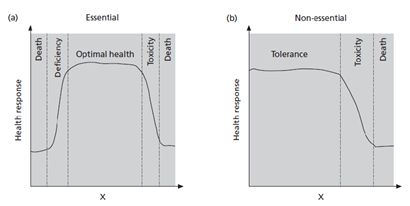
Essential Metals Curve
These nutrients have an optimum concentration necessary for survival. Too little = deficiency in nutrients (and death). Too much = toxic.
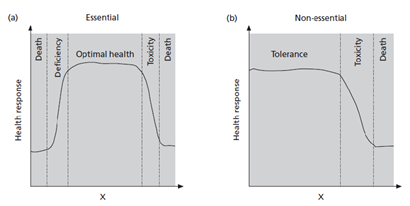
Non-essential Metals Curve
These can be physiologically-tolerated or removed from biotic systems at low doses. Too much = toxic.
Metal complexes with _____ play a major role in controlling metal ______. What are some case studies of this?
Ligands, behavior and toxicity, mercury (Hg) + aluminum (Al)
Mercury (Hg)
Naturally-occurring metal that forms bonds with sulfur easily (occurs naturally in coal and sulfide-rich volcanic rocks). Cinnabar (HgS) = ore rock (most densely-filled with Hg). Only metal that is liquid at room temp. Liquid Hg = NOT toxic (cannot pass through barriers).
Methyl Mercury (HgCH3)
Potent neurotoxin (blurred vision, hearing impairment, olfactory disturbances, ataxic gait, clumsiness of hands, dysarthria, somatosensory disorders, death). Easily passes through blood-brain barrier (very soluble).
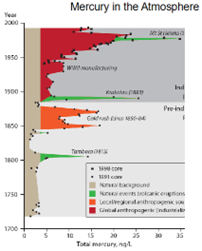
Paleoclimate and Mercury
Ice cores = reconstruct Hg sources in the env. Snow captures heavy species in the atmosphere and can accumulate in glacial ice. Provides an accurate record that tracks major events (ex. volcanic eruptions, local/regional anthropogenic sources (gold-panning), and global events (WWII manufacturing + 1950s industrialization and expansion)).
Formation of Methyl Mercury
Formed in wetlands by anaerobic bacteria (ex. bottom of bays).
Biomagnification
Pollutant concentrations exponentially increase up food chains because higher trophic levels consume organisms from lower trophic levels that have already accumulated Hg from even lower trophic level organisms. Can scale with body size (larger organisms eat more, accumulating more Hg). Thus, albacore tuna, swordfish, and shark = highly concentrated Hg!
Minamata Bay Case Study
First documented mass poisoning of humans by methyl mercury in the 1950s in Japan. Plastic production company = dumped waste into bay (where bacteria converted Hg into methyl mercury). Concentrated in fish and then humans (lots of disorders, disease, and death).
Hg is a problem globally via ______
Air pollution! Residence time of 1-2 weeks (due to chem rxns and foliar uptake = direct absorption by plants)
Sources of Atmospheric Hg
Cement Industry
Coal-mining (burning releases S and Hg into the atmosphere)
Artisanal and small-scale gold mining (Hg used to concentrate fine gold flakes into nuggets; Hg is torched off (vaporizes); used by families in third-world countries = provides income)
Volcanoes
Why do farmed fish and chickens have lower methyl mercury concentrations?
Diminished bioaccumulation and biomagnification in farm systems. Also, chickens experience 1) low biomagnification (low trophic level) and 2) are terrestrial (bacteria that form methyl mercury = anoxic aquatic environments).
Aluminum (Al) Toxicity
Acidification = mobilization of Al3+ into aquatic env. Can have impacts on biological communities.
Most toxic form of Al = when Al is not bonded to an added ligand (lowest % survival of fish) at high and low pHs.
Safest form of Al = when Al is bonded to an added organic ligand (citrate = proxy for DOC) (highest % survival of fish) at low and high pHs. E.g., streams with lots of DOC = reduced toxicity of Al.
Al is more toxic at higher pHs (more basic). Lower survival at higher pHs. Toxicity is pH-dependent. Suggests that the increased abundance of OH- may play a role and that Al(OH)2+ = more toxic to fish than Al3+.

Arsenic Toxicity
VERY toxic to humans. Primarily consumed through arsenic-rich groundwater. Numerous health complications. Global problem but especially bad in Argentina, Bengal Basin (Bangladesh), Nepal, Shanxi Province of China, Pakistan, Mexico, etc. As is naturally-occurring (not pollution). As is strongly connected to iron…
Interactions between Water Molecules and Ions
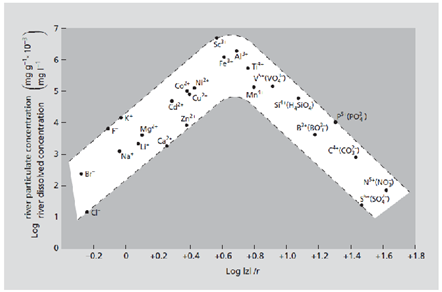
Three categories of response based on CHARGE DENSITY (charge + size). Size decreases as you move up and to the right on the periodic table. Relates to the tendency of these ions to perform hydrolysis. If they do NOT hydrolyze water molecules, they often coordinate around water molecules based on polarity (opposites attract).
Three Categories of Response
Low charge density
Intermediate charge density
High charge density
Low charge density
No hydrolysis with water molecules. Stay in dissolved form (ex. Li, Na, K, Ca, Mg, Sr, Ba, Cs, Rb, Cl, Br, F). Simple dissolved ions.
Intermediate charge density
Undergo partial hydrolysis (knock off one H) to form insoluble hydroxide minerals.
Al3+ + 3H2O → Al(OH)3 + 3H+
Fe3+ + 3H2O → Fe(OH)3 + 3H+

High charge density
Undergo full hydrolysis (grabs O and sometimes grabs H) to form complex dissolved soluble acids/anions.
Si4+ + 4H2O → H4SiO4 + 4H+
N5+ + 3H2O → NO3- + 6H+
Others include SO42-, CO32-, and PO43-

Behavior of Arsenic
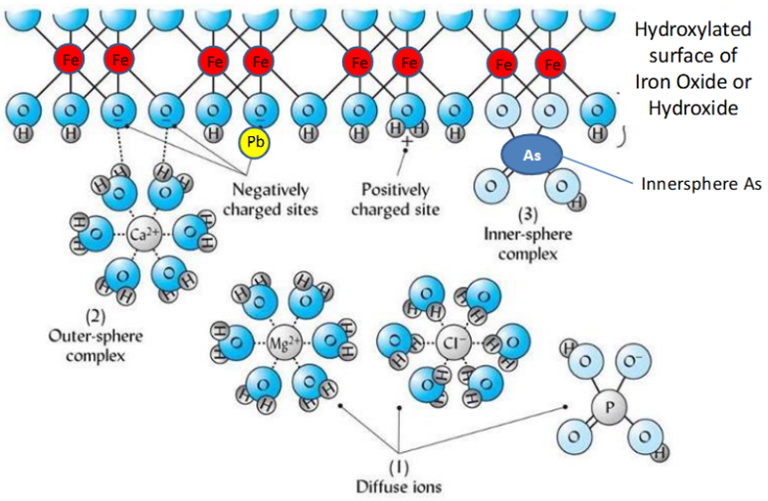
Typically 3+ or 5_ and similar size to Fe… thus, it tends to substitute for iron in minerals and form insoluble hydroxide minerals that precipitate out of solution (ex. As(OH)3). Fe happens to be HIGHLY abundant in Earth’s crust and is most ubiquitous in wet, weathered env (leaching of Si4+). Example = Fe(OH)3 is a thermodynamically stable mineral under most conditions (as a solid). Insoluble + can sequester toxic metals, like Pb/As.
Inner-sphere Absorption
The process by which toxic metal sequestration happens. Rather than performing cation exchange, these metal cations are strongly-bonded to the surface of iron oxide/hydroxide minerals, storing these cations for long periods of time. Other cations = no bonds (part of outer sphere complex)
Why do toxic metals perform inner-sphere absorption?
Have a higher charge density (Pb, As) = bond directly to the mineral edge b/c they “blow up” water molecules. Other cations = coordinated by water molecules (cannot break up water molecules; ex. Ca, Na, etc.). It is often preferred to have these toxic metals sequestered in minerals (easier to filter out of water)
What conditions favor the dissolution of iron minerals (e.g., release of toxic metals into waterways)?
ANOXIC AREAS —> when O levels are low, iron-reducing bacteria metabolize iron minerals, releasing elements attached to its mineral structure. These bacteria are using iron as electron acceptors (rather than O) in redox reactions during anaerobic respiration.
Aerobic Respiration/Metabolism
CH2O (sugar) + O2 → CO2 + H2O… favored in aerobic environments. Respiration! Redox reaction! The O is going from an oxidation number of 0 to an oxidation number of 2- (e.g., reduction = electron acceptor). C = oxidation = electron donor (0 → 4+). REQUIRES O.
Uses the electron transport chain to transport e- through intermediates. H+ are pumped out of cells using diff enzymes, and a proton gradient is formed over the member. Gradient = used by ATP synthase to generate ATP (energy). e- are shuttled from elemental donors to elemental acceptors.
Why is aerobic respiration preferred over anaerobic?
GIBBS FREE ENERGY OF THESE REDOX RXNS → using O2 as the electron acceptor = more energetically favored for metabolism. Only in low oxygen conditions do other reactions occur (e.g., less thermodynamically favored). In those rxns, Fe, Mn, S, N, C, etc. are used as electron acceptors/are reduced. ONLY in anoxic conditions.

Metabolization of Iron Minerals
CH2O + 7CO2 + 4Fe(OH)3 → 4Fe2+ + 8HCO3- + 3H2O… Fe is used as an electron acceptor (3+ → 2+). Thus, iron minerals are dissolved, releasing Fe and any toxic metals bonded to the crustal structure. This rxn requires 1) anoxic conditions (no O2) and 2) organic matter (decomp uses up all O2).
spatial Distribution of Arsenic in Drinking Water
Since microbial dissolution of iron-rich minerals can release As, anoxic groundwaters typically have more As. High dissolved Fe in groundwater = high dissolved As. Problem for areas with LOTS OF ORGANIC MATTER in sediments → aerobic bacteria use up all available O2 during decomposition, leading to the breakup of iron-rich minerals by metal-reducing bacteria
What visual indicator can be used to predict groundwater As levels?
SEDIMENT COLOR! Red sediments = rich in iron-rich minerals (not dissolved). Black sediments = lack of iron minerals + abundance of organics (iron-rich minerals likely dissolved = release of toxic metals).
The Earth’s biosphere ______ mineral weathering
ACCELERATES! Chemical weathering rates are >1000x higher than they would have been with the absence of life. Can be…
Direct causes = bacteria can metabolize normally-insoluble minerals
Indirect causes = cellular respiration produces CO2, which drives many chemical rxns forward to release nutrients based on Le Chatelier’s Principle
Example = feldspar partial dissolution. This phenomena is often seen in soils → higher dissolved CO2 in soil moisture, leading to acidic conditions that dissolve feldspar minerals.
How do oceans differ from freshwater bodies?
Oceans = MUCH HIGHER DISSOLVED ION CONCENTRATIONS (30,000 mg/L), dominated by Na/Cl. Rivers = ~200 mg/L, dominated by Ca/HCO3.
What drives this difference in ionic composition?
EVAPORATION - large SA of oceans = concentrates ions in solution as H2O evaporates. Also continual addition of ions through rivers/runoff. Na/Cl dominant b/c Ca/HCO3 taken up by organisms or readily chemically-precipitated.
Residence Time
Average time a substance remains in a reservoir. Water in oceans = 38,000 yrs. Dissolved ions in oceans = Na (78 Ma), Ca (1.1 Ma), HCO3 (0.09 Ma), etc. Ca/HCO3 faster b/c organismal biomineralization.
Primary Input of Ions into Oceans
RIVER INPUTS (ex. 11.9 Tmol Ca2+ each yr, 30.6 Tmol HCO3-. etc.).
Primary Sink for Ca/HCO3 River Input in Oceans
CaCO3 formation (removal of Ca2+/HCO3-) by calcarous shelled organisms (half by tropical reefs and other half by microscopic plankton). These together remove 17 Tmol of Ca2+… doesn’t balance 11.9 Tmol input…
Other Sources of Ca2+ in Oceans
Ca2+ river input = 11.9 Tmol.
Other input → hydrothermal alteration of basalts at mid-ocean ridges (4.8 Tmol Ca2+). Seawater percolates through fractures at newly-formed basalts. Heated up by magma… anorthite (Ca-plag) hydrothermally alters to form albite (Na-plag) (replacement of Ca by Na in basalts, dissolution of Ca2+).
Other input → cation exchange on clay minerals (brought in by rivers, Na+ flushes out Ca2+ from exchanging)

Sea-air fluxes
Precipitation of halite with sea spray in coastal env = a flux out of oceans of Na/Cl
Potassium Fluxes in Oceans
Currently a MISSING SINK! E.g., more river input and hydrothermal alteration input at mid-ocean ridges that outputs. Where is the K going?
Why is CaCO3 formation in oceans so important?
Critical biogeochemical process: 1) photosynthesis (half of Earth’s oxygen from phytoplankton photosynthesis), 2) biodiversity/food supply (coral reefs = one of the most diverse ecosystems; support food supply for >1 billion people each yr), and 3) long-term carbon sink that regulates climate.
CaCO3 as a Carbon Sink
CaCO3 formation captures dissolved CO2 in oceans (ex. HCO3, CO32-) and retains it in the geologic record for millions of years (as calcareous organism die and are buried on the seafloor). Burial = long-term carbon storage! Balance of carbon emission to the atmosphere with burial in sediments (primary control of global climate change).
How will rising atmospheric CO2 affect calcium carbonate solubility?
Calcite and aragonite only form from the deprotonated CO32- DIC species. Increase CO2 emissions = ocean acidification (drives dissolution of CO2 and dissociation of H2CO3 based on Le Chatelier’s Principle = more H+) = lower pH = reduced CO32- concentrations.

Dissolution of Calcium Carbonate Shells
CO2 + H2O + CaCO3 → Ca2+ + 2HCO3- (e.g., damage to calcareous shells with increased CO2… drives reaction to the right; e.g., thinner, dissolved, and abraded shells in mollusks).
Spatial Variation in CaCO3 Deposits in Oceans
Some oceanic regions dominated by terrigenous deposits (ex. fine clays, coarse continental deposits), and other areas are dominated by biogenous deposits (calcareous/siliceous oozes).
Atlantic Ocean = more calcareous deposits. Pacific Ocean = more clay deposits. Why… Pacific Ocean = OLDER = colder/denser/deeper (sunk with cooling) = impacts CaCO3 solubility based on the ______

Carbonate Compensation Depth
Depth at which CaCO3 is preferentially dissolved (rather than precipitated)
Three Controls on CaCO3 Stability in Oceans
Organic matter decomposition as a CO2 pump
Temperature
Pressure
Organic Matter as a CO2 Pump
Decomposition = releases CO2 (contributes to DIC load). Older seafloors = higher organic content accumulated (from continents (DOC) and dead organisms).
Temperature Shifts
Impact equilibrium coefficients along a depth gradient. Colder = larger K = more products = more dissolution (contributes to CCD)
Pressure Shifts
Higher pressures (at depth) = larger K = more products = more dissolution (contributes to CCD).
Summary of CaCO3 Precipitation in Oceans
Q>K for precipitation (CaCO3 → Ca2+ + CO32-)… calculate dissolves in deep oceans (>3500 m) due to lower T (higher K), increased pressure (higher K), and more organic matter (more CO2 = increased acidity = lower Q as CO32- concentrations decrease at lower pH).
Does the amount of carbon impact recycling back into the atmosphere?
Subduction = eruption of organic matter on the oceanic crust into the atmosphere at volcanoes. So, an oceanic plate with low amounts of CaCO3 organic matter (ex. Pacific) = erupt LESS CO2.
Pacific is subducting today (CARBON-POOR) → less subduction of CaCO3 = less volcanic CO2 emissions. Possibly contributes to ice house climate.
Elemental Depth Profiles
Conservative Behavior
Nutrient Behavior
Scavenged Behavior
Conservative Behavior
Concentration constant with depth. Elements not used by organisms + unreactive (ex. Na, Cl).

Nutrient Behavior
Concentration increases w/ depth to a maximum b/c nutrients consumed at surface by phytoplankton in photic zone (ex. K, Ca, NO3, PO4, Fe)

Scavenged Behavior
Concentration highest at sea level. React with other particles at are adsorbed to the particle surface. As they sink, elements removed to the sediment (ex. Al).
Earth’s Climatic History
Has been MUCH HOTTER (Mesozoic) and MUCH COLDER (Cryogenian). Proportion of C in atmosphere as CO2 compared to that buried is an important control on “ice age” vs “hot house” (strong correlation between CO2 concentrations and abundance of ice).
How can we determine past climate?
CaCO3 taken in by organisms can serve as a record keeper of climate based on DIFFERENT ISOTOPES OF O USED IN SHELL CONSTRUCTION
Oxygen Stable Isotope System
18O vs 16O is a proxy for environmental conditions (due to fractionation = preferential movement of isotopes based on mass). Evaporation = preferential to 16O. Precipitation favors 18O (rainwater at poles = highly concentrated in 16O b/c it hasn’t precipitated).
During glaciations/ice age = 16O rain at poles is sequestered in ice = enrichment in relative 18O in oceans. During interglacials/hot houses = 16O rain at poles runs off into ocean (less ice sequestration) = enrichment in relative 16O in oceans.
The dominant oxygen isotope is often taken up in shell construction more than the less frequent isotope.
18O over the Last 70 Ma
Peak in T (lowest 18O) in Early Eocene. Sharp decrease in T through Eocene and Oligocene (more 18O). Switch from hot house to cool house at ~40-50 Ma. Eocene-Oligocene Transition!
Why is there this switch?
Greenhouse gases are often the culprit… change in carbon storage around 50 Ma? Could be a Ca-limiting problem (e.g., formation of CaCO3). CaCO3 formation (and carbon burial) may be limited by Ca2+ supply from land…
What could limit Ca2+ supply to oceans?
Weathering of continental crust (contributes Ca2+ to oceans). More weathering = more Ca2+ = more carbon burial via biomineralization (reacts with CO32-, which is dissolved CO2) = carbon storage = cooling! So, increased CaCO3 sedimentation could be a CLIMATE FORCING. Note that hydrothermal metamorphism can also contribute Ca2+ to oceans.
CO2 Mobilization with Weathering
Weathering of a limestone mountain = NET/EQUAL flux of CO2 into and out of the atmosphere when paired with biomineralization rxns in shallow seas. NO burial/loss of CO2.
CaCO3 + CO2 + H2O → Ca2+ + 2HCO3-
Ca2+ + 2HCO3- → CaCO3 + CO2 + H2O (exact reverse rxn)
Weathering of a calc-silicate mountain = NET LOSS of CO2 from the atmosphere when coupled w/ CaCO3 formation in oceans. So, increased weathering of calc-silicates (ex. continental crust) could cool the planet via carbon storage).
CaSiO3 + 2CO2 +H2O → Ca2+ + 2HCO3- + SiO2
Ca2+ + 2HCO3- → CaCO3 + CO2 + H2O
Net Rxn = CaSiO3 + CO2 → CaCO3 + SiO2
The above hypothesis is called the _______
Rock-limiting hypothesis (proposed by Raymo & Ruddiman)
How could we test for increased weathering (added Ca2+ supply to oceans)? Is there a proxy?
The Sr isotopic system!
Sr Isotopic System
87 Sr = radiogenic (produced by radioactivity). 86Sr = generic/native. Sr substitutes for Ca and is thus often trapped in shells of organisms (can interpret isotopic ratios in calcareous shells). 87Rb decays into 87Sr (t1/2 = 49 Ga). 87Rb often substitutes for K → abundant in continental rocks (NOT oceanic).
What info does the Sr isotopic system provide?
Increased weathering of continents = more weathering of rocks rich in K (and thus 87Rb) = 87Rb decays into 87Sr = runoff rich in 87Sr = oceans rich in 87Sr with more continental weathering (shift to heavier isotope). Correlates with carbon burial and cooler climate.
Less weathering of continents = less weathering of rocks rich in K/87Rb/87Sr = oceans less rich in 87Sr (relatively more 86Sr, which is abundant in oceans due to replacement of Ca in limestones/biogenic shells).
Rock-limiting Hypothesis
Raymo & Ruddiman. Argued that Indian crashing into Asia ~45 mya caused Cenozoic cooling. Based on… CaSiO3 + CO2 → CaCO3 + SiO2. Suggest that calc-silicates are the limiting reactant and not CO2 (e.g., mtn in sky drives reaction from left to right, causing global cooling).
Evidence for Himalayan Hypothesis
Himalayas = one of largest mtn ranges with high topographic relief (e.g., lots of SA for weathering, sink of atmospheric CO2).
Age of formation of Himalayas correlates with drastic increase in 18O (global cooling) and increase in 87Sr (increase in cont weathering).
Mtns make up 4.2% of world’s drainage area BUT 25% of world’s global dissolved solids in watershed rivers (e.g., dump lots of dissolved ions, like Ca2+).
Around 40 Ma, switch to more 87Sr input into oceans (spike/rapid increase). Correlates with increased 18O

Caveat to this Hypothesis
CO2 is another reactant… could you run out of it? Well… cooling with increased weathering = drop in sea level = exposure of lots of organic carbon on shallow continental shelves = chemical decomposition = releases CO2 and water (e.g., O2 + CH2O → CO2 + H2O). E.g., CO2 is added to atmosphere
Evidence Supporting This Idea
Decrease in organic carbon burial from 40 Ma onwards (possibly due to exposure of buried organic carbon on continental shelves).

Competing Hypotheses
Derry & France-Lanord = weathering of specific clays in Himalayas = high 87Sr ratios (artifact of local clay/soil conditions).
Molnar & England = Ice Age caused the mtns. Ice ages = high abundance of glaciers = lots of glacial erosion = isostatic uplift as mass is removed at high topography = higher topography = more surface area for weathering = continued cooling.
Changes in ocean circulation = opening of Drake Passage (b/w S. America and Antarctica) at ~35 Ma = formed Antarctic Circumpolar current (thermoregulator, mixing of Pacific/Antarctic).
Chicken & Egg Debate
R&R = mtn caused more rock weathering, causing an ice age.
M&E = ice age caused more rock weathering, leading to uplifting of a mtn.