BIO 4226 Part 1
 Call Kai
 Learn
Learn Practice Test
 Spaced Repetition
 Match
Match Flashcards
 Knowt Play
1/74

There's no tags or description
Looks like no tags are added yet.
Name | Mastery | Learn | Test | Matching | Spaced | Call with Kai | Chat |
|---|
No analytics yet
Send a link to your students to track their progress
75 Terms
What disease is caused by infection with Variola Virus?
Smallpox
What is vaccination?
inoculation of healthy individuals with weakened or attenuated strains of disease-causing agent in order to provide protection from disease.
What did Edward Jenner use to protect someone from smallpox?
Inoculation with cowpox, a relatively mild disease, which he called “vaccination”
When was smallpox officially eradicated? How?
Around 1980, due to vaccinations
What is the most effective means of controlling infectious diseases?
vaccination
Who proved that infectious diseases are caused by specific microorganisms.
Robert Koch
Who developed vaccine against cholera in chickens and a rabies vaccine.
Louis Pasteur
Who discovered the presence of antibody?
Emil von Behring and Shibasaburo Kitasato
Who discovered the complement?
Jules Bordet
Who discovered phagocytic cells called macrophages?
Elie Metchnikoff
Describe the two kinds of adaptive immunity
Cellular Immune Response: T cells and B cells.
Humoral Immune Response: Antibody from B cells.
Immune activity depends on what cells? Where do they arise?
White blood cells aka leukocytes.
They arise in the bone marrow and circulate in the bloodstream and in the lymphatic system.
Blood cells derive from what part of the bone marrow?
hematopoietic stem cells (HSCs)
List the relative amounts of the following in the body: neutrophils, lymphocytes, monocytes, eosinophils, basophils.
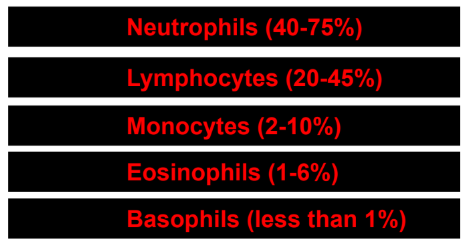
3 main categories of leukocytes and description
Lymphocytes: T cells and B cells
Phagocytes: engulf foreign particles. Monocytes, neutrophils, and eosinophils are the main phagocytic cells
Auxiliary cells: secrete inflammatory mediators which attract leukocytes to the point of infection. Basophils.
What microbes are not pathogens
Commensal microbiome in the gastrointestinal tract, oral mucosa, skin and conjunctiva.
Granulocytes include what cells
neutrophils, eosinophils, and basophils
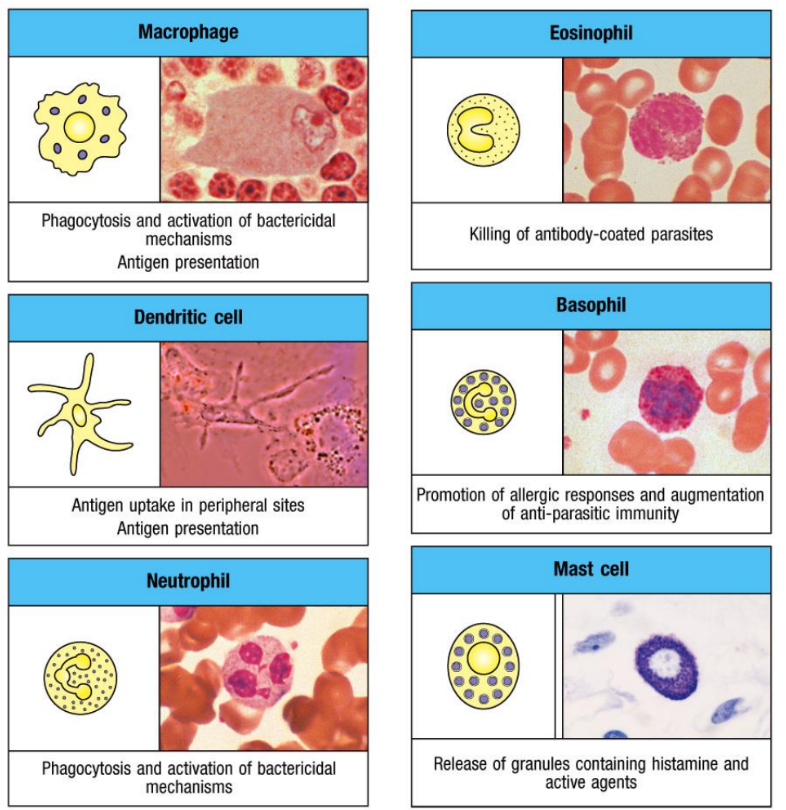
Three types of phagocytes in the immune system are:
Macrophages, Dendritic cells, Granulocytes.
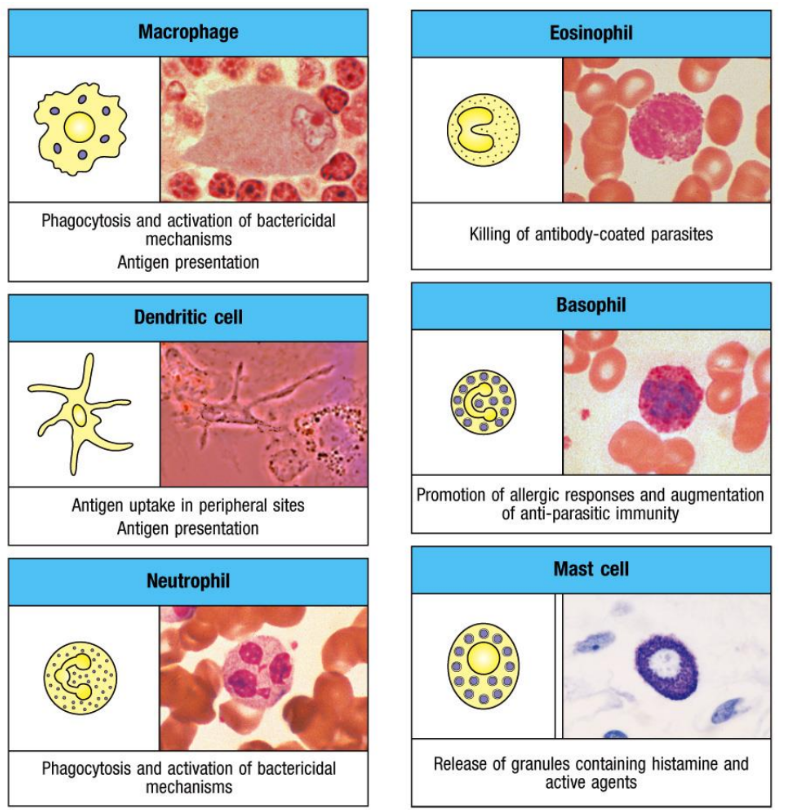
Describe what macrophages are/do:
engulf and kill invading pathogens
general scavenger cell in the body to clear out dead cell and cell debris.
Describe granulocytes. Granulocytes are also called what, and why?
Aka polymorphonuclear leukocytes bc oddly shaped nuclei.
Have many granules in the cytoplasm
survive a few days
mature in the bone marrow
increase during inflammation and migrate to inflammatory sites
Describe neutrophils
most numerous and important cells in innate immune response
phagocytic
neutropenia (low # of neutrophils) → overwhelming bacterial infection
Describe eosinophils and basophils
less abundant than neutrophils
important in defense against parasites which are too large to be ingested by macrophages or neutrophils
contribute to allergic inflammatory reactions
Describe mast cells
Begin development in the bone marrow, then mature in peripheral tissues, skin, intestines, and airway mucosa.
Protecting the internal surfaces from pathogens including parasitic worms.
Describe dendritic cells (DCs)
discovered by Ralph Steinman in 1970s
phagocytic
dendrites of cell membrane
macrophinocytosis: ingests extracellular fluid
protecting the internal surfaces from pathogens including parasitic worms
professional antigen presenting cell (APC)
immature DCs from the bone marrow and migrate to the tissues
What do sensor cells express to provide an initial discrimination between self and nonself
pattern recognition receptors (PRR)
Infection triggers an inflammatory responses by releasing what?
cytokines and chemokines
Describe how bacteria triggers inflammation pathway
sensor cells encounter pathogenic microorganisms recognized by PRRs that produce cytokines and chemokines
cytokine affects neighbor cells
chemokines and cytokines act as chemoattractant to attract cells bearing chemokine receptors, such as neutrophils, from the bloodstream to an infected tissue → inflammation
Describe natural killer (NK) cells
do not have antigen-specific receptors
important to innate immunity
Describe adaptive immunity
Mediated by antigen-specific lymphocytes which express huge repertoire of receptors that are highly diverse in their antigen-binding sites
generates immunological memory
Effector means what in immunology?
killing
Describe B cells and T cells
the two types of lymphocytes
express antigen receptors
inactive (naive) until their specific receptor encounters specific antigen
when activated, they differentiate further to be full, functional lymphocytes
when lymphocytes are activated, they become functional and now called
effector lymphocytes
after antigen binds to b cell receptor (BCR),
B cell proliferates and differentiates into plasma cells which produce antibodies
after antigen binds to t cell receptor (TCR),
T cell proliferates and differentiate into effector T lymphocytes
difference between cytotoxic T cell, helper T cell, and regulatory T cell
cytotoxic: kill cells infected with pathogens
helper: provide signaling or specific cytokines to activate function of other cells like B cells
regulatory: suppress activity of other T cells and limit over-activation of lymphocytes
what do antibodies consist of (chains, regions)?
two identical heavy chains, two identical light chains
constant region/Fc region & two variable regions

A small portion of the antigen’s molecular structure
and the part recognized is called an antigen
determinant or what?
epitope

What do T cell receptors bind?
A complex of an antigen fragment and a self molecule.
How are TCRs unlike most antibodies?
TCR bind a peptide epitope from a partially degraded epitope only it’s buried in the MHC

Where do lymphocytes mature then congregate?
mature in bone marrow or thymus and congregate in lymphoid tissues
What are the central lymphoid organs?
Bone marrow and thymus
What are the peripheral (secondary) lymphoid organs?
lymph nodes
spleen
mucosal lymphoid tissue in the gut, nasal and respiratory tract, and urogenital tract
what are lymph nodes interconnected by, which drain extracellular fluid form tissues?
lymphatic vessels
B and T lymphocytes originate in the bone marrow. Where do B cells complete their development?
in the bone marrow
B and T lymphocytes originate in the bone marrow. Where do immature T lymphocytes complete their development?
the thymus
where do mature naive lymphocytes go
peripheral lymphoid tissues
what do dendritic cells do? what are they also called?
present peptide antigens on MHC molecules of the DCs; antigen presenting cell (APC)
other than DCs, what other cells can act as antigen presenting cells (APC)
B cells and macrophages
What traps antigen-bearing DCs and facilitates initiation of adaptive immune responses?
peripheral immune responses
pathogenic antigens are carried from sites of infection by what?
DCs
Antigen and lymphocytes encounter each other where?
peripheral lymphoid organs
What happens when an infection occurs in tissue?
free antigen-DCs travel from infection site to peripheral lymph nodes through afferent lymphatic vessels
then ag-specific lymphocytes activate, and undergo proliferation and differentiation
they leave as effector cells via the efferent lymphatic vessel
the effector cells go to tissues through bloodstream (4-6 days) to act.
what is the organization of lymph nodes
follicles: B lymphocytes localized here, make up outer cortex
para-cortical area: T lymphocytes
deep cortex: T cell zones
germinal centers: activated B cells undergo proliferation and differentiation into plasma cells

Tell me about the spleen
Has no direct connection with lymphatic cells, only blood vessels connected
Collects antigen from the blood, filters blood-borne pathogens to induce immune responses
Collects and disposes of senescent RBCs in red pulp
What does MALT stand for? examples?
Mucosa-associated lymphoid tissues.
ex: Gut-associated lymphoid tissues (GALT)
Tonsils
Adenoids
Appendix
Peyer’s patches
Nasal-associated lymphoid tissues (NALT)
Bronchus-associated lymphoid tissues (BALT)
What are Peyer’s patches?
specialized lymph structure in the small intestine
Ag collected by specialized epithelial cells called microfold or M cells
Follicle consists of large dome of B lymphocytes surrounded by smaller number of T lymphocytes
How do lymphocytes enter and leave Peyer’s patches
enter from blood and leave through efferent lymphatics
Lymphocytes activated by antigen proliferate in the peripheral lymphoid organs, generating what?
effector cells and immunological memory
Activated innate and adaptive immune cells employ effector mechanism in order to what?
kill pathogen
What is effector module-1?
Innate immune response
What does effector module-1 include?
NK cells
ILCs (innate lymphoid cells)
What is the function of NK cells and ILCs
similarities to T cells
exhibit the cytotoxic capacity of T cells
produce IFN-gamma to kill Ag
What is effector module-2
antibody protection against extracellular pathogens and their toxic products (humoral immunity)
how do antibodies function
neutralization, opsonization, complement activation
what is effector module-3
cell-mediated immune response (cellular immune response)
how does effector module-3 work
if some pathogens replicate inside cells, cannot be detected by antibodies, so cell-mediated immune responses destroy intracellular invaders, while T cells respond to extracellular pathogens
MHC class I and MHC class II are associated with what T cells
MHC Class I: CD8+
MHC Class II: CD4+
1 × 8 = 8
2 × 4 = 8
MHC class I molecules present what
antigen derived from protein in the cytosol.
CD4+ cells from MHC class II are called what?
Helper T cell
CD8+ cells from MHC Class I are called what?
Cytotoxic T cell
Inherited and acquired defects in immune system results in what?
increased susceptibility to infection
Mosquito bites transmit what disease? How does the bite function?
Malaria
Mosquitos inject saliva to keep the blood from clotting
When mosquitos bite a malaria-infected person, what happens?
They ingest Plasmodium parasites which invade mosquito cells and replicate, then migrate to salivary glands where mosquitos can infect another human in next bite.
It is almost impossible for mosquitos to pass along what disease? why?
HIV; the HIV viruses get digested and die in the insect.
What are ILCs?
innate lymphoid cells: group of innate immune cells that lack B or T cell receptors so don’t respond in anti-gen specific manner