Chem Unit 2 Ch 10
 Call Kai
 Learn
Learn Practice Test
 Spaced Repetition
 Match
Match Flashcards
 Knowt Play
1/24

There's no tags or description
Looks like no tags are added yet.
Name | Mastery | Learn | Test | Matching | Spaced | Call with Kai | Chat |
|---|
No analytics yet
Send a link to your students to track their progress
25 Terms
stopping the oxidation of an ester at an aldehyde
use Dibal-H with H3O+

Dibal-H is a reducing agent that turns esters into aldehydes
using dess martin periodinane
to turn a primary alcohol into an aldehyde
using Dibal-H with a nitrile group


forms an imine intermediate! PRODUCES AN ALDEHYDE
making ketones via
ozonolysis and acid chloride
ozonolysis to make ketone


pie bond to CH2 and replace with pie bond O
other Ch2 from pie bond also forms pie bond with O
making a ketone with acid chloride


react acid chloride with gillman reacent to make ketone! (R group) of gillman is added to compound and Cl is kicked off
Gillman reagent

(Ch3)2Cu-Li+
replace X with Ch3 (R group)

KMnO4/H20 reaction with aldehyde


KMnO4 oxidizes an aldehyde to a carboxylic acid with presence of water
Organolithium reagents


R-Li is very strong base
ex. R-Br + 2Li → R-Li + LiBr
LiBr is carbanion!!!
Organometallic Coupling reactions and gillman reagents

generic:

this forms a gillman reagent! (use whatever R group you want)
stability of particles
carbocations: 3 > 2 > 1
radicals: 3 > 2 > 1
carbanions: 1 > 2 > 3
negatively charged nucleophiles
-OH, H-, R3C-, RO-, NtirpleC-, -CtripleC-R
neutral nucleophiles
HOH, ROH, H3N, RNH2
hydrating carbonyls
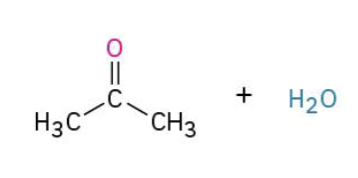
with H20

aldehydes are
more likely to hydralyze because they have a greater net + charge
hydration is
base or acid catalyzed
the catalyst that started the reaction comes out unchanged
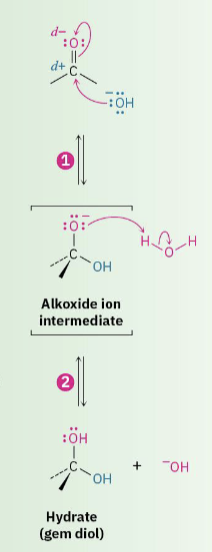
under basic conditions
a negatively charged nucleophile adds to the carbonyl group, giving an alkoxide ion intermediate. alkoxide intermediate takes H from H2O, makes compound with 2 alcohol groups
under acidic conditions
protonation of the carbonyl group happens first, then neutral nucleophile is added and subsequent deprotonation occurs
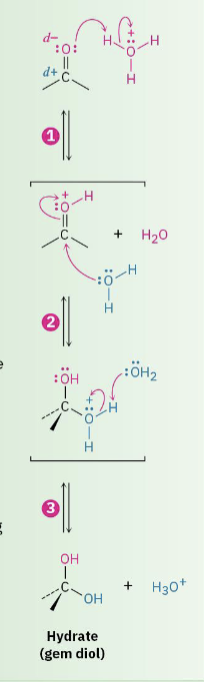
H3O catalyzer emerges unchanged
cyanohydrin formation

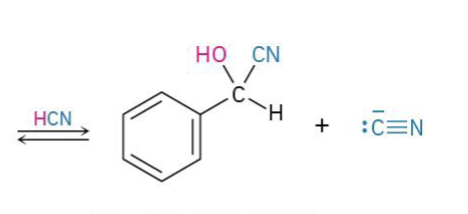
ex. catalyst that started reaction comes out unchanged
nucleophilic addition
cyanohydrin reaction with LiAlH4, THF


make a primary amine
cyanohydrin reaction with H3O+


make a carboxylic acid
Pinner reaction
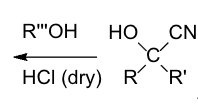
this yields a pie bond to N and a + charge on N, R OH adds to C in C pie N
then react with water to replace pie N+ with O pie!
yields an ester

Imine formation with 1’ ketone

react 1’ ketone with H2N-CH3

Eamine formation

if alpha carbon is avaliable
double bond on more substituted side!

makes alkene bond!
when to form imine vs. eamine
1’ amine (reagent) = form an imine

2’ amine (reagent) = form an eamine
