Orgo Exam 2

0.0(0)
Studied by 0 people
call kaiCall Kai
learnLearn
examPractice Test
spaced repetitionSpaced Repetition
heart puzzleMatch
flashcardsFlashcards
GameKnowt Play
Card Sorting

1/15

encourage image

There's no tags or description

Looks like no tags are added yet.

16 Terms

1
New cards

addition of hydrogen halides (XH)

  • markovnikov product

  • mechanism:

    • alkene + H-Br

    • alkene looks for more positive = H

    • arrow from double bond to H, arrow from H-Br bond to Br

    • H adds to least subst. carbon in double bond b/c positive charge is more stable on more subst. carbon

    • Br- attacks the carbocation

  • forming carbocation so rearrangement possible


<ul><li><p>markovnikov product</p></li><li><p>mechanism:</p><ul><li><p>alkene + H-Br</p></li><li><p>alkene looks for more positive = H</p></li><li><p>arrow from double bond to H, arrow from H-Br bond to Br</p></li><li><p>H adds to least subst. carbon in double bond b/c positive charge is more stable on more subst. carbon</p></li><li><p>Br- attacks the carbocation</p></li></ul></li><li><p>forming carbocation so rearrangement possible</p></li></ul><p></p>
2
New cards

free radical addition of HBr

  • anti-markovnikov

  • in presence of peroxide, HBr forms free radicals

  • start with Br radical + alkene

  • double bonds breaks, one arrow to each carbon, Br joins with least subst carbon bc radical more stable on more subst carbon

  • H-Br attacks radical on carbon and H adds to radical


<ul><li><p>anti-markovnikov</p></li><li><p>in presence of <strong>peroxide</strong>, HBr forms free radicals</p></li><li><p>start with Br radical + alkene</p></li><li><p>double bonds breaks, one arrow to each carbon, Br joins with least subst carbon bc radical more stable on more subst carbon</p></li><li><p>H-Br attacks radical on carbon and H adds to radical</p></li></ul><p></p>
3
New cards

Addition of Water: Hydration of Alkenes

  • alkene reacts with water in presence of strong acid to form alcohol

  • reagents: —>(H+ on top, H2O on bottom)

  • markovnikov products

  • forming carbocation so can have markovnikov rearrangements

  • H+ first reacts with alkene —> attaches to less subst carbon

  • carbocation formed on more subst. carbon

  • H2O attacks carbocation —> another H2O attacks to neutralize


<ul><li><p>alkene reacts with water in presence of strong acid to form alcohol</p></li><li><p>reagents: —&gt;(H+ on top, H2O on bottom)</p></li><li><p>markovnikov products</p></li><li><p>forming carbocation so can have markovnikov rearrangements</p></li><li><p>H+ first reacts with alkene —&gt; attaches to less subst carbon</p></li><li><p>carbocation formed on more subst. carbon</p></li><li><p>H2O attacks carbocation —&gt; another H2O attacks to neutralize</p></li></ul><p></p>
4
New cards

Addition of Water/OH: Hydration by oxymercuration-demurcuration

  1. no carbocation formed —> no rearrangements

  2. follows markovnikov product

  3. anti-addition = have to write both enantiomer

  4. reagents:(1. Hg(OAc)+, H2O, 2.NaBH4)

  5. Hg(OAc)+, H2O —> Hg(OAc) forms triangle ring with carbons, water attacks more subst. carbons

  6. opens ring with Hg(OAc)+, H2O on more subst carbon, Hg(OAc)+ becomes neutral

  7. another H2O molecule attacks oxonium to make it neutral

  8. with NaBH4 —> replaces Hg(OAc) with H


<ol><li><p>no carbocation formed —&gt; no rearrangements</p></li><li><p>follows markovnikov product</p></li><li><p>anti-addition = have to write both enantiomer</p></li><li><p>reagents:(1. Hg(OAc)+, H2O, 2.NaBH4)</p></li><li><p>Hg(OAc)+, H2O —&gt; Hg(OAc) forms triangle ring with carbons, water attacks more subst. carbons</p></li><li><p>opens ring with Hg(OAc)+, H2O on more subst carbon, Hg(OAc)+ becomes neutral</p></li><li><p>another H2O molecule attacks oxonium to make it neutral</p></li><li><p>with NaBH4 —&gt; replaces Hg(OAc) with H</p></li></ol><p></p>
5
New cards

Addition of Water/OH: alkoxymercuration-demercuration

  • mercuration taking place in alcohol (R-OH) solvent, alcohol = nucleophile —> attacks mercurinium

  • markovnikov product

  • anti-addition

  • reagents: —> (1. Hg(OAc)+, H2O, 2.NaBH4)

  • alchohol attacks more subst carbon and opens Hg(OAc) ring —> alcohol atacks alochol attached again to make it neutral

  • NaBH4 attacks to replace Hg(OAc) with H

  • have to write both enantiomers bc anti addition


<ul><li><p>mercuration taking place in alcohol (R-OH) solvent, alcohol = nucleophile —&gt; attacks mercurinium</p></li><li><p>markovnikov product</p></li><li><p>anti-addition</p></li><li><p>reagents: —&gt; (1. Hg(OAc)+, H2O, 2.NaBH4)</p></li><li><p>alchohol attacks more subst carbon and opens Hg(OAc) ring —&gt; alcohol atacks alochol attached again to make it neutral</p></li><li><p>NaBH4 attacks to replace Hg(OAc) with H</p></li><li><p>have to write both enantiomers bc anti addition</p></li></ul><p></p>
6
New cards

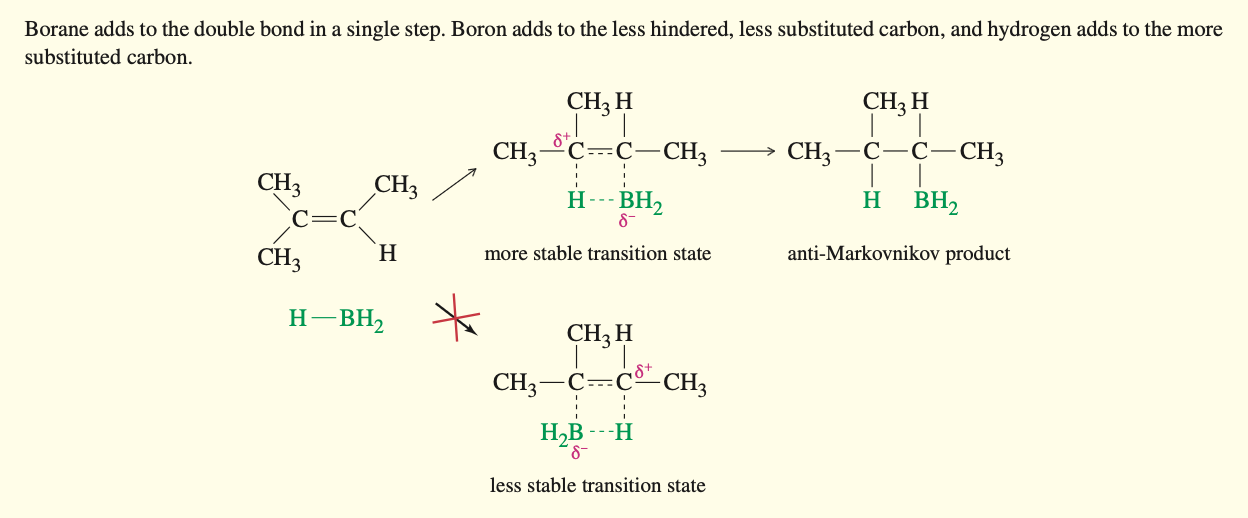
Addition of Water/OH: Hydroboration of Alkenes

  • anti-markovnikov alcohol —> if want OH on least subst carbon

  • reagents: —> (1. BH3 THF, 2. H2O2, OH-)

  • BH3 breaks double bond —> BH2 attaches to least subst carbon, H attaches to more subst C

  • H2O2, OH- —> OH replaces BH2 to least subst carbon

  • if double bond is in cycloalkene/ring has alkyl subst (methyl, ethyl, etc) the alchohol will be trans of it —> have to write both produts

    • OH will be trans of alkyl


<ul><li><p>anti-markovnikov alcohol —&gt; if want OH on least subst carbon</p></li><li><p>reagents: —&gt; (1. BH3 THF, 2. H2O2, OH-)</p></li><li><p>BH3 breaks double bond —&gt; BH2 attaches to least subst carbon, H attaches to more subst C</p></li><li><p>H2O2, OH- —&gt; OH replaces BH2 to least subst carbon</p></li><li><p>if double bond is in cycloalkene/ring has alkyl subst (methyl, ethyl, etc) the alchohol will be trans of it —&gt; have to write both produts</p><ul><li><p>OH will be trans of alkyl</p></li></ul></li></ul><p></p>
7
New cards

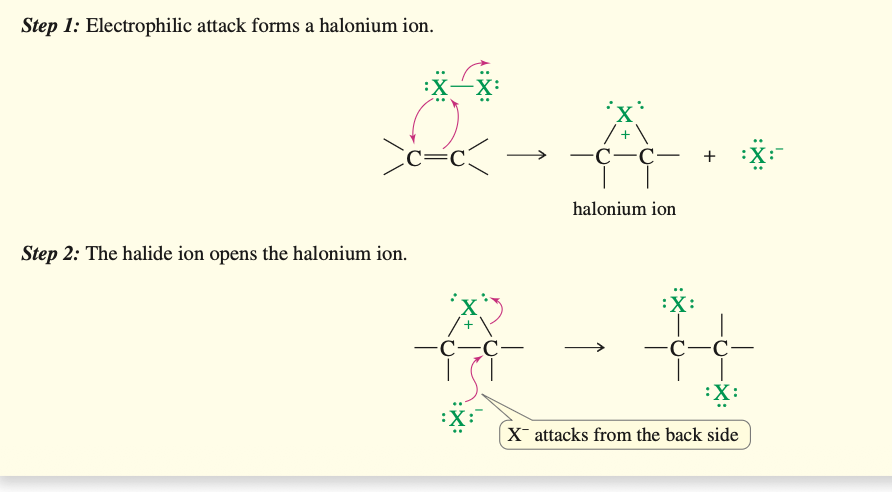
Addition of Halogens to Alkenes

  • add to double bond to form vicinal dihalide

  • usually anti-addition

  • Mechanism:

    • alkene + X2 (ex. Br2)

    • One of the Br’s forms bond with double bond to make a ring, other Br in bond expelled

    • Br in ring is positive, Br- that was expelled does backside attack —> results in anti-sterochemistry

    • Br- attacks more subst carbon

  • can’t be asked stereochemistry in non-ring, Br just has to be on opposite side, in ring Br are trans (one wedge on dash) —> have to draw both products

<ul><li><p>add to double bond to form vicinal dihalide</p></li><li><p>usually anti-addition</p></li><li><p>Mechanism:</p><ul><li><p>alkene + X2 (ex. Br2)</p></li><li><p>One of the Br’s forms bond with double bond to make a ring, other Br in bond expelled</p></li><li><p>Br in ring is positive, Br- that was expelled does backside attack —&gt; results in anti-sterochemistry</p></li><li><p>Br- attacks more subst carbon</p></li></ul></li><li><p>can’t be asked stereochemistry in non-ring, Br just has to be on opposite side, in ring Br are trans (one wedge on dash) —&gt; have to draw both products</p></li></ul><p></p>
8
New cards

Formation of Halohydrins

  • halohydrin: compound that contains a halogen atom (such as chlorine, bromine, or iodine) and a hydroxyl group (–OH) attached to adjacent (neighboring) carbon atoms

  • halogen added in the presence of water

  • markovnikov product

  • anti-addition —> have to write both products

    • OH and halogen will always be opposite (one wedge other dash)

  • reagents: —> (Halogen on top, H2O bottom)

  • halogen attaches to least subst carbon in double bond, H2O to most subst carbon

  • have to write both enantiomers


<ul><li><p>halohydrin: compound that contains a halogen atom (such as chlorine, bromine, or iodine) and a hydroxyl group (–OH) attached to adjacent (neighboring) carbon atoms</p></li><li><p>halogen added in the presence of water</p></li><li><p>markovnikov product</p></li><li><p>anti-addition —&gt; have to write both products</p><ul><li><p>OH and halogen will always be opposite (one wedge other dash)</p></li></ul></li><li><p>reagents: —&gt; (Halogen on top, H2O bottom)</p></li><li><p>halogen attaches to least subst carbon in double bond, H2O to most subst carbon</p></li><li><p>have to write both enantiomers</p></li></ul><p></p>
9
New cards

Catalytic Hydrogenation

  • adding H2 across double bond in presence of catalyst (Cd, Ni, Pd, Pt, Rh)

  • reagents: —> (H2 on top, catalyst on bottom)

  • syn addition

  • alkene —> (H2 on top, catalyst on bottom) then double bonds breaks and H added to each carbon in double bond, H will be syn —> draw both products of both wedge and both dash


<ul><li><p>adding H2 across double bond in presence of catalyst (Cd, Ni, Pd, Pt, Rh)</p></li><li><p>reagents: —&gt; (H2 on top, catalyst on bottom)</p></li><li><p>syn addition</p></li><li><p>alkene —&gt; (H2 on top, catalyst on bottom) then double bonds breaks and H added to each carbon in double bond, H will be syn —&gt; draw both products of both wedge and both dash</p></li></ul><p></p>
10
New cards

Addition of Carbenes: Simmons Smith Reaction

  • reagent: CH2ZnI2

  • —> (CH2ZnI2 on top; Zn, CuCl on bottom)

  • 3 reagents togethers form 3 carbon ring


<ul><li><p>reagent: CH2ZnI2</p></li><li><p>—&gt; (CH2ZnI2 on top; Zn, CuCl on bottom)</p></li><li><p>3 reagents togethers form 3 carbon ring</p></li></ul><p></p>
11
New cards

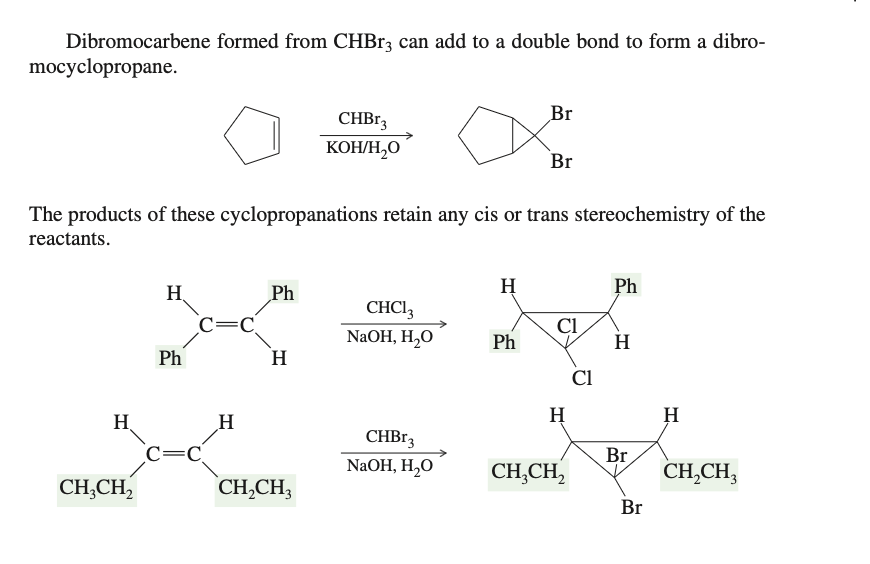
Addition of Carbenes: Formation of Carbenes by Alpha Elimination

  • forms carbene ring with two halogens

  • reagents: —> (CHBr3 on top; KOH/H2O on buttom)

  • retains any cis/trans stereochemistry of the alkenes it had —> if it was cis then write both products of both groups in wedge and then both in dash

<ul><li><p>forms carbene ring with two halogens</p></li><li><p>reagents: —&gt; (CHBr3 on top; KOH/H2O on buttom)</p></li><li><p>retains any cis/trans stereochemistry of the alkenes it had —&gt; if it was cis then write both products of both groups in wedge and then both in dash</p></li></ul><p></p>
12
New cards

Epoxidation of Alkenes

  • alkene reacts with peroxyacid in one step to form epoxide and and carboxylic acid

  • peroxyacid has extra oxygen it can donate —> most common = mCPBA

  • regants: (mCPBA on top; Ch2Cl3 on bottom)

  • alkene —> (mCPBA on top; Ch2Cl3 on bottom) makes ring with oxygen (epoxide)

  • retains stereochemistry of the alkene —> have to write both products


<ul><li><p>alkene reacts with peroxyacid in one step to form epoxide and and carboxylic acid</p></li><li><p>peroxyacid has extra oxygen it can donate —&gt; most common = mCPBA</p></li><li><p>regants: (mCPBA on top; Ch2Cl3 on bottom)</p></li><li><p>alkene —&gt; (mCPBA on top; Ch2Cl3 on bottom) makes ring with oxygen (epoxide)</p></li><li><p>retains stereochemistry of the alkene —&gt; have to write both products</p></li></ul><p></p>
13
New cards

Acid Opening of the Epoxides

  • makes anti-diol/anti-addition

  • have epoxide react with H3O+ —> H+ adds to Oxygen in epoxide —> oxygen now positive

  • backside attach of H2O on more subst carbon in the ring —> opens the ring

  • another H2O attacks to neutralize the previous H2O

  • both OH are anti


<ul><li><p>makes anti-diol/anti-addition</p></li><li><p>have epoxide react with H3O+ —&gt; H+ adds to Oxygen in epoxide —&gt; oxygen now positive</p></li><li><p>backside attach of H2O on more subst carbon in the ring —&gt; opens the ring</p></li><li><p>another H2O attacks to neutralize the previous H2O</p></li><li><p>both OH are anti</p></li></ul><p></p>
14
New cards

Syn Dihydroxylation of Alkenes

  • want cis diol

  • two types of reagents

    • OsO4

    • cold, dilute solution of KMnO4 in base

  • —> (OsO4 or KMnO4, H2O2)

  • —> (KMnO4 on top; cold or diluted on bottom)

  • syn addition of OH, breaks carbene


<ul><li><p>want cis diol</p></li><li><p>two types of reagents</p><ul><li><p>OsO4</p></li><li><p>cold, dilute solution of KMnO4 in base</p></li></ul></li><li><p>—&gt; (OsO4 or KMnO4, H2O2)</p></li><li><p>—&gt; (KMnO4 on top; cold or diluted on bottom)</p></li><li><p>syn addition of OH, breaks carbene</p></li></ul><p></p>
15
New cards

Oxidative Cleavage of Alkenes: Cleavage by KMnO4

  • reagent: warm, acidic, or concentrated KMnO4 produces oxidative cleavage: C=C cleaved into two C=O

  • reagent: —> (KMnO4 on top; concen. or warm or dilute on bottom)

  • break C=C , add double bond to Oxygen to both carbons

    • if ketone (no hydrogen attached to C) —> can leave as is

    • if aldehyde (hydrogen attached to C) —> have to oxidize to OH (whole thing is COOH)

    • if CH2 (terminal carbon, 2 hydrogens attached to C), make that a double bond to O and get CO2 (losing a carbon basically)


<ul><li><p>reagent: warm, acidic, or concentrated KMnO4 produces oxidative cleavage: C=C cleaved into two C=O</p></li><li><p>reagent: —&gt; (KMnO4 on top; concen. or warm or dilute on bottom)</p></li><li><p>break C=C , add double bond to Oxygen to both carbons</p><ul><li><p>if ketone (no hydrogen attached to C) —&gt; can leave as is</p></li><li><p>if aldehyde (hydrogen attached to C) —&gt; have to oxidize to OH (whole thing is COOH)</p></li><li><p>if CH2 (terminal carbon, 2 hydrogens attached to C), make that a double bond to O and get CO2 (losing a carbon basically)</p></li></ul></li></ul><p></p>
16
New cards
<p>Oxidative Cleavage of Alkenes: Ozonolysis</p>

Oxidative Cleavage of Alkenes: Ozonolysis

  • ozone cleaves double bond to make ketones and aldehydes —> don’t get oxidized into acids

  • same as Cleavage by KMnO4 except no extra oxidation step can leave H as is if aldehyde

  • if terminal carbon, still make it into a double bond with O, but get H2C=O instead of CO2