C18 - Organic Chemistry III
 Call Kai
 Learn
 Practice Test
 Spaced Repetition
 Match
 Flashcards
 Knowt Play
1/16

There's no tags or description
Looks like no tags are added yet.
17 Terms
Benzene and arenes
Arenes
Contain benzene rings
Benzene
Has a planar ring structure

Delocalised model
Arises from the overlap of p-orbitals on six carbon atoms in benzene
Each carbon contributed one electron from its 2p orbital to a pi bonding
P orbitals overlap side-by-side around the ring
Delocalised rings of 6 pi electrons
Creates an electron density above and below the plane of carbon atoms
Electrons are not fixed but rather are delocalised
Leads to equal C-C bond length and enhanced stability

Evidence 1
Equivalent C-C bond lengths
X-ray diffraction revealed that all C-C bonds measure 140pm in length
Length sits between length of typical C-C bond and C=C bond
Contradicts Kekule model
Would suggest alternating lengths for single and double bonds
Evidence 2
Enthalpy of hydrogenation
Hydrogenation of cyclohexane has enthalpy change of -120
If there were 3 double bonds, there would be change of enthalpy of -360
However the actual enthalpy change is only -208
Indicates that breaking the bonds in benzene requires more energy
More stable than Kekule model
Evidence 3
Benzene is resistant to these reactions
Due to the delocalised electron system which stabilised the benzene ring and makes it less reactive towards electrophiles
Kekule model would predict benzene to be more reactive
Like alkenes
Naming aromatic compounds
Substituted benzene
Substituents precede the word benzene
Phenyl derivatives

Difference in benzene and alkene reactivity
Alkenes readily undergo addition reactions
Localised pi system around the C=C has sufficient electron density to polarise the Br-Br bond
Benzenes prefer substitution over addition
These preserve the aromatic ring's integrity
The delocalised pi system across the ring has insufficient electron density to polarise the Br-Br bond
Heat and a catalyst are needed
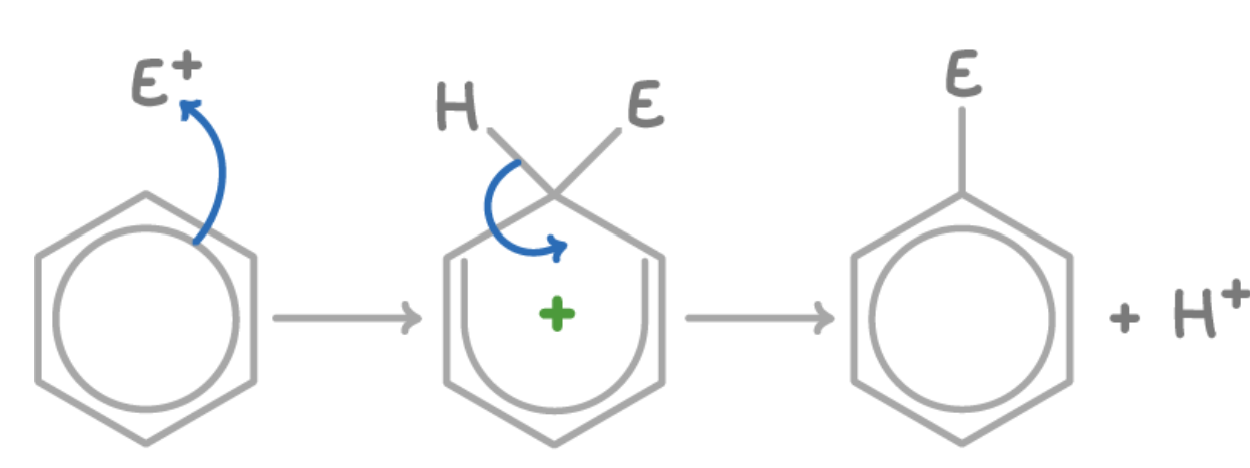
Electrophilic substitution
Involves a hydrogen atom being replaced by an electrophile
Two stages
Addition of the electrophile to the benzene ring
Breaks the aromaticity and forms a positively charged intermediate
Loss of H+
Reforms the aromatic benzene ring with the electrophile substituted in place of H
Halogen carriers
Electrophile has to have a strong positive charge to be able to attack the stable benzene ring
Most compounds aren't polarised enough
Halogen carriers
Some compounds can be made into stronger electrophiles using a catalyst
Catalyst is called a halogen carrier
Accepts the lone pair of electrons from a halogen atom on an electrophile
Polarisation of molecule increases
Sometimes a carbocation forms, making electrophile stronger
AlCl3 + Cl2 ➔ Cl+ + AlCl4-
AlCl3 + Br2 ➔ Br+ + AlCl3Br-
Halogenation of benzene
Electrophilic substitution
Can be carried out by reacting benzene with halogen molecules in presence of halogen carriers
Chlorination
Chlorine reacts with aluminium chloride (or FeBr3) catalyst to form Cl+ ion
Benzene undergoes electrophilic substitution with the electrophile Cl+, displacing a proton and forming chlorobenzene
Displaced proton reacts with AlCl4- to form AlCl3 and HCl
Nitration of benzene
Electrophilic substitution of a nitro group (NO2)
Done in the presence of a concentrated H2SO4 catalyst
Nitration
Formation of nitronium ion
HNO3 + H2SO4 ➔ NO2+ + HSO4- + H2O
Benzene undergoes electrophilic substitution displacing a proton
Proton reacts with HSO4- to regenerate the H2SO4
Cooling the nitration reaction to less than 60 ensures that only mononitration occurs
Friedel-Crafts
Form C-C bonds using reflux and a halogen carrier
Two types
Friedel-Crafts alkylation
Puts any alkyl group onto a benzene ring using a haloalkane and a carrier
Acylation
Substitutes an acyl group for an H atom on benzene using an acyl chloride and halogen carrier
Produces phenyl-ketones or benzaldehydes
F-C Alkylation
Formation of electrophilic methyl carbocation intermediate
CH3Cl + AlCl3 ➔ CH3+ + AlCl4-
Electrophilic substitution occurs on benzene
Proton reacts with AlCL4- to regenerate AlCl3 catalyst and HCl
F-C Acylation
Formation of electrophilic acetyl cation intermediate
CH3COCl + AlCl3 ➔ CH3CO+ + AlCl4-
Electrophilic substitution occurs on benzene
Proton reacts with AlCl4- to regenerate the AlCl3 catalyst and HCl
Combustion of benzene
When burnt in oxygen, complete combustion occurs
C6H6 + 7.5O2 ---> 6CO2 + 3H2O
When it is burnt in air, limited oxygen supply
Incomplete combustion
Smoky flame
Reaction of phenol
Reaction of the aromatic ring in phenols
Phenols react more readily with electrophiles than benzene
Because one of the lone pairs on the O in -OH overlaps with pi bonding system
Increases the electron density of the benzene ring
More susceptible to electrophilic attack
-OH group in phenols is activating and directs incoming electrophiles

Bromination of phenol
Phenols also undergo electrophilic reactions when reacted with bromine water at room temp
Phenol decolourises the orange bromine solution to form white precipitate
2,4,6 - tribromophenol