MC700 - Exam 2 FULL CONTENT
 Call Kai
 Learn
Learn Practice Test
 Spaced Repetition
 Match
Match Flashcards
 Knowt Play
1/314

Earn XP
Description and Tags
Cytotoxic Agents, Hormonal Therapies, Antiemetics
Name | Mastery | Learn | Test | Matching | Spaced | Call with Kai | Chat |
|---|
No analytics yet
Send a link to your students to track their progress
315 Terms
What are examples of cell cycle phase-nonspecific drugs?
Direct DNA damaging agents
What does cell cycle phase-nonspecific drugs mean?
They exert their actions anywhere in the cell cycle
What are the cell cycle phase-specific drugs?
microtubule inhibitors
topoisomerase inhibitors
antimetabolites
Where do microtubule inhibitors/stabilizers act?
M-phase
Where do topoisomerase inhibitors act?
S/G2 Phase
Where do antimetabolites act?
S-phase
What are the 3 types of DNA lesions caused by direct DNA damaging agents?
Interstrand/Intrastrand Crosslinks
O6 guanine methylation
oxygen-induced strand breaks
What types of agents cause Inter/Intrastrand crosslinks?
DNA crosslinkers such as nitrogen mustards, nitrosurea alkylating agents, platinum agents.
What types of agents cause O6 guanine methylation?
DNA methylators such as triazenes
What types of agents cause oxygen-inducd strand breaks?
Bleomycin, the only antitumor antibiotic that also damages DNA.
How do nitrogen mustards work? MOA":
They form covalent bonds with guanine by forming an electrophilic aziridium ion that will allow N7 of guanine to form nucleophilic attack and lead to crosslinking.
What are the active drugs in the class of nitrogen mustards?
Mechlorethamine, Chlorambucil and conjugates
What makes chlorambucil available as an oral medication as compared to mechlorethamine?
Chlorambucil is less reactive and can be administered orally due to increased stability. The nitrogen on chlorambucil is less electron rich due to the aromatic phenyls which thus lead to slower activation to the electrophilic aziridinium species
Where on guanine does nucleophilic attack occur for nitrogen mustards?
N7
What is the key electrophilic species for nitrogen mustards?
Aziridinium ion (+)
What is the nitrogen mustard conjugates we need to know?
Bendamustine: a benzimidazole conjugate designed to mimic purine nucleobases and exhibit DUAL funciton as an alkylating agent and an antimetabolite
What does interstrand crosslinking lead to?
Blocking of DNA replication AND RNA transcription
What is the dose limiting toxicity for most alkylating crosslinkers?
Myelosuppression
What are the prodrug Nitrogen Mustards?
Cyclophosphamide and Ifosfamide
What structural characteristic of Cyclophosphamide and Ifosfamide is there that prevents their spontaneous formation of the aziridinium ion?
THe P=O bond which is electron withdrawing
How is cyclophosphamide activated to the active species?
Via primarily CYP2B6 but also other cyps
What is the first metabolite formed by CYP2B6 on cytoxan?
4-hydroxy cyclophosphamide
What is the next step in activating cyclophosphamide?
Conversion to aldophosphamide
What is aldophosphamide then formed into to get the active version of cytoxan?
Phosphoramide mustard
How is cytoxan’s metabolites inactivated?
Through aldehyde dehydrogenase in the liver.
What toxic metabolite is also formed when cytoxan is activated?
Acrolein
What does acrolein do?
It causes inflammation of the bladder and acute hemorrhagic cystitis (blood in the urine)
Is acrolein a metabolite of both cytoxan and ifos?
YES
Which between the two has the greatest potential for cystitis: Ifos or Cytoxan
Ifosfamide
How do we protect from acute hemorrhagic cystitis by acrolein formation?
Give MESNA to react with and neutralize it
How can cytoxan be given?
Orally or IV
How can Ifosfamide be given?
Only IV
How does MESNA neutralize Acrolein?
The nucleophilic thiol group on MESNA competes with bladder protein thiols and attacks the electrophilic a, B unsaturated aldehyde on acrolein to block the cystitis
How is Ifosfamide activated?
Via CYPs
What is the active form of Ifosfamide?
Ifosfamide mustard
What additional metabolite (in addition to acrolein) does conversion of Ifosfamide produce?
Chloroacetaldehyde
What does chloroacetaldehyde do?
It is a CNS penetrating metabolite most associated with nephrotoxicity and CNS neurotoxicity (encephalopathy). Patients present with confusion, ataxia, seizures, coma and even death
Will MESNA work for the chloroacetaldehyde metabolite?
NO
What does treosulfan do as an alkyl sulfonate but still alkylating agent?
It forms a double epoxide which is a good electrophile to get attacked by N7 on guanine (x2 reaction)!
What is the nitrosourea alkylating agents?
Carmustine and Streptozotocin
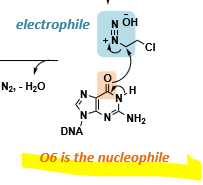
How does carmustine work?
It forms crosslinks in DNA by forming a diazonium (N triple bond to N) electrophilic ion that gets attacked by O6 of guanine as the nucleophile

What is the key pharmacore for nitrosourea drugs?
A nitroso (N=O) and a urea lol)
What does the chloroethyl substituent on nitrosoureas do?
It enhances anti-cancer activity and INCREASES LIPOPHILICITY TO ENABLE BBB PENETRATION
Because carmustine is highly lipid soluble and penetrates BBB what do you think it is used for?
Many brain cancers
What is another unique admin besides IV for carmustine?
Small biodegradable discs implanted into the brain (Gladiel wafers)
What is the dose limiting toxicity of carmustine when used systemically?
DELAYED myelosuppresion; nadir or lowest wbc count will appear at 4-6 weeks and recover is also slower
What is a unique toxicity of carmustine?
Pulmonary fibrosis which is dose-related and cumulative
What is streptozotocin?
A nitrosourea (natural) that is conjugated to a glucose-like sugar.
What is unique about streptozotocin in relation to its MOA?
Because of the glucose it can selectively enter pancreatic beta cells via GLUT2 and be used to treat specifically metastatic cancers of pancreatic islet cells.
What is the last class of agents in relation to DNA alkylators?
Platinum agents
What are our platinum agents?
Cisplatin, Carboplatin and Oxaliplatin
What is the MOA of platinum agents?
React with water inside cells to form reactive platinum complexes (electrophilic) that bind to N7 of guanines and form intra and interstrand DNA crosslinks
What is the SAR considerations for platinum agents?
All contain a Pt inert metal and good leaving groups that are CIS to one another
What is the active species consideration for platinum agents?
MUST be in the 2+ charge state which occurs by displacing leaving groups and forming water complexes (they take the place of the leaving groups)
Explain why Cisplatin is very highly reactive in cells but stable in the blood?
Cisplatin has chloride leaving groups which are stable in the blood because of the high chloride concentration in the blood, but in cells there is lower chloride concentration which thus permits a rapid reaction with water.
T/F: Cisplatin is the most toxic platinum agent due to its high rate of activation and reactivity.
True
How does carboplatin’s activation compare to cisplatin?
Carboplatin has a more stable dicarboxylate ligand leading to slower activation and less toxicity.
How does oxaliplatin’s SAR compare to the other two platinum agents?
Oxaliplatin has an oxalate and a diaminocyclohexane ligand which forms bulkier crosslinks due to the increased size of the latter and is more stable than cisplatin’s leaving groups but more reactive compared to carboplatin’s leaving groups.
What does this SAR mean for oxaliplatin’s usefullnes as an agent?
It has notable activity to resistant cancers in cisplatin and carboplatin!
What is the dose limiting toxicity for Cisplatin?
Peripheral neuropathy and is dose dependent and cumulative as well as nephrotoxicity which is also dose dependent and cumulative
How do we manage the nephrotoxicity effect of cisplatin?
With IV hydration before and after administration
What is another unique toxicity to Cisplatin?
Ototoxicity which can be IRREVERSIBLE and is most notable in peds patients.
What is the dose limiting toxicity of carboplatin?
Myelosuppression which is dose-dependent and due to its super longer half life
What is the dose limiting toxicity of Oxaliplatin?
Peripheral neuropathy but this is ACUTE and COLD-triggered and REVERSIBLE compared to cisplatin’s.
What are a classwide adverse effect of platinum agents?
Hypersensitivity reactions of the classic type I IgE Mediated, mild reactions include pruritus of the palms and soles, flushing and hives, while severe include abdominal pain, nausea, diarrhea, chest or throat tightness, dyspnea, angioedema, hypotension and anaphylactic shock
T/F: We can test for platinum hypersensitivity and patients can also be allergic to more than one platinum agent at a time.
True
What are our triazene drugs?
Dacarbazine and Temozolomide
What is the MOA of our DNA methylators or triazenes?
They release a common metabolite that methylates guanines at the O6 position, creating a mutagenic and toxic base in DNA.
What is the name of the common metabolite that both dacarbazine and temozolomide form to then methylate O6 guanine?
MTIC

What is the key electrophilic species of MTIC that is formed from it to then exert action?
Diazomethane
T/F: DNA methylation can also occur at N7 of guanine for cytotoxic effects by Temozolomide or Dacarbazine.
FALSE if we methylate there, it is NON cytotoxic, whereas O6 is the only cytotoxic area.
T/F: Both dacarbazine and temozolomide are prodrugs
True
How is dacarbazine activated?
Via CYPs
How is temozolomide activated?
Via reaction with H2O
What is unique about temozolomide that overcomes the challnges associated with dacarbazine?
improved hydrophobicity and absorption leading to both oral and IV admin.
No photosensitivity AE
Why is the O6 methylguanine of DNA methylators such a fatal lesion?
A:T transition mutations by mispairing with T; futile MMR repeatedly removes T without fixing O⁶-meG, causing DNA breaks and cell death. (endless loop of T insertion and removal without actually fixing the methylated guanine)
What are mechanisms of resistance to DNA alkylators (nitrogen mustards, nitrosureas and platinum agents)
Inactivation of the drugs through increased production of glutathione or increased glutathione-S-transferase
Upregulation of DNA repair pathways like nucleotide excision repair, which directly removes the lesions.
What are mechanisms of resistance to DNA methylators (Dacarbazine and Temozolomide)
Upregulation of O6 methylguanine DNA methyl-transferase (MGMT) which removes the methyl group from guanine directly and leads to resistance.
Loss of mismatch repair function (escaping the endless cycle and surviving cancer cells)
Which Direct DNA Damaging agents are highly emetogenic?
Cisplatin (but all platinums to an extent)
Carmustine
Bendamustine
High-dose Cytoxan
Ifos
Dacarbazine
Temozolomide
What are some other common toxicities associated with direct DNA damaging agents?
DLT is usually myelosuppresion (EXCEPT CIS AND OXALI), very emetogenic, mucosal and hair follicle toxicities, vesicants (can cause local tissue damage, blistering, and necrosis), infertility and sterility, can develop secondary cancers (dacarbazine and temozolomide)
What is Bleomycin?
An antitumor antibiotic that chelates Ferrous (Fe2+ iron) and interacts with O2 to generate a DNA cleaving agent, leading to single and double strand DNA breaks.

What region on Bleomycin is responsible for DNA binding?
The rightmost region with the nitrogen sulfur rings.

What region on Bleomycin is responsible for solubility and cell permeability?
The sugar-like portion on the bottom

What are the Fe2+ coordination ligans on bleomycin?
The many nitrogens
What is the active species of bleomycin?
BLM-Fe3+-OOH, through oxidation to ferric peroxy complex. It generates oxygen free radicals that damage the phosphodiester backbone of DNA.
What is a unique property of bleomycin?
It causes very little myelosuppression which is an advantage for its use in combination therapy.
What is the dose limiting toxicity for bleomycin?
pulmonary fibrosis and is CUMULATIVE (it is highly active in all tissues except the lung which is why there might be organ toxicity)
How do we manage the pulmonary fibrosis AE of bleomycin?
STEROIDS
How is bleomycin inactivated?
By hydrolases (cystein peptidases)

What is calicheamicin?
It is a member of the enediyne (coffin like structure) family that is TOO TOXIC to be a drug on its own, but is used in ADCs.
How does calicheamicin work?
It generates a key radical intermediate after undergoing intramolecular cyclization to generate double strand DNA breaks.
What are antimetabolites?
They are chemicals that inhibit the use of an endogenous metabolite (i.e nucleobases and nucleosides or folate)
What are our nucleobase and nucleoside analogues antimetabolites?
6MP
Cytarabine
5FU
Capecitabine (Xeloda)
What is 6MP an inhibitor of?
Purine metabolism
How does 6 MP work?
It incorporates into DNA causing DNA damage.
What are the steps in 6MP MOA?
6-mercapto purine is converted to 6-mercapto-IMP, a nucleotide (one phosphate) by HPRT
IMP is then converted to GMP via adding an NH2 group HPRT
Nucleotide kinase adds a second phosphate group to form 6-mercapto GDP
ribonucleotide reductase removes the 2-hydroxyl to form 6-mercapto deoxyGDP and covert from ribose to deoxyribose sugar
nucleotide kinase adds a 3rd phosphate group to form 6-mercaptodeoxyGTP and can incorporate now into DNA to exert effects


What additional MOA does 6-mercaptopurine also have?
Inhibition of de novo purine biosynthesis by 6-methylmercapto IMP inhibiting PRPP amidotransferase.
What are the two ways of inactivating 6-MP?
Xanthine oxidase (allopurinol DDI!) leading to oxidation
S-methyl transferase (TPMT) leading to methylation
6MP has many MOAs. What is the main one that is most recognized as cytotoxic?
Incorporation of 6-thio-dGTP into DNA.
T/F: 6-thio-dGTP incorporation has a similar cytotoxic and mutagenic effect as dacarbazine and temozolomide
True, it basically attempts to fix the mismatched base only to have it reincorporated because 6-thiodGTP is stuck in there.