117: Partition Coefficient pt 1
 Call Kai
 Learn
 Practice Test
 Spaced Repetition
 Match
 Flashcards
 Knowt Play
1/34

There's no tags or description
Looks like no tags are added yet.
35 Terms
Partition Coefficient
how a drug distributes at equilibrium btw 2 iisicble phases
octanol (lipid-like) & water
at a fixed temp using only neutral, UN-Ionized form
partiion coefficient is independent of what
concentration, within dilute limits
what does partiion coefficient reflect
a molecule's intrinsic lipophilicity (fat-loving) versus hydrophilicity (water-loving) character.
P = [C] octanol / [C] water
logP = log10(P)
meaning of P values
P >1: compound favors organic (octanol), lipophilic phase
P=1: equal affinity for both phases
P<1: compound favors aqueous phase, hydrophilic
why is n-Octanol the standard ref solvent
mimics the amphipathic environment of biological membranes better than any simpler alternative
octanol amphipathic structure
Its long hydrocarbon tail (lipophilic) and polar hydroxyl head (capable of H-bonding) resemble phospholipids in cell membranes
Why does water-saturated octanol retain water?
Holds approximately 2 M water, allowing hydrogen bonding with polar solutes and mimicking a real membrane environment
Why is octanol considered a historical standard?
Used for decades in regulatory and pharmacological studies (Hansch and Lipinski) to provide standardized drug comparisons.
What properties of octanol make it easy to work expeerimentally?
Low volatility
Low water solubility
UV transparency
Why can LogP be misleading for drugs at physiological pH?
measures only the neutral form of a drug.
Most drugs partially ionize at physiological pH (7.4)
ionized forms are charged, prefer water, and partition poorly into octanol.
Log P vs Log D
LogP: Constant; measures lipophilicity of the neutral drug only and does not change with pH.
LogD: Variable; measures effective lipophilicity at a specific pH, accounting for both ionized and unionized forms.
what happens w/ non-ionizable compounds (or fully un-ionized)
LogD = LogPat every pH
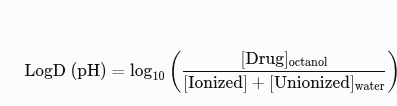
log D ((distribution coefficient)

logP<0
Highly polar / water-soluble
Poor membrane permeability; often renally excreted quickly
logP 0-3
most oral drug
balanced/ drug-like
hydrophilic enough to stay in solution
lipophilic enough to cross mem
log P >5
Highly lipophilic
Risk of poor solubility, high protein binding, toxicity, bioaccumulation
log P values ref

what increases logP (lipidphilic)
Longer alkyl / aliphatic chains (each -CH2- adds ~0.5)
Aromatic rings and halogens (Cl, Br, I)
Branching and increased molecular bulk
Fewer hydrogen bond donors/acceptors
what decreases logP
Ionizable groups
(-COOH, -NH2) when charged
Hydroxyl (-OH), amine, and amide groups
Hydrogen bond donors and acceptors
Polar functional groups
(-CN, -NO2 to a lesser extent)
what shapes a drug’s journey thru body at every step
lipophilicty
Absorption logP
high, improves passive diffusion acx gut wall
too high can harm dissolution in gut fluid
Distribution
Lipophilic drugs partition into fatty tissue and cross the blood-brain barrier more readily;
hydrophilic drugs stay in plasma/extracellular fluid.
Metabolism
Lipophilic compounds are typically better substrates for CYP450 oxidation,
- faster hepatic clearance.
Excretion
Hydrophilic drugs (and lipophilic drugs after metabolism to polar
metabolites) are more readily cleared renally.
How Is Partition Coefficient Measured?
Shake-Flask Method
RP-HPLC Retention
Computational (in silico)
Shake-Flask Method
Classic reference method
• Drug shaken to equilibrium in octanol + buffered water
• Phases assayed by UV/HPLC
• Best for log P range −2 to 4
RP-HPLC Retention
Retention time on C18 column correlates with log P
• Fast, small sample size
• Calibrated against reference standards
• Good for high-throughput screening
Computational (in silico)
• Fragment-based: ClogP, AlogP
• Atom-based & QSPR models
• No compound needed — used pre-synthesis
• Guides early drug design choices
Incomplete Phase Separation
Residual emulsification traps droplets of one phase in the
other, contaminating the assay of both
Insufficient Equilibration Time
Stopping before true equilibrium under-estimates transfer into the organic phase, especially for larger molecules
Wrong Solvent System
Octanol may not represent every biological barrier —
skin, GI mucus, and CNS membranes can need different
reference solvents.
Uncontrolled / Unbuffered pH
Without a buffer, ionization shifts mid-experiment, turning a P measurement into an uncontrolled mix of P and D.
Interfacial Adsorption
Surface-active solutes adsorb at the oil-water interface rather than truly partitioning, inflating apparent recovery
Temperature Drift
KD is temperature-dependent; assays run at inconsistent temperatures are not directly comparable