16.2- plant reponse to abiotic stress
 Call Kai
 Learn
 Practice Test
 Spaced Repetition
 Match
 Flashcards
 Knowt Play
1/13

There's no tags or description
Looks like no tags are added yet.
14 Terms
example of a abiotic stresses
change in day length
Temperature
Lack/excess water
High winds
Change in salinity
What are abiotic stresses?
Anything that’s harmful to a plant but is non-living
Why are plants photoperiodism?
They are sensitive to a lack of light
What are phytochromes
Plant pigments that react to different types of light
In what two forms do phytochrome live in?
Pr and Pfr
What’s the Pr phytochrome?
It’s the inactive form of phytochrome and it absorbs light from the red part of the spectrum
What is the Pfr part of the phytochrome?
It’s the active form of phytochrome, it absorbs light from the far red part of the spectrum
What does the absorption of different wavelengths of light cause in terms of phytochromes?
Reversible conversion between the Pr and Pfr form of phytochrome. When Pr absorbs red light, it is converted into Pfr and when Pfr absorbs far red light it’s converted back into Pr
Why do deciduous trees loose their leafs?
Amount of glucose required for respiration to plantain the leaves and produce chemicals to protect them against the freezing is greater than the amount of glucose produced by photosynthesis. Loosing the leaf converses energy as they go dormant
What does auxins and ethene do in terms of leafs?
Auxins, produced by young laves inhabit leaf loss and ethene, produced by sharing leaves, stimulate leaf loss
What does falling levels of light do?
Cause failing concentration of auxins, and they respond by producing ethene
Abscicion zone on trees- image
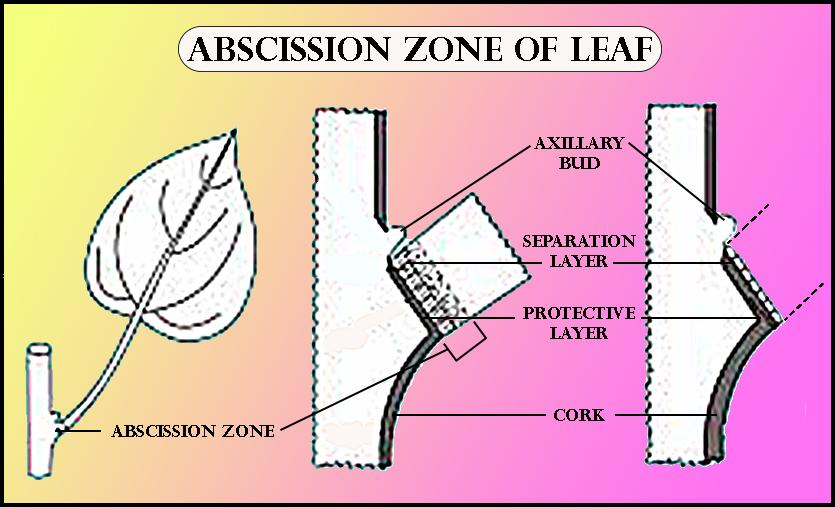
What are the two layers called in the abscision zone and what are they sensitive too?
Protective layer, and separation layer (closer to the leaf). They are sensitive to ethene
The process of trees loosing their leaves?
Ethene switches on gene causing the the production of new enzymes
The enzymes digest and weaken the cell walls in the outer layer of the abscission zone (separation layer).
The vascular bundles that carry materials into the leaf are sealed off
Fatty materials are deposited into the cell on the protective layer
This forms a protective scar when the leaf falls to prevent patoghen entering
Cells deep in the separation zone respond to hormones by retaining water and swelling (putting strain on the weakened outer layer)
Other biotic factors finish off the process leaving a waterproof scar